Advertisement






The Gulf conflict has disrupted global supply chains, pushed...
REITs have changed the way commercial real estate is owned a...
What really powers the cloud? Behind every Google search, A...
What really powers the cloud? Behind every Google search, A...
Luxury real estate is one of the most talked-about segments ...
Bhubaneswar is gaining prominence as an emerging real estate market, supported by infrastructure development, employment generation, urbanisation and growth in services-led industries. A CII-Knight Frank India report identified the Odisha capital among 11 emerging markets driving India's next phase of real estate growth. Residential property prices in the city rose 63% between 2021 and 2026, compared with 42% across India's eight largest metropolitan markets. Between 2016 and 2026, residential prices recorded a compound annual growth rate of 8%, twice the 4% registered by major metros. The city's expanding services economy, which accounts for approximately 50% of its GDP, is supporting demand across residential, commercial, retail, hospitality and warehousing segments. Premium housing demand is evident in locations such as Patia, Khandagiri and Chandrasekharpur, while more affordable residential options are gaining traction in suburban areas, including Pahal, Raghunathpur, Patrapara and Sundarpada.
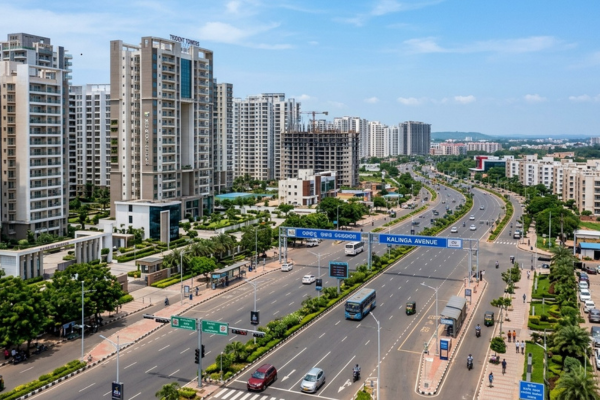
Bhubaneswar is emerging as a growing real estate market in eastern India, with residential property prices rising 63% between 2021 and 2026, according to a report by CII-Knight Frank India. The Odisha capital is among 11 emerging markets identified in the report as contributors to India's next phase of real estate growth, supported by expanding employment opportunities, infrastructure development, urbanisation and rising demand for contemporary housing and commercial spaces.
Odisha's economy has traditionally relied on minerals, steel, aluminium, power generation and heavy industry. However, the expansion of information technology, education, healthcare, financial services, start-ups and other knowledge-driven sectors is broadening the state's economic base. In Bhubaneswar, this diversification is generating employment, supporting disposable incomes and increasing demand for residential and commercial real estate.
Connectivity and urban infrastructure are also extending the city's development footprint beyond its established core. Bhubaneswar's airport provides national and international links, while road and rail networks connect the city with Cuttack, Puri, Khordha and industrial centres such as Jharsuguda and Rourkela. The wider Bhubaneswar Capital Region is expanding the geographical scope for residential and commercial development.
The city's participation in India's Smart Cities Mission has also brought planned development, digital governance, public amenities and technology-enabled civic management into focus. These developments are supporting growth in peripheral locations that are increasingly attracting residential and commercial projects.
The CII-Knight Frank India report found that Bhubaneswar's residential property prices recorded a compound annual growth rate (CAGR) of 8% between 2016 and 2026. This was double the 4% CAGR recorded across India's major metropolitan markets over the same period. The 63% increase in residential prices during 2021–2026 also exceeded the 42% growth registered across the country's eight largest metropolitan markets.
The report attributed the city's real estate momentum to infrastructure and connectivity improvements, employment creation, the expansion of services and micro, small and medium enterprises (MSMEs), skilled talent availability and rising consumption. Bhubaneswar's growing role as a destination for Global Capability Centres (GCCs) was also identified as a contributing factor.
The services sector accounts for approximately 50% of Bhubaneswar's gross domestic product (GDP), according to the report. The city also holds a significant share of Tier-2 retail and shopping-centre stock. In warehousing, Bhubaneswar was among six markets that collectively recorded 5.3 million sq. ft. of transactions in 2025.
Residential demand is developing across premium and more affordable segments. Entrepreneurs, high-net-worth individuals and Odias living in other states and overseas are contributing to demand for luxury homes with modern amenities in Khandagiri, Patia and Chandrasekharpur. Meanwhile, suburban locations such as Raghunathpur, Pahal, Patrapara and Sundarpada are attracting interest in budget housing.
Beyond residential property, demand is extending to office spaces for sale and lease, co-working facilities, organised retail, hospitality and mixed-use developments. The changing requirements of urban consumers are also increasing interest in integrated residential communities, larger living spaces, serviced residences and commercial developments that combine different uses.
For developers, the expanding market presents opportunities across housing categories and commercial property segments. The city's evolving economic profile, infrastructure network and changing consumer preferences are broadening the scope of development beyond conventional residential projects, while the price growth reported over the past decade highlights Bhubaneswar's increasing significance in India's emerging real estate markets.
Disclaimer:
The views, opinions, and information expressed in this article are solely those of the author and do not necessarily reflect the views of Prop News Time. The content has not been independently verified or endorsed by Prop News Time. Readers are advised to exercise their own discretion and seek professional advice if required.

16th Nov, 2026

10th Nov, 2026

9th Nov, 2026



28th Oct, 2026

27th Oct, 2026

Advertisement








 Facebook
 Whatsapp

