Advertisement






The Delhi government has taken a bold step to address rising air pollution levels by requiring anti-smog guns to be installed in high-rise structures taller than 45 meters. The directive, issued under the Unified Building Bye-Laws for Delhi 2016, applies to both new and existing projects. Developers have been instructed to incorporate these pollution-control measures during the construction phase itself. The requirement also extends to previously completed high-rises, reflecting the government's broadened approach to environmental compliance. The move comes amidst persistent air quality concerns and a push for stricter enforcement in the capital's real estate sector.Read more

India's real estate sector could drive significant climate gains by adopting net-zero building practices, according to the NIUA-RMI report 'Build Right for the First Time.' The report estimates that integrating net-zero principles in new construction could cut up to 8 gigatons of CO? by 2050. Though this transition adds INR 4,566 per sq. m, benefits include lower emissions, reduced operational costs, and healthier living spaces. Developers like Signature Global and Krisumi Corporation are embedding sustainability through energy-efficient designs, low-carbon materials, and advanced cooling systems. Market demand for eco-friendly homes is growing, with certifications like EDGE and IGBC gaining traction. The report calls for supportive policies, incentives, and updates to the National Building Code. States like Gujarat and Maharashtra are leading the way with net-zero codes. As regulations evolve, India's real estate industry is poised to be a cornerstone of the nation's green transition.Read more

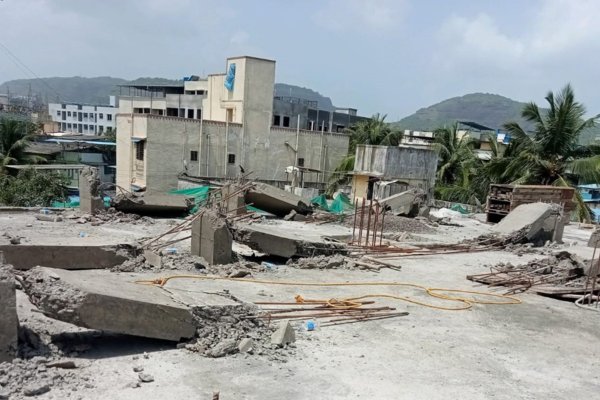
The Navi Mumbai Municipal Corporation (NMMC) has intensified action against unauthorized construction in Airoli. Acting on the Municipal Commissioner's directives, the encroachment department demolished an illegally built RCC structure behind Vinita Apartments in Sector 20. Despite prior notices under Section 54 of the Maharashtra Regional and Town Planning Act, 1966, the builder continued work without approval. The operation involved demolition equipment, a specialized crew, and an on-site encroachment team. A penalty of INR 50,000 was also imposed on the violator. NMMC has announced that such enforcement will continue citywide to deter violations and uphold planned urban development. The move underscores NMMC's commitment to preserving Navi Mumbai's orderly infrastructure and protecting law-abiding residents. Ongoing vigilance will be key to sustaining the city's growth and urban integrity.Read more
The Punjab Cabinet has approved a new Land Pooling Policy aimed at facilitating urban development without forcibly acquiring land. Announced by Cabinet Minister Aman Arora, the policy gives landowners three choices: transfer land to the government, partner with private developers, or undertake development themselves. The first phase will launch in 27 major cities across Punjab. Under the scheme, landowners surrendering one acre will receive a developed 1,000-square-yard residential plot and a 200-square-yard commercial plot. Those contributing nine acres can reclaim three acres for group housing projects. The policy, chaired by Chief Minister Bhagwant Mann, is positioned as a transparent, fair approach to land use planning. The government aims to counter opposition criticism by ensuring clear communication and effective implementation.Read more

The Uttar Pradesh Real Estate Regulatory Authority (UP-RERA) has been actively working to improve the transparency and efficiency of project registration and grievance redressal procedures, according to Sanjay Bhoosreddy, chairman of the authority, who spoke at a real estate conference in Noida. He highlighted the exponential rise in project registration applications from across the state and stated that the authority, despite limited resources, is committed to ensuring timely delivery of registration numbers within 30 days. The event, organised by Realty & More, also shed light on UP-RERA's efforts to uphold builder-buyer trust and bolster the state's growing real estate ecosystem.Read more

Advertisement


In a concerning development for Karnataka's real estate sector, over 2,600 projects have been officially marked as 'expired' due to developers failing to seek registration extensions. Additionally, more than 2,700 projects have lapsed, having their registrations invalidated because of non-completion. Out of 7,707 registered projects, 2,632 builders defaulted, primarily by not delivering homes on time. Builders are mandated to submit quarterly updates on project status, expenditures, and funds collected, with penalties for non-compliance reaching up to 10% of the project cost. However, enforcement has been weak, with the Karnataka Real Estate Regulatory Authority (K-RERA) recovering only INR 91 crore out of the INR 758 crore ordered refunds to homebuyers.Read more

Real estate developers in Ranchi are currently encountering major project hold-ups due to a backlog of 327 building plan approvals pending with the Ranchi Municipal Corporation (RMC) since earlier this year. The principal cause of the delays was the prolonged vacancy of the legal officer position, essential for final approval of plans. Although a legal officer has been appointed recently following a Jharkhand High Court directive, the accumulated backlog continues to impact builders, stalling construction, and tying up investments. The RMC is gradually working through the approvals, but concerns remain over the financial strain and operational disruptions faced by developers.Read more

Gujarat Real Estate Regulatory Authority (GujRERA) has launched a state-wide crackdown on developers violating RERA by promoting and accepting pre-registration bookings. The authority reiterated that projects must obtain RERA registration before any marketing or bookings, to protect buyers and ensure transparency. Alongside enforcement, GujRERA has introduced new marketing guidelines, effective mid-June. Developers must now display their Unique RERA registration number and a QR code from the RERA certificate on all promotional materials-including brochures, booking forms, print, digital, and video ads. In videos, the QR code must appear for at least three seconds; audio ads must clearly mention the RERA number. Non-compliance could result in penalties of up to 5% of the project's estimated construction cost under Section 63 of the Act. GujRERA's measures aim to foster trust, accountability, and stricter compliance across Gujarat's real estate sector.Read more
The Indian government is set to amend the Delhi Development Act, 1957, to strengthen the Land Pooling Policy (LPP) and enhance private sector participation in Delhi's urban redevelopment. Under the revised policy, land pooling will become mandatory if 70% of landowners in a sector consent, allowing the Centre to enforce development without full consensus-addressing long-standing implementation delays. Introduced in 2013 and operational since 2018, LPP currently allocates 60% of pooled land for residential projects and 40% for community infrastructure. The amendments will impact 129 sectors across 104 urban villages, including Narela, Bawana, and Najafgarh, aimed at promoting vertical growth and modern infrastructure. Public consultations will precede the legislative rollout. The reforms are expected to unlock stalled projects, expedite housing supply, and drive coordinated urban planning in Delhi's expanding periphery.Read more

The Maharashtra government recently approved revised terms for utilizing an 8.5-hectare Mother Dairy land plot in Kurla. This decision aims to rehabilitate ineligible slum dwellers from Dharavi, India's largest slum cluster. The redevelopment plan encompasses not only housing but also essential amenities like schools, hospitals, and shopping complexes. This decision follows a Government Resolution issued last year handing over the land to the Slum Rehabilitation Authority (SRA). The ambitious Dharavi project aims to rehabilitate 8.5 lakh families, with 3.5 lakh requiring land outside Dharavi itself. However, local residents and political leaders have opposed the move, citing environmental concerns and demanding alternative land use such as botanical gardens and hospitals.Read more

Advertisement