Advertisement






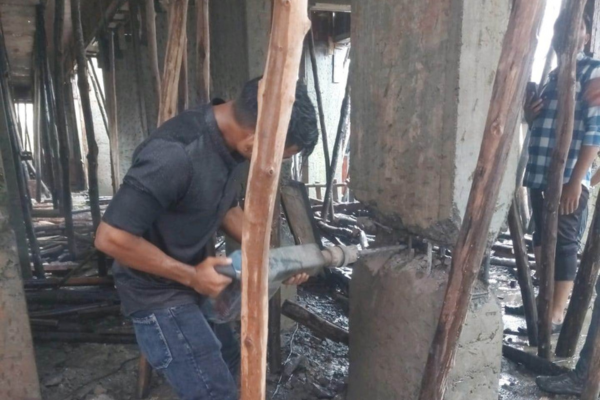
The Navi Mumbai Municipal Corporation (NMMC) undertook a demolition drive in Ghansoli after unauthorised RCC construction continued despite prior notice. The action was initiated under the guidance of the Municipal Commissioner and senior civic officials, targeting illegal work on a ground-floor column and a progressing first-floor slab by a local developer. The civic team, supported by police personnel, deployed labourers and breakers to remove the structure. The NMMC confirmed that similar encroachments would face intensified enforcement going forward.Read more
The Andhra Pradesh government has announced plans to reintroduce the Building Penalisation Scheme (BPS) and Layout Regularisation Scheme (LRS) in response to the rising number of unauthorised constructions across the state. A recent assessment revealed over 35,000 buildings that have never been taxed and more than 25,000 illegal layouts. These schemes, originally implemented during the previous Telugu Desam Party (TDP) government, aim to legalize unapproved constructions and bring them under municipal regulation. However, before implementation, the state must obtain approval from the Cabinet and clearance from the High Court, which had earlier raised concerns that such schemes could encourage future violations.Read more

Odisha's Housing and Urban Development Department launched a streamlined initiative to accelerate implementation of the Real Estate (Regulation and Development) Act. Following a high-level review chaired by the Chief Secretary, key departments including Revenue & Disaster Management, Town Planning, General Administration, and ORERA have been instructed to report on progress. Priorities include developing digital tools, integrating land-record portals, deploying enforcement squads, and filling vacant operations roles. These targeted measures build on reforms introduced earlier in July aimed at strengthening monitoring, improving inter-departmental coordination, and protecting homebuyers from illegal developments.Read more

The Gujarat government has scrapped the INR 200 fee for ownership certificates, or 'sanads,' under the SVAMITVA scheme, making them free for rural property holders. This move will benefit about 25 lakh villagers, with the state allocating INR 50 crore to fund the initiative. Along with the property card, beneficiaries will now receive the sanad at no cost. The SVAMITVA scheme, launched nationwide in 2021, uses drone surveys to map rural land and issue legal ownership documents. The initiative aims to cut property disputes and promote access to credit and government benefits.Read more

The Supreme Court has upheld an earlier order by the Bombay High Court allowing Adani Cementation Ltd to cut 158 mangrove trees in Maharashtra's Raigad district to develop a captive jetty along the Amba River. The project involves a 620-metre-long jetty with mechanised conveyor systems aimed at transporting cement, clinker, and raw materials through waterways instead of roads. This move is intended to reduce heavy vehicular traffic and carbon emissions. Despite opposition from an environmental NGO, the court has mandated compensatory afforestation and strict adherence to environmental safeguards as a condition for proceeding with the construction.Read more

Advertisement


The Chandigarh Administration has served a notice to former BJP MP Kirron Kher, seeking INR 12.76 lakh in unpaid rent for a government-allocated residence in Sector 7. Issued by the Assistant Rent Controller, the demand includes accumulated licence fees and interest charges. Kher, however, has contested the basis of the charges, stating she became aware of the dues through media reports. Her office has requested a clarification on the rent calculations, alleging that they contradict established House Allotment Committee rules.Read more

The Supreme Court has issued an interim order modifying a Bombay High Court directive that required the Mumbai Metropolitan Region Development Authority (MMRDA) to deposit the full INR 1,169 crore arbitral award in favor of Mumbai Metro One Private Limited (MMOPL), a joint venture involving Anil Ambani's Reliance Infrastructure. The apex court now mandates MMRDA to deposit 50 percent of the awarded amount, approximately INR 584.5 crore, for the stay on the High Court's full deposit order to remain active.Read more
Maharashtra's newly unveiled Housing Policy 2025 targets INR 70,000 crore in investments and aims to build 50 lakh homes over the next decade, with 35 lakh planned in five years. The policy focuses on slum rehabilitation, affordable housing, and urban sustainability-especially for EWS, LIG, MIG groups, industrial workers, and senior citizens. Affordable housing now enjoys infrastructure status, easing access to funding via ECB, FDI, and PSL. Key initiatives include redevelopment of old buildings, integrated townships, and the 'Walk to Work' model with dedicated MIDC housing zones. A INR 20,000 crore MahaAwas Fund and a state housing portal will further support implementation and transparency.Read more

Rajasthan's revamped Township Policy sets a new course for eco-conscious and inclusive urban growth. It mandates parks and utility spaces, promotes rainwater harvesting and wastewater recycling, and emphasizes affordable housing for all segments especially EWS, LIG, and industrial workers. The policy also encourages vertical development and mixed-use planning, while developers are held accountable to maintain infrastructure. This vision aligns with feasibility studies for satellite towns and advances in renewable energy demonstrating a momentous move toward sustainable city planning without sacrificing essential services.Read more

Punjab has revised its land-pooling policy to offer improved financial incentives, faster approvals, and wider inclusion of small landowners. Farmers now get INR 50,000 per acre upfront, INR 1,00,000 annually (with 10% hike for delays), and the option of both residential and commercial plots in return for contributed land. The updated policy applies to over 40,000 acres and assures no forced acquisition, no third-party interference, and full rights to farmers. Despite these changes, protests led by political and farmer groups continue, who claim the policy benefits developers at the cost of rural communities.Read more

Advertisement