Advertisement






The Gulf conflict has disrupted global supply chains, pushed...
REITs have changed the way commercial real estate is owned a...
What really powers the cloud? Behind every Google search, A...
What really powers the cloud? Behind every Google search, A...
Luxury real estate is one of the most talked-about segments ...
The Navi Mumbai Municipal Corporation (NMMC) has introduced a bilingual ‘Green Society’ information booklet to encourage residents to adopt environmentally sustainable practices in residential complexes. Unveiled on October 8 by Mayor Sujata Patil, in the presence of Deputy Mayor Dashrath Bhagat and Additional Commissioner Sunil Pawar, the publication outlines measures for scientific tree maintenance, water conservation, green waste management and biodiversity protection. Developed through the civic body's gardens department under the guidance of the mayor and Municipal Commissioner Dr Kailas Shinde, the booklet emphasises that increasing green cover must be accompanied by appropriate plant selection and regular maintenance. It also recommends composting garden waste, using treated recycled water wherever possible, avoiding excessive tree pruning and creating biodiversity corners to support pollinators and birds. The publication is intended to help housing societies maintain greener, healthier and more sustainable residential environments.
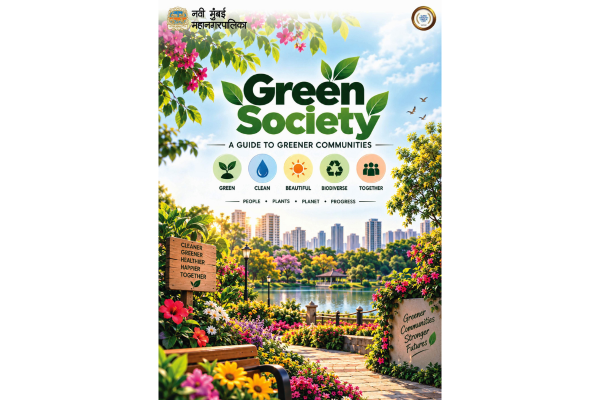
The Navi Mumbai Municipal Corporation (NMMC) unveiled its ‘Green Society’ information booklet on October 8 to promote sustainable landscaping, water conservation and biodiversity management in residential complexes across Navi Mumbai. The publication was launched at the civic body's Knowledge Centre during a special event marking Abhijat Marathi Bhasha Din, with Mayor Sujata Patil, Deputy Mayor Dashrath Bhagat and Additional Commissioner Sunil Pawar present.
The initiative is being implemented through the municipal corporation's gardens department under the guidance of the mayor and Municipal Commissioner Dr Kailas Shinde. It aims to build environmental awareness among residents while encouraging housing societies to adopt practices that protect and maintain existing green spaces.
The bilingual booklet, published in Marathi and English, highlights the importance of selecting appropriate trees, maintaining vegetation scientifically and balancing landscaping requirements with natural ecosystems. It stresses that increasing the number of trees alone is insufficient without proper upkeep, efficient water use and measures to conserve biodiversity.
For residential complexes, the publication recommends choosing trees and plants according to the characteristics of different spaces, including open areas, entrances, footpaths, gardens, pots and designated biodiversity zones. It also advises scientific pruning, including the removal of dry, weak and diseased branches, while discouraging excessive or aggressive pruning and the cutting of tree tops. Green waste generated through pruning should be managed appropriately rather than burnt.
The booklet identifies leaves, grass, flowers and tree-pruning residues as resources that can be reused through composting. It recommends separating large and small branches and using the resulting organic manure in gardens, lawns, around trees and in pots. Plastic, glass, metal and chemical or hazardous waste should not be mixed with compostable material.
Water management is another key component of the guidelines. Housing societies are encouraged to use only the quantity of water required, direct water towards plant roots and use treated recycled water wherever feasible. Watering in the morning or evening is recommended, alongside measures to prevent waterlogging.
The publication also advocates creating biodiversity corners with plants that support butterflies, bees and other pollinators. Maintaining a variety of native plants, providing drinking water for birds and avoiding unnecessary pesticide use are among the recommended measures for improving biodiversity within residential premises.
The booklet was developed with contributions from Deputy Commissioner of the gardens department Smita Kale, Deputy Commissioner of Circle 2 Dr Sanjay Shinde and Chief Legal Officer Abhay Jadhav. Noted author and speaker Sanjay Upadhye was also present at the launch, along with other dignitaries.
Through the publication, NMMC has presented a framework combining appropriate plant selection, scientific maintenance, efficient water management and biodiversity conservation. The civic body aims to encourage housing societies to apply these practices to maintain greener and healthier residential surroundings while supporting long-term environmental sustainability.

16th Nov, 2026

15th Nov, 2026

15th Nov, 2026

13th Nov, 2026

13th Nov, 2026



Advertisement








 Facebook
 Whatsapp

