Advertisement






The Gulf conflict has disrupted global supply chains, pushed...
REITs have changed the way commercial real estate is owned a...
What really powers the cloud? Behind every Google search, A...
What really powers the cloud? Behind every Google search, A...
Luxury real estate is one of the most talked-about segments ...
The Navi Mumbai Municipal Corporation (NMMC) has started accepting online applications for 46 welfare schemes for the 2026-27 financial year, covering economically weaker residents, women, children, backward communities, tribal families and eligible beneficiaries from the open category. Applications opened on October 12, 2026, through the civic body's official website, www.nmmc.gov.in. The deadline is December 15, 2026, for scholarship schemes and December 31, 2026, for other schemes. The initiatives include educational scholarships, vocational training, marriage assistance, support for self-employment, medical hardship assistance and financial aid for eligible families. The schemes are being implemented through the civic body's Social Development Department under the Women and Child Welfare Committee, Social Welfare and Slum Improvement Committee, and open-category provisions. Mayor Sujata Patil and Municipal Commissioner Kailas Shinde have urged eligible residents to apply online.
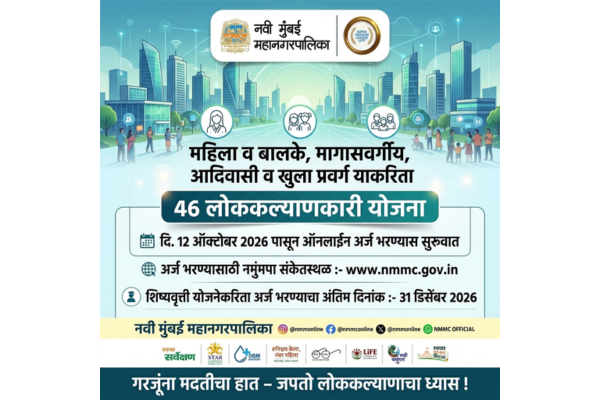
The Navi Mumbai Municipal Corporation (NMMC) began accepting online applications on October 12, 2026, for 46 welfare schemes for the 2026-27 financial year, covering eligible residents across Navi Mumbai. Implemented through the civic body's Social Development Department, the initiatives aim to provide financial assistance, educational support and vocational training to needy and economically weaker sections. Applications are available on the NMMC website, with separate deadlines for scholarships and other schemes.
Residents applying for scholarship schemes must submit their applications by December 15, 2026, while applications for the remaining schemes will close on December 31, 2026. Mayor Sujata Patil and Municipal Commissioner Kailas Shinde have appealed to eligible residents to review the criteria and apply through the official portal.
The schemes are divided into provisions for women and children, backward communities, tribal communities and the open category. According to the civic body, the programme covers a broad range of beneficiaries through 46 separate initiatives.
Under the women and child welfare category, assistance is available for the marriage of daughters of destitute, widowed, deserted and divorced women, as well as orphaned girls. Other provisions include vocational training for unemployed and educated women, incentives for adoptive parents of orphaned children, support for women-led self-help groups and scholarships for children of widowed or divorced women. Financial assistance is also available for eligible students from economically weaker families, including orphaned children requiring educational fee support.
The category further covers financial assistance for women from economically weaker households suffering from specified serious illnesses, support for families following the death of the earning male member, and assistance for children who lost one or both parents during the COVID-19 pandemic. Other initiatives include vocational training and employment-related assistance for transgender people and women engaged in sex work, support for eligible women aged 50 and above, and assistance for equipment purchases by women's self-help groups. The civic body will also provide bus facilities through its transport undertaking for children attending municipal schools.
The backward-class welfare schemes include incentives for inter-caste marriages, vocational training for unemployed educated youth, scholarships from primary school to college, and financial assistance for bicycles for students in Classes V to XII. Eligible beneficiaries can also receive support for marriage expenses, computers or laptops for college and engineering students, and equipment required for self-employment. Assistance is available for people suffering from serious illnesses and for groups seeking to establish collective businesses.
For tribal communities, the schemes cover scholarships from Class I to postgraduate education, vocational training for unemployed youth, assistance towards purchasing three- and four-wheeled vehicles for passenger or goods transport, and financial support for self-employment. Other provisions include equipment for women's self-help groups and organisations, marriage assistance, funding for higher education in India and abroad after Class XII, and support for competitive examinations, police training, pre-military training, paramilitary preparation and banking-related private training. Financial assistance is also available to eligible families following the death of an earning member or in cases of serious illness.
Under the open-category schemes, eligible project-affected families can seek tuition-fee assistance for meritorious students pursuing full-time professional courses after Class XII. Scholarships are also available to children of quarry, construction, sand and naka workers, project-affected families, and sanitation and contractual workers employed by the municipal corporation. Additional provisions cover vocational training for needy and unemployed youth and fee assistance for eligible students pursuing professional medical and engineering courses after Class XII.
The NMMC has asked residents to check the eligibility conditions for individual schemes and submit applications through its official website, www.nmmc.gov.in, before the relevant deadlines.
16th Nov, 2026

15th Nov, 2026

15th Nov, 2026

13th Nov, 2026
13th Nov, 2026


Advertisement








 Facebook
 Whatsapp

