Advertisement






The Gulf conflict has disrupted global supply chains, pushed...
REITs have changed the way commercial real estate is owned a...
What really powers the cloud? Behind every Google search, A...
What really powers the cloud? Behind every Google search, A...
Luxury real estate is one of the most talked-about segments ...
Navi Mumbai Municipal Corporation (NMMC) Commissioner Dr Kailas Shinde participated as a panellist at the ninth International India Water Week 2026 in New Delhi, discussing treated wastewater reuse, digital water management and innovative financing for future-ready cities. The session, organised under the Ministry of Housing and Urban Affairs, examined rural-urban water grids and safe reuse of treated water. Shinde presented NMMC’s wastewater management model, under which the civic body treats 100% of its daily sewage and has a treatment capacity of 454 MLD. Treated water is supplied for industrial use, gardens, construction and other non-potable purposes. He also outlined the use of SCADA, GIS, an Integrated Command and Control Centre and AI-based analysis in water management, besides NMMC’s agreement with MIDC to supply treated water to industries.
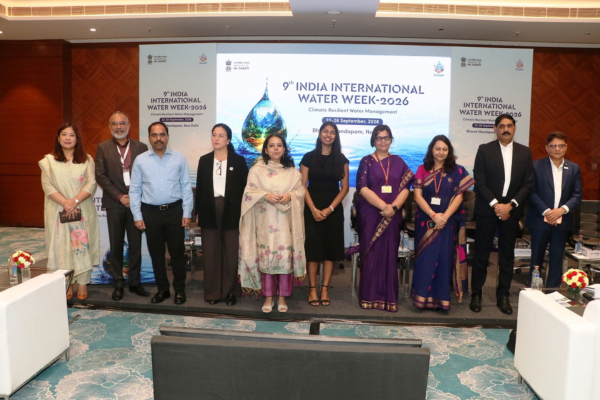
Navi Mumbai Municipal Corporation Commissioner Dr Kailas Shinde participated as a panellist at the ninth International India Water Week (IIWW) 2026 in New Delhi, where he presented the civic body’s wastewater reuse model and discussed digital technologies, innovative financing and treated water management for future-ready cities.
The session, titled “Rural–Urban Water Grids & Innovation in Safe Reuse of Treated Water”, was organised by the Ministry of Housing and Urban Affairs (MoHUA). It included a panel discussion on “Future-Ready Cities: Harnessing Digitalization, AI and Innovative Finance for Circularity”.
The session was chaired by Isha Kalia, Joint Secretary, AMRUT division of the central government, with Dr T.K. Sridevi, Secretary, Municipal Administration Department, Government of Telangana, serving as co-chair. Conrad Fernandes moderated the discussion, which included experts from Jacobs, the World Bank and Digital Pani. Madhusudan Reddy, Director, Municipal Administration, Government of Tamil Nadu, and Dr Shweta Banerjee, Superintending Engineer, Nagpur Municipal Corporation, presented case studies on water reuse models in Tamil Nadu and Nagpur.
Shinde outlined NMMC’s approach to treating and reusing wastewater. Navi Mumbai currently treats 100% of its daily sewage, with the civic body having a total wastewater treatment capacity of 454 MLD. The treated water is supplied for industrial activities, gardens, construction projects and other non-potable applications, reducing dependence on potable water sources for these requirements.
During the panel discussion, Shinde described treated wastewater as a resource rather than waste and said that appropriate measurement, management and economic valuation could enable cities to derive value from it. He highlighted technology as a key component of NMMC’s water management system, including SCADA, GIS, the Integrated Command and Control Centre (ICCC) and artificial intelligence-based analysis.
He also outlined the arrangement between NMMC and the Maharashtra Industrial Development Corporation (MIDC) for supplying treated water to industrial establishments. According to the civic body, the initiative has provided industries with an alternative water source at a lower cost while helping make more potable water available for citizens.
Several industrial establishments are currently using the treated water supplied through the initiative, while NMMC plans to increase its reuse capacity in the future. The municipal corporation said the model is intended to support conservation and more sustainable management of available water resources.
The wider panel discussion covered digitalisation and artificial intelligence in the water sector, innovative financing, wastewater reuse, future-ready cities and sustainable water management. Shinde said NMMC’s experience in wastewater treatment and reuse could provide a reference for other cities developing circular water management systems.
16th Nov, 2026

15th Nov, 2026

15th Nov, 2026

13th Nov, 2026
13th Nov, 2026


Advertisement








 Facebook
 Whatsapp

