Advertisement






The Gulf conflict has disrupted global supply chains, pushed...
REITs have changed the way commercial real estate is owned a...
What really powers the cloud? Behind every Google search, A...
What really powers the cloud? Behind every Google search, A...
Luxury real estate is one of the most talked-about segments ...
27 Sep 2026
India’s logistics transformation is increasingly moving beyond physical infrastructure towards digital systems that connect government departments, businesses and supply-chain networks. Maharashtra, Punjab and Andhra Pradesh are using the Unified Logistics Interface Platform (ULIP) to address state-specific logistics challenges, improve data availability and support decision-making. Maharashtra is focusing on challenges faced by exporters and MSMEs, Punjab is integrating logistics-related departments across agriculture, warehousing, transport and trade, while Andhra Pradesh is developing an integrated logistics dashboard to monitor key performance indicators. At the national level, ULIP connects 13 Ministries, 48 Systems, 2,000+ Data Fields and 142 APIs. The growing state-level adoption could help smaller businesses access logistics information, improve shipment predictability and make India’s physical connectivity more efficient through connected digital infrastructure.Read more
26 Sep 2026
Commercial workplaces are moving beyond their traditional role as spaces designed mainly for desks, meetings and daily operations. As hybrid working gives employees greater flexibility over where they work, companies are placing more emphasis on creating environments that encourage collaboration, comfort and interaction. Workplace design is increasingly incorporating flexible layouts, informal areas, cafés, smart building systems and data-driven planning. At the same time, functionality and long-term maintenance remain important, as commercial interiors need to work efficiently beyond their visual appeal. The future office is therefore expected to combine technology, flexibility and human experience while continuing to support collaboration, learning and company culture.Read more
26 Sep 2026
RentenPe’s ORA (Owners Rental Asset) aims to strengthen rental security by bringing tenant KYC, income details, past tenancy records and ongoing rental behaviour together on a single platform. The system is designed to help landlords assess prospective tenants and monitor rent payments, delays and other tenancy-related events throughout the rental period. It also seeks to benefit tenants by allowing responsible rental behaviour to build a digital rental profile that could support future applications and access to better rental terms. The proposed ecosystem extends accountability to landlords through structured issue reporting and could provide a basis for authorised independent verification, rating or dispute-resolution agencies, subject to consent and privacy safeguards. The broader objective is to establish a more transparent, data-backed rental relationship for both parties.Read more

26 Sep 2026
Sion is gaining renewed relevance as Mumbai’s residential landscape evolves, with its established infrastructure and central location supporting connectivity to key employment, education, healthcare and lifestyle destinations. The neighbourhood links the island city with the eastern and western suburbs through the Eastern Express Highway, Dr Ambedkar Road, Sion-Panvel Highway and suburban rail. Its proximity to BKC further strengthens its appeal for professionals, while ongoing road and Metro investments are adding connectivity. Sion also benefits from longstanding institutions, markets, retail and social infrastructure across nearby Matunga, Dadar, Kurla and Wadala. As commute times and accessibility increasingly influence home-buying decisions, the neighbourhood’s combination of established community infrastructure and improving transport links is shaping its residential relevance within Mumbai’s evolving urban network.Read more
20 Sep 2026
Infrastructure announcements can trigger sharp property price increases well before projects become operational, but early appreciation does not necessarily indicate sustainable real estate value. The article examines how airports, expressways and metro corridors influence land prices, development and investor expectations, while highlighting the importance of local civic infrastructure, employment access, liveability and rental demand. It argues that connectivity enables economic activity rather than creating it on its own, and that developers, investors and homebuyers need to distinguish between anticipated appreciation and value supported by actual use. The article identifies expectation, execution and utilisation as three stages of infrastructure-led real estate markets, with residential absorption, occupancy, rental demand, commercial leasing and improved travel times becoming more meaningful indicators once infrastructure becomes operational.Read more
Advertisement






20 Sep 2026
Vasai’s residential market could gain a new growth driver from the proposed Vadhavan Port and the wider infrastructure network planned around the region. The port, estimated to involve an investment of INR 76,220 crore and a proposed cargo-handling capacity of 298 million tonnes annually, is expected to support logistics, warehousing, manufacturing, freight and related economic activity. For Vasai, the impact could extend beyond port operations as new employment centres and connectivity projects develop across the northern Mumbai Metropolitan Region. The region already has an established housing market, social infrastructure and local communities, providing a base for future residential development. Proposed links including the Uttan-Vadhavan Port connection, Bhayander-Vasai Sea Link, Mumbai Metro Line 13 and the Vasai–Diva–Panvel railway extension could further strengthen regional connectivity and influence the location and format of future housing projects.Read more

20 Sep 2026
Mumbai’s redevelopment landscape is expanding beyond the replacement of ageing buildings, with greater attention being given to neighbourhood character, community spaces, cultural heritage and local identity. The article examines how redevelopment can respond to the history and associations of established communities while creating contemporary residential environments. It highlights Agami Realty’s projects Agami Eternity and Agami Legends in Kalanagar, where art, cultural heritage, sporting traditions and community infrastructure inform the developments. The article also cites Knight Frank’s Upgrading Mumbai: The Redevelopment Story 2025, which recorded more than 910 housing societies initiating redevelopment between 2020 and the first half of 2025, covering over 326.8 acres of potential buildable area. With 1,094 development agreements signed since 2020 and the potential for nearly 59,000 additional homes by 2031, redevelopment is increasingly influencing Mumbai’s urban fabric.Read more
20 Sep 2026
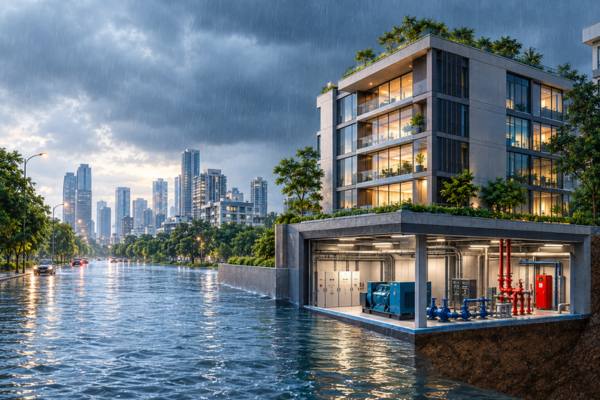
India’s cities are increasingly exposed to intense rainfall, flash flooding and prolonged waterlogging, making flood resilience a priority for urban infrastructure and buildings. The article examines how MEPF (Mechanical, Electrical, Plumbing and Fire protection) systems can support flood-ready buildings by protecting critical equipment, strengthening drainage and pumping capacity, providing proportionate redundancy and enabling faster recovery after flooding. It highlights the need to integrate building-level planning with wider urban drainage, utilities and transport infrastructure, particularly in rapidly expanding cities. The article also emphasises the importance of assessing flood risks during the concept-design stage, accounting for changing rainfall patterns and ensuring critical systems remain operational during disruptions. It argues that the focus needs to move beyond responding to floods towards designing buildings and infrastructure that can anticipate, withstand and recover from extreme weather events.Read more
19 Sep 2026
As Bengaluru's residential development becomes increasingly vertical, climate-adaptive architecture is gaining importance in discussions around comfort, resource efficiency and long-term building performance. The approach focuses on reducing heat gain, improving natural ventilation, managing water resources and limiting dependence on mechanical cooling. Building orientation, wind-flow modelling, shaded balconies, overhangs, high-performance glazing, reflective finishes and thermally stable materials can influence indoor conditions. Water resilience is another key consideration, with rainwater harvesting, groundwater recharge, permeable surfaces, greywater reuse, sewage treatment and native landscaping forming part of an integrated approach. The shift also places greater emphasis on measurable design features rather than broad sustainability claims. For high-rise developments in Bengaluru, questions around how buildings manage heat, airflow and water are becoming increasingly relevant to both design and residential experience.Read more

19 Sep 2026
India's packaging industry has undergone significant changes over the past four decades as consumer expectations have evolved alongside lifestyles, purchasing behaviour and retail formats. Packaging, once primarily focused on product identification and protection, now serves wider functions including information delivery, convenience, brand communication, product security and sustainability. The expansion of organised retail and e-commerce has increased the importance of packaging as a source of product information, while urbanisation, smaller households and faster-paced lifestyles have increased demand for portable, resealable and easy-to-use formats. At the same time, greater competition between products has encouraged brands to invest in packaging design, print quality and premium finishes. Consumers have also placed greater emphasis on authenticity, tamper evidence and clear product information, particularly in sensitive categories. More recently, recyclability, material consumption and environmental impact have become increasingly relevant to packaging decisions.Read more
Advertisement








