Advertisement






The Gulf conflict has disrupted global supply chains, pushed...
REITs have changed the way commercial real estate is owned a...
What really powers the cloud? Behind every Google search, A...
What really powers the cloud? Behind every Google search, A...
Luxury real estate is one of the most talked-about segments ...
Mumbai’s expanding road and metro network is strengthening east–west connectivity between the established western suburbs and emerging commercial locations in the eastern corridor. The Jogeshwari–Vikhroli Link Road (JVLR) already connects the Western Express Highway with the Eastern Express Highway, while proposed and ongoing infrastructure projects, including the Goregaon–Mulund Link Road (GMLR), Eastern Freeway Extension and Vikhroli–Koparkhairane Bridge, are expected to improve access between Andheri, Goregaon, Malad, Powai, Vikhroli, Mulund and Airoli. Real estate developers see these improvements as factors that could influence corporate location decisions, residential demand and the development of integrated urban centres. Vikhroli’s proximity to Powai’s established business district and Mulund’s residential base could support demand for commercial and residential properties. Access to healthcare, retail, hospitality and green spaces also contributes to the eastern corridor’s appeal as Mumbai’s infrastructure network expands.
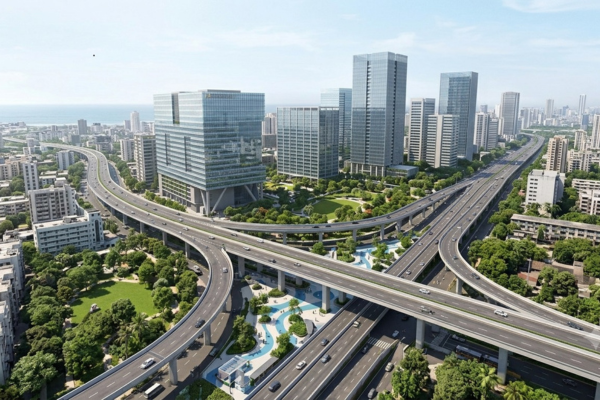
Mumbai’s expanding infrastructure network is strengthening east–west connectivity between the established western suburbs and emerging commercial locations in the eastern corridor, with developers identifying Vikhroli, Mulund and surrounding neighbourhoods as potential beneficiaries. The Jogeshwari–Vikhroli Link Road (JVLR) already connects the Western Express Highway with the Eastern Express Highway, while projects such as the Goregaon–Mulund Link Road (GMLR) and Vikhroli–Koparkhairane Bridge are expected to improve access across the Mumbai Metropolitan Region (MMR).
Andheri, Goregaon and Malad have long served as established commercial locations, supported by office developments, business infrastructure and transport links. However, improvements to the road network and access to multiple Metro lines could widen employee catchment areas and make locations in the eastern suburbs more accessible to businesses evaluating office space beyond traditional commercial districts.
The proposed GMLR, alongside the Eastern Freeway Extension and Vikhroli–Koparkhairane Bridge, is expected to strengthen connections between the western suburbs, Powai, Vikhroli, Mulund and Airoli. Better cross-city access could reduce the commuting burden for employees travelling between residential neighbourhoods and workplaces, while enabling companies to consider a wider range of office locations.
Shilpin Tater, managing director of Superb Realty, said infrastructure development influenced not only travel times but also the distribution of economic activity across a city. He noted that JVLR had established an important east–west connection and that further infrastructure improvements could strengthen integration between Mumbai’s established business districts and emerging commercial locations.
Tater identified Vikhroli as a potential commercial destination, citing its proximity to Powai’s established business ecosystem, access to a diverse workforce and the presence of major corporates and global capability centres (GCCs). He said future commercial developments would need to combine connectivity with workplace quality, sustainability and social infrastructure to meet the requirements of occupiers and investors.
Mulund could also benefit from improvements to the wider transport network. Its established residential base and access to major roads provide a foundation for further commercial development, while stronger connections with other parts of the MMR could increase its accessibility to businesses and homebuyers.
Navin Makhija, managing director of The Wadhwa Group, said improved connectivity could support both residential and commercial real estate by making workplaces easier to reach and surrounding neighbourhoods more accessible. He added that Mulund could attract businesses assessing office locations as well as homebuyers seeking connectivity across Mumbai and the wider metropolitan region.
Beyond transport infrastructure, the eastern corridor has access to healthcare facilities, hospitality, retail, entertainment and other everyday services. Green spaces and protected mangrove landscapes in parts of the corridor also contribute to its environmental setting. These factors form part of the wider considerations for businesses assessing office locations, alongside commuting times, occupancy costs and employee requirements.
As Mumbai’s transport network expands, Vikhroli, Mulund and the Bhandup–Nahur belt could gain greater prominence within the city’s commercial and residential property markets. The extent of this shift will depend on the delivery of planned infrastructure, the availability of suitable developments and the ability of emerging locations to provide workplaces, housing and supporting amenities within accessible urban centres.

20th Oct, 2026

3rd Oct, 2026

28th Sep, 2026
24th Sep, 2026


4th Aug, 2026


Advertisement








 Facebook
 Whatsapp

