Advertisement






The Gulf conflict has disrupted global supply chains, pushed...
REITs have changed the way commercial real estate is owned a...
What really powers the cloud? Behind every Google search, A...
What really powers the cloud? Behind every Google search, A...
Luxury real estate is one of the most talked-about segments ...
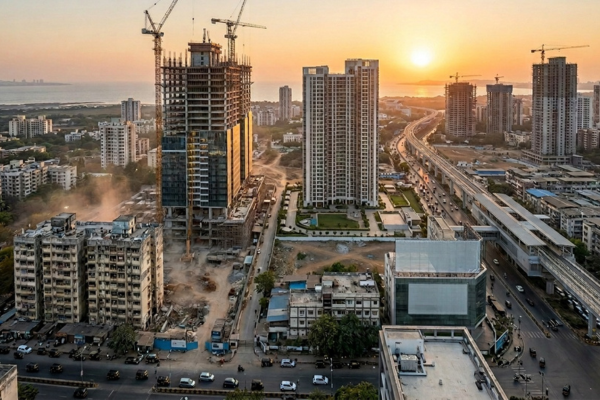
The Maharashtra government has constituted a 10-member committee to prepare a policy for regularising residential encroachments on government land in Mumbai, Pune and Pimpri-Chinchwad. The move follows the state’s earlier decision to regularise eligible residential encroachments existing before January 1, 2011, while keeping these municipal areas outside the original policy. The committee, headed by the Konkan divisional commissioner, will examine existing policies of agencies including the Slum Rehabilitation Authority and Maharashtra Housing and Area Development Authority and recommend rules for both state and central government land. It has been given three months to submit its recommendations.

The Maharashtra government has formed a 10-member committee to frame a comprehensive policy for regularising residential encroachments on government land in Mumbai, Pune and Pimpri-Chinchwad municipal areas. The committee has been asked to submit its recommendations to the Revenue Department within three months.
The decision follows the state government’s policy announced earlier this year to regularise residential encroachments on government land that existed before January 1, 2011. Mumbai city and Mumbai Suburban districts were excluded from that policy, while the newly constituted committee will now examine how the rules could be applied to Mumbai, Pune and Pimpri-Chinchwad.
The committee will be headed by the Konkan divisional commissioner. Its members include the district collectors of Mumbai City, Mumbai Suburban and Pune, along with representatives from the Slum Rehabilitation Authority, Brihanmumbai Municipal Corporation, Pune Municipal Corporation and Pimpri-Chinchwad Municipal Corporation. Senior land records officials from Mumbai City, Mumbai Suburban and Pune will also be part of the panel. The Joint Commissioner of the Divisional Commissioner’s Office, Konkan Division, will serve as the member secretary.
The panel will study existing regularisation policies followed by the Slum Rehabilitation Authority, MHADA and other relevant authorities before recommending a common framework for the three municipal areas. It will also make specific recommendations for residential encroachments located on land owned by the central government or its subordinate agencies.
The move comes after the state had ordered a survey of eligible encroachments in Mumbai, Mumbai Suburban and Pune to assess the ground situation before deciding whether the regularisation policy should be extended to these areas. The survey exercise was intended to provide data on structures existing before the January 1, 2011 cut-off.
Under the broader state policy announced earlier this year, residential encroachments of up to 500 square feet are eligible for regularisation without a charge. For areas above 500 square feet, an occupancy charge equal to 10% of the prevailing market value is applicable, while the maximum area eligible for regularisation is capped at 1,500 square feet. Any area beyond that limit is to be removed. Where a portion of a residential structure is being used for commercial purposes, 25% of the prevailing market value is applicable for that portion.
The earlier policy also excludes encroachments on riverbeds, drains, grazing land, public roads, forests, cremation grounds, playgrounds and land reserved for schools or hospitals. Such structures are not eligible for regularisation, with affected families to be considered for alternative housing under the Pradhan Mantri Awas Yojana. The policy also requires documents such as voter lists, electricity bills or property tax receipts from before January 1, 2011, along with recent proof of residence.
The committee’s recommendations will determine the framework specifically for Mumbai, Pune and Pimpri-Chinchwad, which were not covered by the original state-wide policy. The three-month deadline means the government is now moving from the earlier survey and review process towards preparing specific rules for these urban areas.
Source PTI
17th Nov, 2026

17th Nov, 2026

17th Nov, 2026

16th Nov, 2026
16th Nov, 2026

16th Nov, 2026

16th Nov, 2026

16th Nov, 2026

15th Nov, 2026

Advertisement








 Facebook
 Whatsapp

