Advertisement






The Gulf conflict has disrupted global supply chains, pushed...
REITs have changed the way commercial real estate is owned a...
What really powers the cloud? Behind every Google search, A...
What really powers the cloud? Behind every Google search, A...
Luxury real estate is one of the most talked-about segments ...
Thane’s proposed Mumbai-Ahmedabad High-Speed Rail station was a key focus at the Project-SMART Open Visualisation Seminar held in New Delhi, where government officials and representatives of the developer community discussed station area development and transit-oriented planning. The initiative is being undertaken jointly by the Ministry of Housing and Urban Affairs, Ministry of Railways and Japan International Cooperation Agency to develop station precincts as connected urban areas. Thane is among four stations on the 12-station corridor selected for model station area development. Representatives from Thane Municipal Corporation and CREDAI MCHI Thane participated in the seminar, with CREDAI MCHI Thane president Sachin Mirani representing the developer community on the panel. Discussions covered TOD regulations, commercial development, last-mile connectivity and private participation in station-area development.
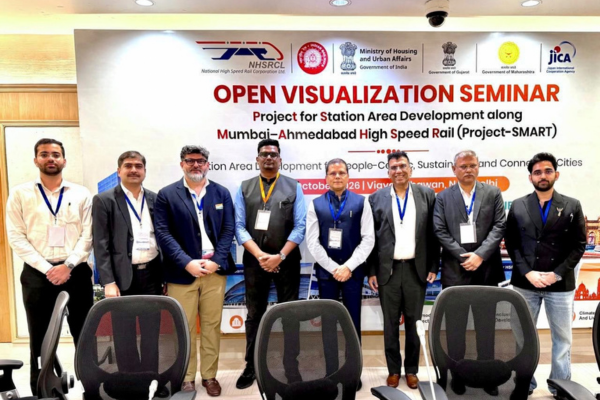
The development of the area around Thane’s upcoming Mumbai-Ahmedabad High-Speed Rail station came under focus at the Project-SMART Open Visualisation Seminar held at Vigyan Bhawan, New Delhi, on October 1, where representatives from Thane Municipal Corporation (TMC) and CREDAI MCHI Thane discussed station-area planning, transit-oriented development and private participation.
The seminar, titled ‘Station Area Development for People-Centric, Sustainable and Connected Cities’, was organised under Project-SMART, or the Project for Station Area Development along the Mumbai-Ahmedabad High-Speed Rail corridor. The initiative is a joint effort involving the Ministry of Housing and Urban Affairs, Ministry of Railways and Japan International Cooperation Agency (JICA), with the objective of integrating high-speed rail stations with surrounding urban development.
Of the 12 stations planned along the Mumbai-Ahmedabad corridor, Thane, Virar, Surat and Sabarmati have been selected as model stations for comprehensive station area development. For Thane, the planning approach involves mapping areas around the station into three buffer zones in coordination with relevant state-level agencies, including the Mumbai Metropolitan Region Development Authority (MMRDA).
The proposed planning framework is intended to integrate the station with surrounding residential, commercial and retail development while improving last-mile connectivity. The approach places the station within a wider urban planning framework rather than treating it as an isolated transport facility.
TMC officials led by Municipal Commissioner Saurabh Rao represented the civic administration at the seminar. The Thane developer community was represented by CREDAI MCHI Thane president Sachin Mirani, who participated as a panellist and shared suggestions on the development of the station precinct from a private-sector perspective.
The discussions highlighted the importance of clear transit-oriented development (TOD) regulations, facilitating commercial development and creating infrastructure that supports pedestrian movement and transit-linked growth around the station. Private-public participation was also identified as an important component in implementing station-area development.
Representatives from CREDAI MCHI Thane included Sachin Mirani, Amit Datar, Faiyaz Virani and Vibhav Borkar. TMC representatives included Commissioner Saurabh Rao, Ambukar, Kunal Muley, Assistant Director of Town Planning, and Mahesh Raval.
For Thane’s real estate sector, the station-area development framework could influence the planning and development of surrounding areas by encouraging mixed-use projects and integrating residential, commercial and retail uses with public transport. However, the extent and timing of any impact on development will depend on the final planning framework, regulations, infrastructure execution and implementation of the station-area development plan.
The proposed three-zone approach is intended to provide a structured framework for development around the station, while TOD-based planning can bring transport connectivity, pedestrian access and supporting infrastructure into the broader development process.
The seminar placed emphasis on developing urban areas around high-speed rail stations rather than limiting the exercise to station construction. For Thane, the implementation of Project-SMART will involve coordination between government agencies, the civic administration, infrastructure authorities and private-sector stakeholders as the station precinct and surrounding areas are planned.
15th Nov, 2026


11th Nov, 2026

11th Nov, 2026

10th Nov, 2026

Advertisement








 Facebook
 Whatsapp

