Advertisement






The Gulf conflict has disrupted global supply chains, pushed...
REITs have changed the way commercial real estate is owned a...
What really powers the cloud? Behind every Google search, A...
What really powers the cloud? Behind every Google search, A...
Luxury real estate is one of the most talked-about segments ...
Mumbai’s western suburbs are emerging as the city’s strongest redevelopment corridor, supported by ageing housing stock, established infrastructure and sustained residential demand. Of the 1,094 redevelopment agreements signed across Mumbai between January 2020 and March 15, 2026, 773 were in the western suburbs, accounting for nearly 71% of the total and unlocking around 321.2 acres. Redevelopment projects also contributed 15% of Mumbai’s housing sales in 2025 and the first half of 2026. With the government promoting cluster-based redevelopment, the region could see more neighbourhood-level urban renewal in the coming years.
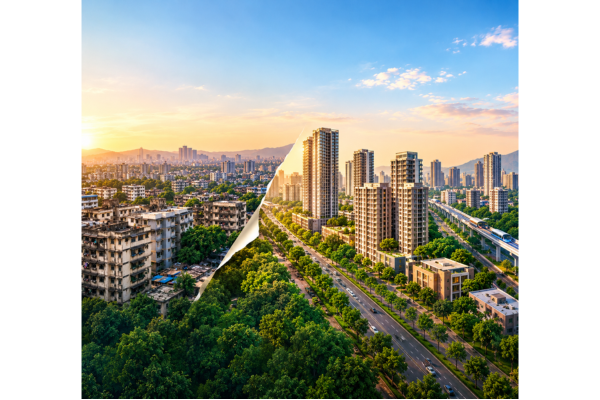
Mumbai’s western suburbs could see a further rise in redevelopment activity as the state government places greater focus on cluster-based urban renewal. Maharashtra Chief Minister Devendra Fadnavis has said that Mumbai could become slum-free within the next decade through a cluster-based redevelopment approach, putting greater emphasis on large-scale redevelopment across the city.
The western suburbs are particularly positioned for this shift because of their ageing housing stock, established infrastructure and continued residential demand. The region has already recorded a large share of Mumbai’s redevelopment activity.
According to Knight Frank India, 773 of the 1,094 redevelopment agreements signed across Mumbai between January 2020 and March 15, 2026, were in the western suburbs. These projects together unlocked approximately 321.2 acres of land, with the region accounting for nearly 71% of all redevelopment agreements signed during the period.
The broader housing market is also showing a greater role for redevelopment. A JLL-NAREDCO report found that redevelopment projects accounted for 15% of Mumbai’s housing sales during 2025 and the first half of 2026, compared with around 6% during 2016-21. More than 1,000 redevelopment projects have been launched since 2020, indicating that redevelopment has become an important source of new housing supply within the city.
Arshad Lashkaria, CEO and Managing Director, Lashkaria Group, said the western suburbs were at an important stage in their redevelopment cycle. He pointed to the scale of activity already underway and said the combination of housing demand, land economics and the need to replace ageing residential stock was supporting redevelopment. He added that a cluster-based model could bring fragmented land parcels together and allow for more integrated and better-planned development.
The opportunity is not limited to individual housing societies. Older MHADA layouts, ageing settlements and fragmented developments across the western corridor could also benefit from a larger redevelopment approach. Bringing adjoining plots together could allow for better planning, larger open spaces, upgraded infrastructure and modern amenities, while making more efficient use of Mumbai’s limited land.
The western suburbs, stretching from Andheri and Jogeshwari through Malad and Kandivali to Borivali, have established social infrastructure, connectivity and strong housing demand. These factors have helped the region remain a key residential market while also creating favourable conditions for redevelopment.
However, executing projects at a larger scale will require developers to balance the interests of existing residents with those of developers and civic authorities. Issues related to rehabilitation, approvals, project execution and coordination between multiple stakeholders could become increasingly important as redevelopment moves from individual buildings towards larger clusters.
An industry expert said redevelopment was increasingly becoming Mumbai’s main mechanism for creating new housing within its existing urban footprint. The western suburbs have already recorded the highest level of redevelopment activity, and the next opportunity could be to move towards larger, neighbourhood-level transformation.
The government’s focus on cluster redevelopment indicates a shift from isolated reconstruction projects towards broader urban regeneration. For the western suburbs, where redevelopment activity is already significantly higher than in other parts of Mumbai, the policy push could add further momentum to projects already in the pipeline.
With limited scope for the city to expand outward, redevelopment will remain important for adding housing and improving older neighbourhoods. The western suburbs, with their existing infrastructure, strong housing demand and large redevelopment pipeline, are likely to remain at the centre of Mumbai’s urban renewal over the coming years.

20th Oct, 2026

3rd Oct, 2026

28th Sep, 2026
24th Sep, 2026



4th Aug, 2026


Advertisement








 Facebook
 Whatsapp

