Advertisement






The Gulf conflict has disrupted global supply chains, pushed...
REITs have changed the way commercial real estate is owned a...
What really powers the cloud? Behind every Google search, A...
What really powers the cloud? Behind every Google search, A...
Luxury real estate is one of the most talked-about segments ...
India's cities are growing rapidly, and some of their most interesting urban development ideas have roots overseas. From Singapore's master planning for Amaravati to Latin America's bus rapid transit systems and global experiments in pedestrian-friendly streets, international examples have influenced how Indian cities approach mobility, public spaces and urban growth. These adaptations offer valuable lessons for policymakers, planners and real estate stakeholders. However, successful urban development depends on more than copying a blueprint: each idea must work with India's local conditions, infrastructure and communities.
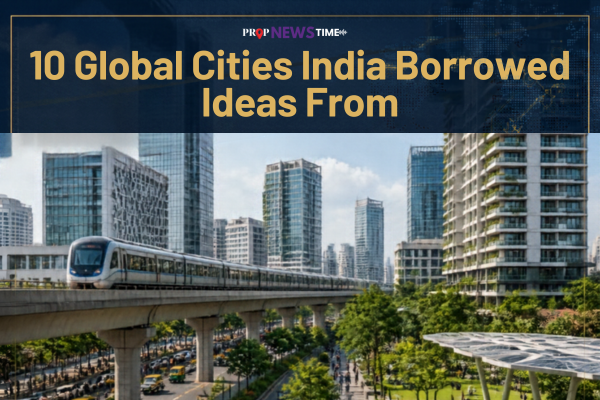
Ever wondered why some cities make public transport feel effortless, turn busy roads into lively public spaces or bring homes, offices and shops closer together. Many of these ideas emerged through decades of experimentation in cities around the world. Indian planners have studied these approaches, adapted some of them and collaborated directly with international partners on others.
The results range from Ahmedabad's bus rapid transit system to Chennai's pedestrian-friendly shopping streets and Andhra Pradesh's planned capital, Amaravati. Not every example is a direct copy; some are adaptations or lessons drawn from overseas experience. Together, they show how global ideas can shape India's urban future.
1. Singapore: Planning an entire city, not just individual buildings
Singapore's influence on Indian urban planning is especially visible in Amaravati, Andhra Pradesh's planned capital. In 2015, Singapore and Andhra Pradesh unveiled a master plan intended to guide the city's development, followed by a more detailed plan for its initial development area. The collaboration covered land use, infrastructure and the organisation of the new capital.
2. Curitiba: Making buses the backbone of urban growth
The Brazilian city of Curitiba became internationally recognised for integrating bus rapid transit (BRT) with land-use planning. Its dedicated bus corridors helped organise urban development around public transport rather than relying exclusively on private cars.
India adapted this broader approach through BRT systems, including Ahmedabad's Janmarg, launched in 2009. The Indian experience has varied between cities, demonstrating that dedicated bus lanes alone cannot guarantee success: service quality, station access, street design and operational management also matter.
3. Bogotá: Giving streets back to people
Colombia's capital, Bogotá, popularised large-scale open-street initiatives through its Ciclovía programme, which opens selected roads to cyclists, pedestrians and recreational activities at designated times.
The idea has travelled beyond Latin America. In India, initiatives such as Gurgaon’s Raahgiri Day and Mumbai’s Equal Streets drew on international open-street examples, including Bogotá's experience. These programmes demonstrate how road space can serve social and recreational purposes in addition to motorised transport.
4. Copenhagen: Designing streets for walking, not just driving
Copenhagen is widely studied for its pedestrian-friendly public spaces and efforts to make walking and cycling practical parts of daily life.
This approach informed discussions around Chennai's Pondy Bazaar pedestrian plaza, where planners sought to improve the experience of people visiting a busy shopping district. The project was developed with support from the Institute for Transportation and Development Policy (ITDP) and Chennai City Connect.
5. Barcelona: Turning commercial streets into people-friendly places
Barcelona's pedestrian-priority streets and public spaces offer another lesson in rethinking how urban areas allocate space. Its superblocks approach reorganises selected groups of streets to reduce through-traffic and give more room to pedestrians, cycling, greenery and neighbourhood activities.
Chennai's Pondy Bazaar redevelopment drew inspiration from Barcelona, alongside Copenhagen and Singapore. The project demonstrates how international approaches to public space can inform Indian shopping districts, even when the final design must accommodate local traffic, vendors and commercial activity.
6. Hong Kong: Connecting transport investment with property development
Hong Kong is an important international example of transit-oriented development (TOD), in which housing, offices, retail and other activities are concentrated around public transport.
Its railway-linked property development model is frequently studied for how transport infrastructure and real estate development can support one another. Indian planning research has examined such international approaches while exploring ways to coordinate land use, metro networks and development around stations.
7. New York: Giving old infrastructure a new purpose
New York's High Line transformed a disused elevated railway into a public park, demonstrating how redundant infrastructure can become a destination rather than a demolition problem.
In January 2026, a proposal to redevelop Delhi's defunct Rajghat thermal power plant drew inspiration from the High Line and other international industrial-reuse projects. Separately, Chandigarh's proposed Sky Garden concept has also referenced the High Line as an international example of elevated public space. These are proposals, not evidence that the projects have already been completed.
8. London: Reimagining former industrial sites
London's Battersea Power Station redevelopment illustrates how a former industrial landmark can be repurposed as a mixed-use destination with retail, leisure, offices and public spaces.
Delhi's proposed Rajghat power plant redevelopment also looked to Battersea as an international reference. The idea is particularly relevant to Indian cities with obsolete industrial facilities or underused public land, although successful reuse depends on site conditions, environmental remediation, access and viable long-term management.
9. Essen: Preserving industrial heritage while creating new destinations
Germany's Zollverein Coal Mine Industrial Complex, a former coal-mining and industrial site, has been transformed into a cultural and visitor destination. It demonstrates how industrial heritage can retain its identity while supporting new activities.
The Zollverein model was among the international examples studied for the proposed redevelopment of Delhi's Rajghat power plant. For Indian cities, this approach raises an important question: must obsolete industrial sites be cleared completely, or can parts of their structures and history become assets for future generations.
10. Toronto: Making historic districts part of a modern urban economy
Toronto's Distillery District demonstrates how historic industrial buildings can be repurposed for cultural activities, retail, hospitality and public gatherings. Like the High Line, Battersea Power Station and Zollverein, the Distillery District was cited among the international precedents considered for Delhi's Rajghat redevelopment proposal. Its relevance lies in combining heritage preservation with new uses that attract visitors and support local businesses. India's urban development story is increasingly shaped by the exchange of ideas across borders. Singapore offers lessons in coordinated master planning, Curitiba and Bogotá demonstrate alternatives to car-dependent mobility, and Copenhagen and Barcelona show how public spaces can prioritise people. Hong Kong provides insights into transit-linked development, while New York, London, Essen and Toronto offer examples of adaptive reuse.
Yet importing a successful idea is only the beginning. Indian cities have different population densities, climate conditions, funding constraints, governance structures and informal economies. An approach that succeeds abroad must be adapted to local realities rather than copied wholesale.
Sources: Centre for Liveable Cities Singapore, Singapore Ministry of Trade and Industry, World Bank, Institute for Transportation and Development Policy (ITDP), WRI India, C40 Cities, Asian Development Bank, NITI Aayog, The Indian Express, The Tribune, Lee Kuan Yew World City Prize Secretariat

17th Nov, 2026

17th Nov, 2026


17th Nov, 2026




17th Nov, 2026


17th Nov, 2026
Advertisement








 Facebook
 Whatsapp

