Advertisement






The Gulf conflict has disrupted global supply chains, pushed...
REITs have changed the way commercial real estate is owned a...
What really powers the cloud? Behind every Google search, A...
What really powers the cloud? Behind every Google search, A...
Luxury real estate is one of the most talked-about segments ...
Converting brownfield industrial land into residential estates offers developers an opportunity to acquire large urban land parcels in well-located areas. However, the transition involves environmental, structural, engineering and regulatory challenges. Soil and groundwater contamination may require extensive remediation, while buried foundations and underground infrastructure can complicate excavation. Industrial utility networks may be unsuitable for residential requirements, and zoning changes can involve prolonged legal and planning processes. In addition, mandatory buffer zones and inconsistent soil conditions can reduce saleable development potential and increase construction costs, affecting project feasibility and timelines.
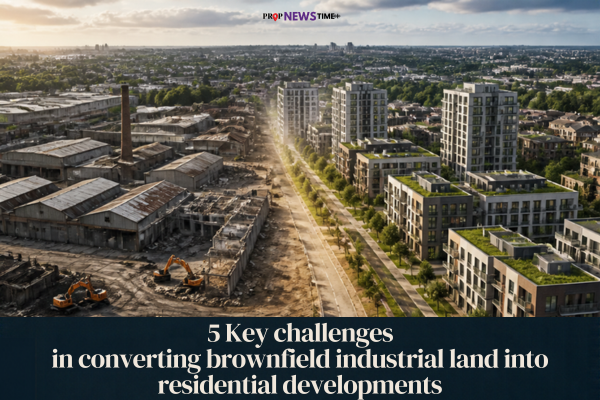
Brownfield industrial land presents a significant redevelopment opportunity because it can provide developers with access to large, well-located urban land banks. However, sites originally designed for manufacturing, heavy machinery, logistics or industrial operations cannot be converted into residential estates through redevelopment alone. Their existing environmental conditions, underground structures, utility networks, land-use classifications and soil profiles can create substantial technical and financial challenges. Developers must assess these factors before determining the feasibility of residential construction, as unforeseen complications can increase costs, delay execution and reduce the area available for development.
1. Soil and groundwater contamination
Industrial land may contain contamination resulting from decades of manufacturing, chemical processing or fuel storage. Potential contaminants include heavy metals, volatile organic compounds (VOCs), hydrocarbons and asbestos, making environmental assessment and remediation important stages in the conversion process. Developers may need to undertake Phase I and Phase II Environmental Site Assessments (ESAs) before determining the extent of contamination. Depending on the findings, remediation measures could include deep soil excavation, thermal desorption or bioremediation. Environmental compliance requirements for residential use are stricter than those for commercial or industrial use, and failure to remediate the site to the required human-habitation safety limits can expose developers to toxic liability, financing delays or a complete halt to the project.
2. Subsurface anomalies and legacy foundations
Industrial sites often contain underground structures and obstructions left behind by previous operations, including buried concrete slabs, machine pits, deep pile footings, abandoned underground storage tanks and unmapped utility vaults. These structures complicate excavation because conventional residential mass-excavation equipment may not be sufficient to remove reinforced industrial-grade beams and heavy equipment pads. Developers may require specialised hydraulic breakers and ground-penetrating radar (GPR) surveys to identify and address these obstructions. Unmapped structures discovered during excavation can increase costs and delay site clearance, while their presence may also affect foundation planning for new residential towers and require specialised deep-piling designs.
3. Utility grid mismatches and capacity inversion
Industrial sites are generally designed to support operational requirements such as high-voltage electricity, high-pressure gas and bulk industrial water intake, but these systems may not be compatible with residential infrastructure needs. Residential estates require individual domestic water meters, low-voltage residential transformers, decentralised sewage networks and fibre-optic internet connections. Where these systems are absent, developers may have to redesign on-site and off-site utility infrastructure, coordinate with municipal utility providers to decommission high-voltage infrastructure and install new residential trunk lines. This re-engineering introduces additional planning, coordination and expenditure before the site can support residential occupation, making utility infrastructure a key consideration in assessing redevelopment feasibility.
4. Zoning conversion and municipal buffer mandates
Industrial land may be covered by heavy industrial or commercial land-use designations under the applicable master plan, making conversion to residential use a potentially prolonged political and legal process. Even where municipal authorities support a change in land use, planning codes may require environmental buffer zones between active industrial units and new residential areas, with setbacks ranging from 50 to more than 200 metres. These requirements can substantially reduce the net buildable area and saleable floor space index (FSI) or floor area ratio (FAR), compressing project margins and affecting development feasibility. Developers may also need to incorporate acoustic and visual barriers along property boundaries, adding further design considerations to the conversion process.
5. Incompatible soil load-bearing profiles
Industrial sites may have uneven soil compaction due to concentrated heavy loads, chemical softening or extensive cut-and-fill operations carried out over several decades. Consequently, soil conditions can vary across a single property, and land beneath an old warehouse or assembly line may carry differential settlement risks that make it unsuitable for uniform residential slab foundations or multi-storey apartment buildings without further engineering intervention. Structural engineers may need to undertake soil stabilisation, deep dynamic compaction or install continuous flight auger (CFA) piles, significantly increasing early-stage civil engineering expenditure. Assessing the soil profile alongside contamination, underground obstructions and utility requirements is therefore essential when determining whether an industrial site can support residential construction.
Converting brownfield industrial land into residential estates requires developers to address environmental, structural, infrastructure and regulatory constraints before construction begins. Contamination can necessitate extensive remediation, legacy foundations can complicate excavation, and industrial utility systems may require substantial redesign. Zoning restrictions, mandatory buffer zones and inconsistent soil conditions can further reduce the buildable area and increase costs. Understanding these challenges is essential to assessing project feasibility, estimating expenditure and managing redevelopment timelines.
Sources: NYS DEC, RICS, BE3 & Geosyntec, EPA

17th Nov, 2026

17th Nov, 2026


17th Nov, 2026




17th Nov, 2026


17th Nov, 2026
Advertisement








 Facebook
 Whatsapp

