Advertisement






The Gulf conflict has disrupted global supply chains, pushed...
REITs have changed the way commercial real estate is owned a...
What really powers the cloud? Behind every Google search, A...
What really powers the cloud? Behind every Google search, A...
Luxury real estate is one of the most talked-about segments ...
A study by scientists from the India Meteorological Department (IMD) and the Indian Institute of Tropical Meteorology, Pune, has found that the hot semi-arid climate zone in peninsular India shrank from about 30% of the region in 1951–1980 to 16% in 1991–2020. Published in IMD’s peer-reviewed journal MAUSAM, the research attributes the change largely to increased rainfall, with the tropical savannah zone expanding to cover approximately three-quarters of the peninsula. The findings contrast with north-western India, where the hot semi-arid zone expanded. Despite the long-term increase in rainfall across southern India, the region experienced a 24.3% rainfall deficit during this year’s El Niño-affected monsoon. Karnataka recorded a 30% shortfall, while Andhra Pradesh, Tamil Nadu and Telangana reported deficits ranging from 17% to 24%.
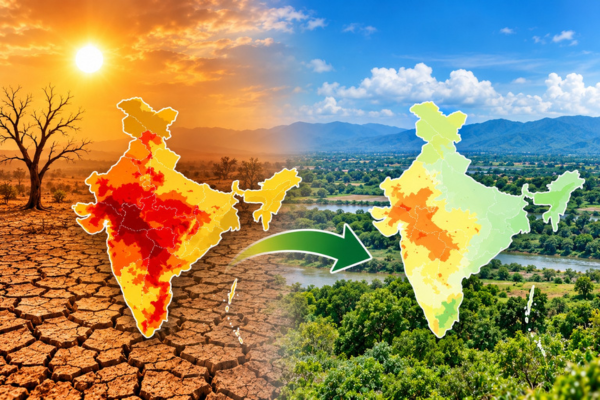
The hot semi-arid climate zone in peninsular India has contracted from approximately 30% of the region in 1951–1980 to 16% in 1991–2020, as rainfall increased over southern India, according to a study by scientists from the India Meteorological Department (IMD) and the Indian Institute of Tropical Meteorology, Pune, published in IMD’s peer-reviewed journal MAUSAM. The findings indicate a long-term shift towards wetter climatic conditions in the peninsula, even as the region faced substantial rainfall deficits during this year’s El Niño-affected monsoon.
The researchers redrew India’s climate map across successive 30-year periods, using observations recorded by IMD from 1951–1980 to 1991–2020. Climate zones are classified according to temperature and rainfall patterns. The hot semi-arid zone is characterised by high temperatures and relatively low rainfall, while the tropical savannah zone experiences warm conditions throughout the year, a prolonged dry season and higher rainfall.
As the semi-arid zone contracted, the tropical savannah zone expanded to cover approximately three-quarters of peninsular India, compared with around three-fifths previously. The study found that most of this transition occurred during the two most recent assessment periods, 1981–2010 and 1991–2020.
The trend in the peninsula differs from that in north-western India, where the hot semi-arid zone expanded over the same period. The study also found that daytime and night-time temperatures increased across the country, while rainfall patterns diverged geographically, rising over southern India and declining across the northern plains. Along the western coast, the tropical monsoon zone, which receives the country’s highest rainfall, extended across coastal Karnataka and Kerala.
However, the long-term shift towards wetter conditions has not prevented seasonal drought. During this year’s monsoon, southern India recorded a rainfall deficit of 24.3%, with Karnataka reporting a shortfall of 30%. Andhra Pradesh, Tamil Nadu and Telangana recorded deficits ranging from 17% to 24%. Karnataka has declared drought in 177 of its 240 taluks, while the Centre has declared drought in parts of Andhra Pradesh and Telangana.
Ananya Karmakar of IMD Pune, the study’s lead author, said the peninsula had experienced the country’s most substantial shift towards wetter climatic conditions, with the hot, dry zone shrinking by about half since the 1950s. She cautioned that the current rainfall deficit demonstrated that long-term climatic changes did not prevent drought during years when El Niño weakened the monsoon.
Mrutyunjay Mohapatra, director general of meteorology and a co-author of the study, said the findings needed to be considered alongside year-to-year rainfall variations. He noted that El Niño had weakened the monsoon this year, contributing to significant rainfall shortfalls and drought conditions in several southern states. IMD’s seasonal forecasts and advisories to farmers were intended to help them prepare for both longer-term climatic trends and seasonal fluctuations.
The study highlights the divergence between changes in long-term climate patterns and rainfall in individual monsoon seasons. While the peninsula has become wetter over seven decades, the latest rainfall deficits underline the continuing variability of seasonal precipitation.

17th Nov, 2026

17th Nov, 2026


17th Nov, 2026




17th Nov, 2026


17th Nov, 2026
Advertisement








 Facebook
 Whatsapp

