Advertisement






The Gulf conflict has disrupted global supply chains, pushed...
REITs have changed the way commercial real estate is owned a...
What really powers the cloud? Behind every Google search, A...
What really powers the cloud? Behind every Google search, A...
Luxury real estate is one of the most talked-about segments ...
The Cabinet's approval introduces a government-backed funding mechanism for large-scale energy storage projects, with participation from public and private sector entities. The initiative also places emphasis on domestic manufacturing through mandatory local content requirements for battery storage projects. Its implementation will involve competitive bidding and financial support for eligible projects, while encouraging investment in different storage technologies.
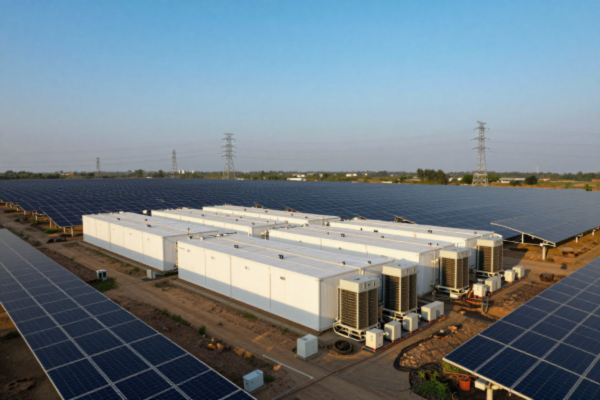
The Union Cabinet has approved a INR 14,500 crore Viability Gap Funding (VGF) scheme to develop 92 GWh of grid-scale energy storage capacity across India over five years, up to the financial year 2030-31. The scheme is aimed at supporting renewable energy integration, improving grid stability and ensuring a reliable power supply. It will cover battery energy storage systems, pumped storage projects and emerging storage technologies, with an estimated total investment of INR 97,600 crore.
The approval was announced by Information and Broadcasting Minister Ashwini Vaishnaw after a Cabinet meeting chaired by Prime Minister Narendra Modi. The scheme will support 30 GWh of battery energy storage systems (BESS), 60 GWh of pumped storage projects and 2 GWh of capacity through emerging energy storage technologies.
The proposed 92 GWh capacity will comprise projects that are yet to be commissioned. Its development is expected to add capacity equivalent to around 170% of India's existing grid-scale energy storage capacity. The initiative will also contribute towards meeting the country's estimated requirement of 411 GWh of grid-scale energy storage capacity by 2031-32.
The scheme carries an estimated investment requirement of INR 97,600 crore, while the government will provide INR 14,500 crore in viability gap funding to support project development. The financial assistance is intended to improve project viability and encourage investment in large-scale storage infrastructure.
Energy storage capacity will be allocated through a tariff-based competitive bidding process. Public and private sector electricity distribution companies will be eligible to receive VGF support for battery energy storage and hydro pumped storage projects. Projects using alternative energy storage technologies can be implemented by both public and private sector entities.
The scheme also includes provisions to strengthen domestic manufacturing of battery storage systems. Battery energy storage projects will have to meet a minimum Domestic Content Requirement (DCR) of 40%, encouraging the use of locally manufactured components.
This requirement is intended to create opportunities for Indian manufacturers, support the domestic battery supply chain and complement existing government incentives for battery manufacturing. The government also aims to reduce dependence on imported components through demand-side financial support.
The expansion of grid-scale storage capacity is expected to help address fluctuations in renewable power generation, allowing electricity generated from renewable sources to be stored and used when required. This can reduce the need to depend on conventional power generation to balance supply and demand and maintain round-the-clock electricity availability.
The government said the initiative would support India's power infrastructure, improve the utilisation of renewable energy and strengthen long-term energy security. It is also aligned with the objectives of Atmanirbhar Bharat and Viksit Bharat.
The implementation of the scheme will depend on project selection, financing and the participation of developers and electricity distribution companies. The 40% domestic content requirement will also be important for Indian battery manufacturers and component suppliers seeking to participate in the expanding energy storage market. As projects move towards bidding and commissioning, the pace of execution and availability of locally manufactured components will be important factors in determining how effectively the planned capacity is developed.
Source PTI

17th Nov, 2026

17th Nov, 2026


17th Nov, 2026




17th Nov, 2026


17th Nov, 2026
Advertisement








 Facebook
 Whatsapp

