Advertisement






The Gulf conflict has disrupted global supply chains, pushed...
REITs have changed the way commercial real estate is owned a...
What really powers the cloud? Behind every Google search, A...
What really powers the cloud? Behind every Google search, A...
Luxury real estate is one of the most talked-about segments ...
CREDAI-MCHI held its 44th Annual General Meeting at the Jio World Convention Centre in Mumbai, bringing together real estate industry leaders to discuss the Mumbai Metropolitan Region’s growth prospects, infrastructure development, housing demand and policy priorities. The event featured a CREDAI-MCHI Red Talk with Motilal Oswal, Co-Founder, Managing Director and CEO of Motilal Oswal Financial Services. The association also highlighted key initiatives from the past year, including industry-wide coordination on policy reforms, changes to fitness centre norms, a deferment policy for Development Cess payments and financial support for students and community welfare.
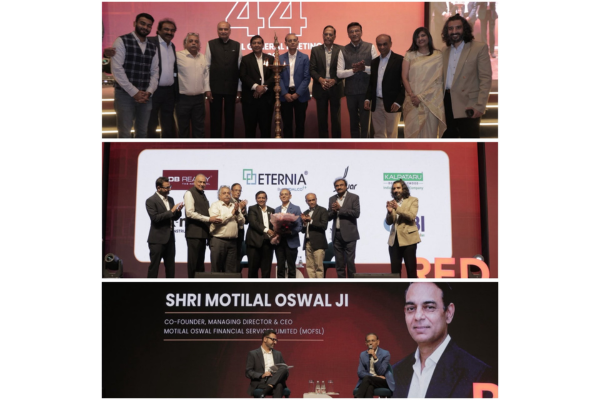
CREDAI-MCHI, the apex body representing real estate developers across the Mumbai Metropolitan Region (MMR), held its 44th Annual General Meeting at the Jio World Convention Centre in Mumbai on Thursday. The meeting brought together senior industry leaders and association members to discuss the region’s real estate outlook, changing economic conditions and the sector’s role in Mumbai’s development.
The event included the formal proceedings of the AGM and a CREDAI-MCHI Red Talk featuring Motilal Oswal, Co-Founder, Managing Director and CEO of Motilal Oswal Financial Services Limited. Discussions covered the region’s growth, infrastructure expansion, changing housing demand and the economic and policy factors influencing the property market.
Motilal Oswal said sustainable business growth depends on strong values, trust, long-term vision and the ability to adapt to new technologies. He emphasised the importance of building teams that take responsibility and continue learning. He added that the MMR’s long-term development would depend on planning, strong institutions and the ability to respond to changing needs, while creating lasting value for future generations.
CREDAI-MCHI President Sukhraj Nahar said expanding infrastructure, better connectivity and rising economic activity were supporting the next phase of growth in Mumbai and the MMR. He identified housing provision and the development of well-planned urban communities as important responsibilities for the real estate sector. He also highlighted the need to improve ease of doing business, speed up approvals, prepare the industry for AI-led processes and emerging regulatory requirements, and maintain coordination with policymakers. He said homebuyers must remain central to reforms, alongside the long-term interests of Mumbai, Maharashtra and its residents.
CREDAI-MCHI Secretary Rushi Mehta said the outlook for the coming year remained positive, supported by the region’s underlying economic strength and long-term housing demand. He noted that festive-season sales had reflected continued homebuyer confidence, but said the industry needed to look beyond seasonal demand. With infrastructure projects progressing and new growth corridors emerging, developers would need to respond to changing buyer preferences while supporting a more integrated and sustainable MMR.
CREDAI-MCHI Senior Vice President Jitendra Mehta said the property market remained closely linked to Mumbai’s wider economic performance. Infrastructure-led development, improving connectivity and consumer confidence had supported housing demand, while policy changes and financing conditions continued to influence the market. He stressed the importance of ensuring that housing supply kept pace with the needs of a growing metropolitan region across different price segments and locations.
The association also reviewed its work over the past year to represent developers, address members’ concerns and pursue policy changes. One of its key initiatives was the Real Estate Leaders’ Convergence, which brought together NAREDCO, BDA, PEATA and CREDAI-MCHI for the first time. The meeting led to the formation of a Joint Task Force to advance a common reform agenda and a proposal for a Chief Minister’s Committee to address industry concerns.
Among the policy outcomes highlighted by the association was an increase in the permissible area for fitness centres under Brihanmumbai Municipal Corporation (BMC) norms from 2% to 4%. CREDAI-MCHI also cited a deferment policy for Development Cess payments with the Maharashtra Housing and Area Development Authority (MHADA) and a four-month extension granted by the Maharashtra Real Estate Regulatory Authority (MahaRERA). The association also intervened in a Supreme Court matter concerning Environmental Clearance in violation cases.
Alongside its policy and industry initiatives, CREDAI-MCHI contributed INR 3.65 crore to the Chief Minister’s Relief Fund and awarded scholarships worth INR 43.74 lakh to 97 students. These efforts formed part of its work on industry representation, institutional development and community welfare. The AGM concluded with a networking session and dinner attended by association members and real estate industry leaders.
CREDAI-MCHI represents more than 2,200 developers across the MMR, with local units covering Thane, Kalyan-Dombivli, Mira-Virar, Raigad, Navi Mumbai, Palghar-Boisar, Bhiwandi, Uran-Dronagiri, Shahapur-Murbad, Alibaug, Karjat-Khalapur-Khopoli and Pen. It is a government-recognised body for private-sector developers in the region and works with government and urban stakeholders on policy reform, housing innovation and sustainable development. As part of CREDAI National, which represents 13,000 developers across India, the association also provides a platform for regional discussions on housing and urban development.
As Mumbai and the surrounding metropolitan region expand, coordination between developers, government agencies and urban authorities will remain important in addressing housing requirements and improving the ease of project execution. Faster approvals, clearer regulatory processes and infrastructure-led development can influence how effectively housing supply responds to demand across different locations and price segments. CREDAI-MCHI’s focus on policy coordination and homebuyer interests places these issues at the centre of its agenda. The challenge will be to translate industry-level discussions and proposed reforms into practical changes that support more accessible and well-planned urban development.

17th Nov, 2026

17th Nov, 2026


17th Nov, 2026




17th Nov, 2026


17th Nov, 2026
Advertisement








 Facebook
 Whatsapp

