Advertisement






The Gulf conflict has disrupted global supply chains, pushed...
REITs have changed the way commercial real estate is owned a...
What really powers the cloud? Behind every Google search, A...
What really powers the cloud? Behind every Google search, A...
Luxury real estate is one of the most talked-about segments ...
The Confederation of Indian Industry (CII) GreenCo Council launched the CII GreenCo Circularity Guidelines – Pilot Version at the 17th CII GreenCo Waste & Resource Management Summit 2026 in Chennai on October 9. The framework introduces indices to assess circularity across industrial resource inputs, including raw materials, consumables and packaging. It aims to help manufacturing and process industries evaluate existing resource-use practices, identify opportunities to improve productivity and measure progress towards circular material use. The initiative also proposes a structured approach to benchmarking, accountability and continuous improvement through a potential certification pathway. The summit brought together industry leaders, policymakers, technology experts and sustainability practitioners to discuss resource efficiency, waste recovery, advanced recycling, renewable energy from waste and digital technologies. CII GreenCo has invited manufacturing and process industries to participate in the pilot, test the framework and provide feedback before its wider adoption.
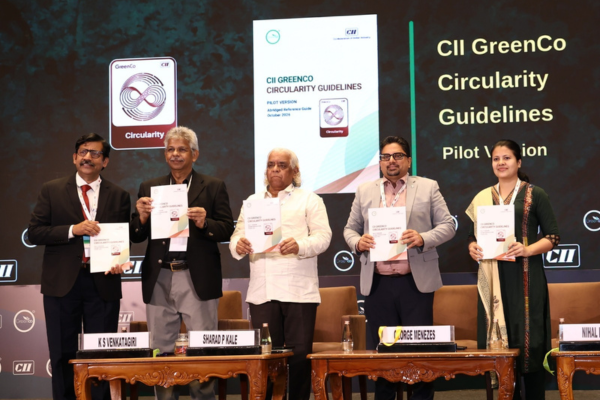
The Confederation of Indian Industry (CII) GreenCo Council launched its CII GreenCo Circularity Guidelines – Pilot Version on October 9 at the 17th CII GreenCo Waste & Resource Management Summit 2026 in Chennai, aiming to help manufacturing and process industries assess resource use, reduce waste and improve circularity through a structured framework. Held under the theme ‘Accelerating Circular Economy through Resource Efficiency & Innovation’, the summit brought together industry representatives, policymakers and sustainability experts to discuss approaches to improving resource efficiency across Indian industry.
The guidelines introduce indices to assess circularity across key resource inputs, including raw materials, consumables and packaging, alongside other relevant areas. The framework is intended to enable companies to evaluate their existing practices, identify opportunities to improve resource productivity and monitor progress towards more circular material use.
A structured assessment framework and credible certification pathway could also establish measurable benchmarks for industrial performance, strengthen accountability and encourage continuous improvement. The pilot version will allow the framework to be tested in operational settings, with feedback from participating companies helping refine its applicability to different industrial processes and resource requirements.
Padma Shri Dr Sharad P. Kale, special adviser to the Chief Minister of Goa and a former scientist at the Bhabha Atomic Research Centre (BARC), said circularity required a fundamental change in how resources were viewed and managed. He emphasised that technology and policy needed to be complemented by individual responsibility, source-level waste reduction, responsible consumption and resource conservation. He added that these principles needed to become integral to everyday practices and industrial operations.
George Menezes, adviser – sustainability at Godrej Enterprises Group, said the guidelines could provide manufacturing and process industries with a common basis for assessing existing practices, identifying areas for improvement and measuring progress. He also highlighted the role of a defined certification mechanism in promoting consistency, accountability and continuous improvement, urging companies to participate in the pilot and submit feedback.
K. S. Venkatagiri, executive director of CII Green Business Centre, said the initiative built on CII GreenCo's earlier environmental sustainability programmes, including the GreenCo Rating System, Zero Waste to Landfill and Zero Liquid Discharge certifications. He invited manufacturing and process industries to test the circularity framework and contribute to its further development.
The summit also examined ways to recover value from waste and strengthen India's circular manufacturing ecosystem. Discussions covered resource recovery, industrial symbiosis, circular product and process design, and collaboration across the value chain.
Technical sessions addressed mechanical, chemical, biological and thermal recycling technologies, alongside opportunities in biogas, Bio-CNG and compressed biogas (CBG), waste-to-energy, electronic waste recycling, and electronics and battery circularity. Another session explored the use of digitalisation, artificial intelligence, smart sensors, automation and digital traceability to improve waste collection, segregation, recycling and resource recovery.
The guidelines address resource-management challenges in industries that consume substantial quantities of raw materials, water and energy while generating multiple waste streams. CII GreenCo has invited manufacturing and process companies to engage with the council, trial the framework in their operations and share feedback to help ensure that the final guidelines are practical, measurable and suitable for wider industry adoption.

17th Nov, 2026

17th Nov, 2026


17th Nov, 2026




17th Nov, 2026


17th Nov, 2026
Advertisement








 Facebook
 Whatsapp

