Advertisement






The Gulf conflict has disrupted global supply chains, pushed...
REITs have changed the way commercial real estate is owned a...
What really powers the cloud? Behind every Google search, A...
What really powers the cloud? Behind every Google search, A...
Luxury real estate is one of the most talked-about segments ...
From Victorian London to present-day Indore, cities keep arriving at the same answer when their roads run out of room. Here are eight reasons a metro is less a choice and more a stage of growing up. On 10 January 1863, Londoners queued up to ride a smoky, gas-lit train running beneath their own streets. The idea had been mocked in the music halls and nicknamed "the Drain". It still carried more than nine million passengers in its first year. London built it for one plain reason: horse-drawn traffic was choking the city and hurting business.
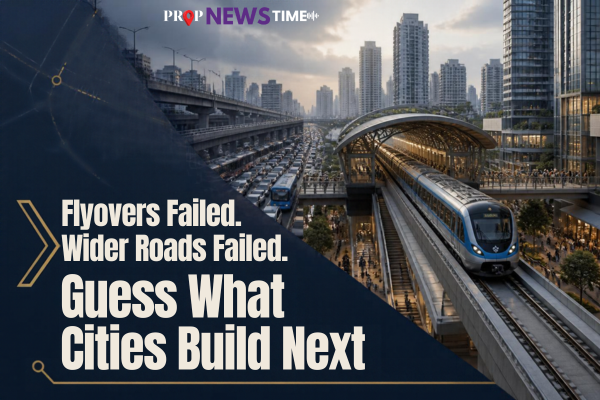
More than 160 years later, the story repeats itself with remarkable loyalty. In 2014, India ran metro trains on about 248 km of track in five cities. By September 2026 the network had reached 1,170 km across 26 cities, the third largest in the world, with roughly 1,000 km more under construction. Different centuries, different continents, same conclusion. So what is it about a growing city that makes a metro almost inevitable?
1. The Road Runs Out of Maths
Every city begins by believing its traffic is a management problem. Then someone does the sums. A single highway lane, flowing at its theoretical best, moves about 2,200 cars an hour. Put two people in every car, which is generous, and you get 4,400 passengers. Transport researchers who studied developing cities found that rail may be the only way to carry more than 30,000 passengers an hour in one direction. Somewhere between those two numbers, a city stops having a traffic problem and starts having a geometry problem.
2. Time Becomes the Costliest Thing in Town
Ask a Bengaluru commuter what they would pay for an extra week every year and you will get a quick answer. In 2025 the average driver there lost about 168 hours to rush-hour traffic, which is seven full days spent looking at brake lights. Pune lost 152 hours, Mumbai 126 and New Delhi 104. A city can live with slow roads when it is small and distances are short. Once it becomes an economic engine, every lost hour is a meeting missed, a delivery delayed and a parent home late.
3. You Cannot Widen Your Way Out
The instinct of every growing city is to add a lane. The trouble is that in a dense city the land beside the road is somebody's home, shop or office. Victorian London reached this wall first, when it was the largest city in the world and its streets had nowhere left to spread, so it sent the railway underground instead. The logic has not aged. Planners in Washington once worked out that simply lengthening metro trains to eight coaches would add as much capacity as widening the neighbouring highway by two lanes, and at less than half the cost per rush-hour trip.
4. Land Starts Following the Line
Watch what happens to a neighbourhood when a station is announced. During construction, life is miserable. Barricades go up, roads narrow, and a study of commercial property along Delhi's Blue Line found that prices near station sites actually dipped in those years. Then the trains start running and the mood flips. The same Delhi study found a clear price premium within roughly half a kilometre of stations once the line opened. In Mumbai, economists tracking 723 pockets of the city found that prices within a kilometre of Metro Line 1 rose 5 to 6 per cent more than in areas just a little further away.
5. The Station Invents the Suburb
Here is a detail from history that every homebuyer should know. The company that built the world's first metro soon realised that trains alone were only half the business. The Metropolitan Railway owned land along its route, so it developed that land into housing and sold a dream of leafy living with an easy commute into London. It even gave the dream a brand name, Metro-land. The homes created the passengers, and the passengers justified the line.
6. The Family Budget Breathes Easier
The most surprising case for the metro comes from inside the household account book. A January 2026 working paper from the Economic Advisory Council to the Prime Minister looked at families living in metro-served areas and found something unexpected. In Delhi, missed mortgage payments fell by 4.42 per cent. In Bengaluru, early home loan repayments rose by 3.5 per cent. The reasoning is simple once you hear it. A household that no longer pays for fuel, parking and the upkeep of a second vehicle has more money left at the end of the month, and a good part of it goes towards the EMI.
7. The Air Makes Its Own Argument
On 18 November 2024, Delhi woke up under a grey haze with the air quality index at 488, deep in the "severe plus" zone. That same day the Delhi Metro recorded its highest ever ridership, with 78.67 lakh passenger journeys. People voted with their feet. A study by The Energy and Resources Institute estimates that the network kept about 5.16 lakh vehicles off Delhi's roads every day in 2021, a figure expected to cross 10 lakh by 2031.
8. The Bill Is Brutal and Cities Pay It Anyway
None of this comes cheap, and honest planners say so. The same researchers who praised rail's capacity also warned that a city should try every other option first, because the capital cost of a metro is extremely high. Critics have argued that several Indian systems carry fewer passengers than their original projections, a charge the Delhi Metro has disputed with its own figure of roughly 67 lakh weekday journeys. India's Metro Rail Policy of 2017 now asks cities to prepare a comprehensive mobility plan before they build.
A metro is rarely a city's first idea. It is usually the last one standing after wider roads, more flyovers and more buses have each bought a few years and then run out of room. That is why the story reads the same in London in 1863 and in Indore in 2026. Growth packs more people into the same land, and sooner or later the only space left is above the street or beneath it. For anyone choosing where to live or invest, the lesson is practical. Watch where the next line is going, because the city has already decided that is where its future will travel.
Sources: PIB, PTI, PNT, Ted ed

17th Nov, 2026

17th Nov, 2026


17th Nov, 2026




17th Nov, 2026


17th Nov, 2026
Advertisement








 Facebook
 Whatsapp

