Advertisement






The Gulf conflict has disrupted global supply chains, pushed...
REITs have changed the way commercial real estate is owned a...
What really powers the cloud? Behind every Google search, A...
What really powers the cloud? Behind every Google search, A...
Luxury real estate is one of the most talked-about segments ...
Buildings and construction use about a third of the world's energy and produce a third of its carbon emissions. A net zero building answers that by generating as much clean energy as it consumes over a year. This piece explains how that balance works, why smart design matters more than solar panels, and how India's first net zero building has done it in Delhi since 2014. It also looks at the coming surge in air conditioning demand, the hidden carbon in cement and steel, the case for retrofitting old buildings, and the rent premiums of up to 24 per cent that green offices now command. It closes with an honest look at how far India still has to go before its 2070 net zero target.
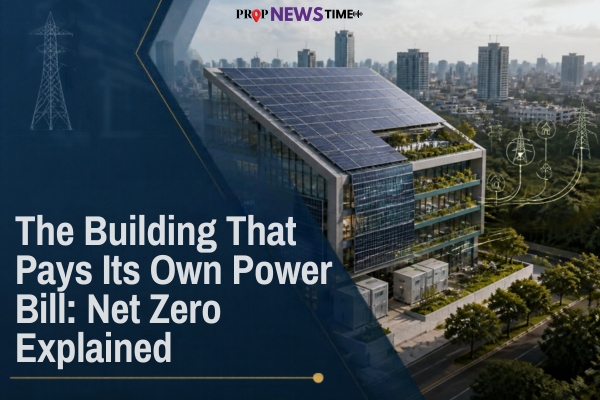
We usually blame cars, factories and power plants for the climate crisis. The quieter culprit is the one we are sitting inside. According to the United Nations, buildings and construction consume 32 per cent of the world's energy and produce 34 per cent of its carbon dioxide emissions. Every lift ride, every air conditioner and every bag of cement adds to the bill.
Now imagine a building that hands that bill back. It makes its own power, wastes very little of it and ends the year owing the planet nothing. That is the promise of a net zero building, and it is no longer a concept sketch. India built its first one in 2014 and has been collecting them ever since. Here is what the term really means and why it matters to anyone who buys, rents or builds.
1. Zero Is a Balance, Not a Blackout
The first myth to clear up is that a net zero building lives off the grid like a cabin in the hills. It does not. Think of it as a bank account for energy. On a bright afternoon the rooftop panels produce more power than the building needs, and the surplus flows out to the grid. At night, or on a cloudy day, the building draws some back. When the year ends and the two columns are added up, the total comes to zero. The lights never flicker and nobody sits in the dark. The building simply gives back as much clean energy as it takes.
2. India Wrote Its First Chapter in 2014
If you want to see the idea in concrete and glass, visit Jor Bagh in New Delhi. Indira Paryavaran Bhawan, home of the environment ministry, opened in 2014 as India's first net zero energy building. Its two blocks face north and south to dodge the harshest sun, a central courtyard pulls breeze through the complex, and three quarters of its floor space is lit by daylight. Above it all sits a 930 kW solar plant. The result is a government office that uses about 70 per cent less energy than a conventional one and generates the rest itself. Not bad for a building full of files.
3. Design Comes First, Solar Comes Last
Here is the part most people get backwards. A net zero building is not an ordinary building with solar panels bolted on top. If the structure leaks cool air and bakes in the afternoon sun, no rooftop is large enough to feed it. So the architect begins by shrinking the appetite. The building is turned to face the right direction. Windows are shaded, walls are insulated, daylight replaces tube lights and efficient cooling replaces power-hungry chillers. Only when demand has been cut to a fraction do the panels arrive to cover what remains.
4. The Air Conditioner Is the Real Opponent
Ask anyone who has lived through an Indian May and they will tell you where the electricity goes. The International Energy Agency expects India's household air conditioners to need nine times more power by 2050 than they do today. That single appliance would then consume more electricity than the whole of Africa uses now. Ownership has already tripled since 2010, to about 24 units for every 100 homes, and most families have not bought their first one yet. This is why net zero matters more here than almost anywhere else.
5. Some of the Carbon Is Hiding in the Walls
Even a building that runs on sunshine has a past. Before the first resident moved in, cement was fired in kilns, steel was forged and glass was melted, and each of those steps released carbon that no solar panel will ever take back. Experts call this embodied carbon. Cement alone is responsible for roughly 7 per cent of global carbon emissions. As buildings become more efficient to run, this hidden share grows, and in a well-designed modern building it can account for half or more of lifetime emissions.
6. Old Buildings Can Join the Club
Net zero is not reserved for shiny new towers. In Mumbai's Vikhroli, an existing building on the Godrej and Boyce campus, the Plant 13 Annexe, became the first in India to earn the Indian Green Building Council's Net Zero Energy rating. It got there through years of efficiency upgrades and a mix of on-site and off-site renewable power. The lesson is a hopeful one, because the greenest building is often the one already standing. Researchers estimate that demolishing and rebuilding produces more than double the embodied carbon of even a deep retrofit.
7. Green Has Started Paying Rent
For years sustainability was sold as the right thing to do. Now it is also the profitable thing. Colliers found that green-certified Grade A offices in India ran at 80 to 90 per cent occupancy in 2024, against 65 to 85 per cent for the rest. They also earned higher rents, with a premium of 24 per cent in Mumbai, 16 per cent in Chennai and 14 per cent in Hyderabad. A separate academic study of more than 17,000 office rental contracts found the same pattern. Global companies have their own climate targets to meet, and they would rather not explain a power-guzzling headquarters to their shareholders.
8. The Finish Line Is Still Far Away
It would be easy to end on applause, so here is the honest scoreboard. India has more than 15.5 billion sq ft of registered green building footprint, one of the largest in the world. More than 350 organisations have pledged to take their buildings to net zero. Yet buildings that are actually certified net zero remain a small and exclusive group, and a green certificate is not the same thing as a zero on the meter. Globally, the UN notes that half of all new buildings still go up without any energy code at all. India has promised to be a net zero nation by 2070. Much of that promise will be kept or broken one building at a time.
A generation ago, nobody asked a builder about power backup, parking ratios or clubhouse size. Today those questions are routine. The energy performance of a home is heading the same way. As summers get hotter and tariffs climb, a building that produces its own power and needs very little of it will stop being a talking point and start being the standard. The technology already exists, the first examples are already standing and the market has begun to pay for them. The next time you walk through a sample flat, look past the marble and ask a simpler question: what will this building cost the planet, and me, to run?
Sources :UNEP, Outlook Planet, Global ABC, NBM & CW

17th Nov, 2026

17th Nov, 2026


17th Nov, 2026




17th Nov, 2026


17th Nov, 2026
Advertisement








 Facebook
 Whatsapp

