Advertisement






The Gulf conflict has disrupted global supply chains, pushed...
REITs have changed the way commercial real estate is owned a...
What really powers the cloud? Behind every Google search, A...
What really powers the cloud? Behind every Google search, A...
Luxury real estate is one of the most talked-about segments ...
India’s logistics and industrial real estate sector has undergone a structural transition from fragmented, unorganised warehousing towards institutional-grade logistics parks and technology-enabled industrial assets. The shift has been supported by policy initiatives such as PM Gati Shakti and the National Logistics Policy, alongside the expansion of dedicated freight corridors, expressways and multimodal logistics infrastructure. As manufacturing, e-commerce, third-party logistics and quick-commerce networks expand across major metros and emerging consumption centres, strategically located warehouses and fulfilment facilities are increasingly being treated as investible real estate assets rather than simply storage infrastructure.
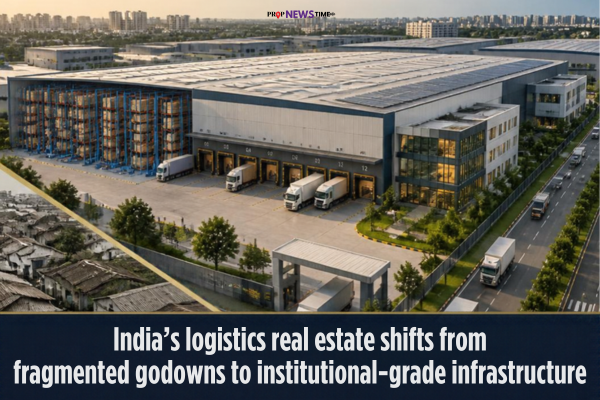
India’s logistics and industrial real estate sector is moving from fragmented warehousing towards institutional-grade assets designed around modern supply chains. Policy initiatives such as PM Gati Shakti and the National Logistics Policy, combined with dedicated freight corridors, expressways and multimodal infrastructure, are reshaping where warehouses and industrial facilities are developed. At the same time, demand from e-commerce, third-party logistics, quick commerce and organised manufacturing is driving greater adoption of Grade-A warehouses, automation and specialised facilities, making logistics infrastructure an increasingly important segment of India’s real estate market.
Grade-A warehouses replace the traditional godown model
The most visible change has been the consolidation of warehousing into larger, professionally managed Grade-A facilities. Traditional godowns were typically characterised by smaller footprints, lower ceiling heights and limited loading or handling infrastructure. Modern logistics parks are designed around higher operational efficiency, with clear heights of around 12–14 metres, higher floor-load capacities, automated dock levelers, advanced fire suppression systems and larger vehicle circulation areas. These specifications allow operators to use warehouse volumes more efficiently while accommodating larger freight vehicles. The shift has also been reinforced by occupier requirements, particularly from third-party logistics providers and quick-commerce companies that need facilities capable of supporting tighter delivery timelines across Tier-1 and Tier-2 markets.
Freight corridors are changing location strategies
The development of dedicated freight and highway infrastructure is also influencing where industrial and logistics assets are being developed. The Western Dedicated Freight Corridor connects Dadri in Uttar Pradesh with Jawaharlal Nehru Port in Navi Mumbai, while the Eastern Dedicated Freight Corridor supports freight movement across northern and eastern India. These rail networks are designed to move heavy freight and double-stack containers, reducing dependence on conventional highway routes. At the same time, expressways and industrial corridors are improving access to peripheral land parcels. Projects such as the Delhi-Mumbai Expressway, Chennai-Bengaluru Industrial Corridor and Samruddhi Mahamarg are strengthening connectivity between manufacturing centres, consumption markets and ports.
Multimodal infrastructure is creating new logistics nodes
The integration of road, rail and port infrastructure is increasingly becoming central to logistics real estate planning. PM Gati Shakti provides a unified spatial framework for coordinating infrastructure development, while multimodal logistics parks are intended to bring different modes of freight movement together at strategic locations. This is changing the traditional relationship between warehouses and cities. Instead of locating facilities primarily on urban fringes to remain close to customers, developers can increasingly assess locations around highway intersections, freight corridors, inland logistics hubs and port-connected networks. Such locations can support the movement of goods between road, rail and maritime infrastructure, while also providing access to large regional consumption and manufacturing catchments.
Automation is reshaping warehouse operations
Technology is becoming another defining feature of modern fulfilment infrastructure. Large logistics facilities are increasingly designed around throughput rather than simply storage capacity. Automated Storage and Retrieval Systems can increase storage density through vertical utilisation, while autonomous mobile robots can support sorting and movement within fulfilment centres. Automated dock management and digital inventory systems can further improve handling efficiency. The requirements become more complex for specialised logistics segments. Cold-chain facilities, for instance, require multiple temperature-controlled zones for ambient, chilled and frozen products, supported by continuous monitoring and IoT-enabled temperature telemetry. Such infrastructure is particularly relevant for pharmaceutical, food and grocery supply chains where product quality depends on controlled storage and transportation conditions.
Infrastructure is strengthening the investment case
The combination of organised warehousing, transport infrastructure and technology is also changing the investment profile of industrial and logistics real estate. Grade-A facilities provide institutional investors with larger, professionally managed assets that can cater to established occupiers and structured logistics operations. Infrastructure improvements can expand the development potential of previously peripheral land parcels, while proximity to freight corridors and multimodal facilities can strengthen their relevance to regional supply chains. For developers, the focus is consequently shifting from constructing standalone warehouses towards creating integrated logistics ecosystems connected to highways, rail freight, ports and consumption centres.
Logistics real estate is becoming a strategic infrastructure asset
India’s logistics sector is therefore moving beyond the traditional warehouse-as-storage model towards a more integrated industrial real estate ecosystem. Policy-led infrastructure planning, dedicated freight networks, expressways, multimodal logistics parks and warehouse automation are collectively changing how goods move and where businesses locate their distribution infrastructure. For the real estate sector, this transition is creating demand for larger and more specialised assets while opening new development nodes outside established metropolitan markets. As supply chains become increasingly technology-driven and time-sensitive, logistics real estate is emerging as an important link between India’s manufacturing base, consumption markets and transport infrastructure.

17th Nov, 2026

17th Nov, 2026


17th Nov, 2026




17th Nov, 2026


17th Nov, 2026
Advertisement








 Facebook
 Whatsapp

