Advertisement






The Gulf conflict has disrupted global supply chains, pushed...
REITs have changed the way commercial real estate is owned a...
What really powers the cloud? Behind every Google search, A...
What really powers the cloud? Behind every Google search, A...
Luxury real estate is one of the most talked-about segments ...
Mass transit infrastructure can influence property prices, land use, rental demand and commercial activity across neighbourhoods. Improved connectivity often makes areas around metro and other mass transit stations more attractive to homebuyers, tenants, retailers and businesses. The impact varies with distance from stations, service frequency, last-mile connectivity, local planning rules and the availability of supporting infrastructure. Transit-oriented development policies can encourage higher-density construction and mixed-use projects, while station areas may attract convenience retail, offices and rental housing. However, benefits are not uniform: properties closest to stations can also face noise, congestion and higher pedestrian activity. Understanding these differences is important for developers, investors and urban planners assessing how transport projects may shape real estate markets.
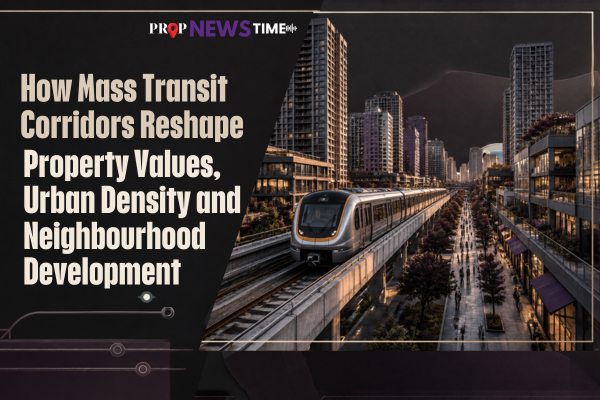
Mass transit infrastructure can reshape the property market around a station by improving accessibility, influencing land values and encouraging changes in how neighbourhoods are developed. Metro lines and other high-capacity transport systems can reduce dependence on private vehicles, connect residential areas with employment centres and attract businesses seeking access to commuter traffic. The extent of this transformation depends on the quality of the transport service, planning regulations, local demand and the availability of supporting amenities.
One of the most closely watched effects is the potential impact on property prices. Expectations of improved connectivity can influence buyer and investor sentiment when a project is announced, receives approval or secures funding. Once services begin, properties with convenient access to stations may become more attractive to commuters. However, price increases are not automatic, and their scale varies by market conditions, the credibility of project timelines, existing property values and the extent to which improved connectivity has already been factored into prices.
Transit-oriented development and higher density
Mass transit corridors can also influence development patterns through transit-oriented development (TOD) policies. Where local planning regulations permit, authorities may allow higher floor space index (FSI), also known as floor area ratio (FAR), around designated transport corridors. This can support more intensive land use and encourage residential, commercial and mixed-use projects close to stations.
In established urban areas, improved accessibility may make older low-rise buildings and underutilised plots more attractive for redevelopment. Developers may seek to replace low-density structures with apartment buildings, offices or mixed-use developments. Such changes depend on development permissions, land assembly, infrastructure capacity and the financial viability of redevelopment. Higher density can support public transport use, but it also requires adequate water supply, sewerage, open spaces and road access.
Commercial activity and retail demand
Station areas can become important locations for businesses that depend on pedestrian movement. Convenience stores, pharmacies, cafes, food outlets and other service-oriented retailers may benefit from regular commuter traffic. Office operators may also value proximity to stations because employees and visitors can reach workplaces more easily.
Commercial properties immediately surrounding station entrances may experience different demand patterns from residential properties farther away. Retail and office spaces can benefit from visibility and footfall, while homes located very close to stations may face noise, crowding and traffic. As a result, the most commercially valuable location is not necessarily the most desirable residential location.
Rental demand and changing tenant profiles
Better transit access can widen the pool of potential tenants, particularly among professionals, students and workers who depend on public transport. Homes within walking distance of a station may appeal to people seeking shorter or more predictable commutes. Where demand strengthens, landlords may experience faster tenant turnover between occupancies, reduced vacancy periods or opportunities to command higher rents. These outcomes, however, depend on the availability of competing housing, rental affordability and the quality of the surrounding neighbourhood.
Why distance from a station matters
The influence of a station often varies across its surrounding catchment. Properties immediately adjacent to entrances may be suited to retail and offices but can face higher noise and pedestrian activity. Residential developments a few hundred metres away may offer a balance between convenient access and a quieter living environment. Farther away, the benefits depend increasingly on walkability, feeder buses, cycling routes and other last-mile connections.
For developers and investors, proximity alone is therefore an incomplete measure of a property's potential. Local planning rules, station access, service frequency, neighbourhood amenities and environmental conditions should also be assessed. For urban authorities, the challenge is to capture the accessibility benefits of mass transit while ensuring that higher density is supported by adequate civic infrastructure and that neighbourhoods remain safe, accessible and liveable.
Sources RICS, JLL Research, UMTC

17th Nov, 2026

17th Nov, 2026


17th Nov, 2026




17th Nov, 2026


17th Nov, 2026
Advertisement








 Facebook
 Whatsapp

