Advertisement






The Gulf conflict has disrupted global supply chains, pushed...
REITs have changed the way commercial real estate is owned a...
What really powers the cloud? Behind every Google search, A...
What really powers the cloud? Behind every Google search, A...
Luxury real estate is one of the most talked-about segments ...
India’s institutional real estate market is entering a phase of greater diversification, with investors looking beyond traditional office assets towards residential and other operational real estate formats. Unlike the US, where institutional investors have sharply reassessed older office stock, India continues to record strong office leasing, led by Global Capability Centres, technology companies and financial services. At the same time, rising housing prices, urban migration and demand for professionally managed rental accommodation are creating opportunities in rental housing. Mumbai, Bengaluru, Delhi-NCR and Hyderabad are likely to see this shift play out differently, depending on office demand, housing affordability, land availability and the depth of institutional investment.
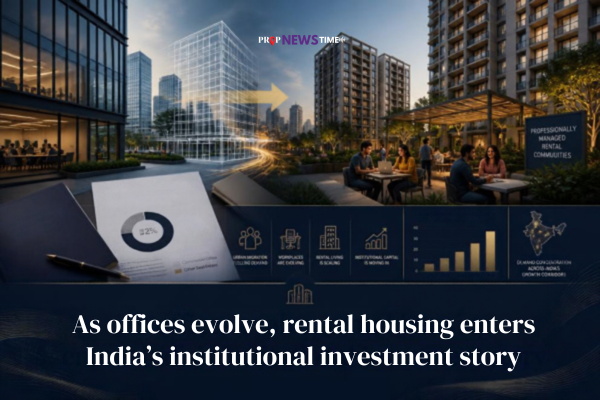
The global real estate investment market has spent the past decade reassessing the role of the office. In the US, hybrid working, higher financing costs and the performance gap between prime and older buildings have pushed investors towards sectors with more diversified and recurring demand. India, however, is following a different trajectory. Institutional capital is not moving wholesale away from offices, with office assets continuing to attract significant investment and occupier demand. In Q1 2026, office assets accounted for half of India's real estate investment inflows at around USD 0.8 billion, while residential followed with USD 0.3 billion, or 20% of quarterly inflows.
Residential enters the institutional investment conversation
The more important change for India is the gradual broadening of institutional exposure to residential. Residential accounted for around 10% of institutional real estate portfolios in H1 2026, with private equity inflows into the sector reaching approximately USD 178 million in Q1. Bengaluru accounted for 18% of residential investment volumes, followed by Chennai at 16% and Delhi-NCR at 12%. The Mumbai Metropolitan Region accounted for 6%, while Hyderabad represented 1%.
India’s rental housing opportunity is different
This creates a different opportunity from the US SFR model. India’s rental housing market remains largely fragmented and dominated by individual landlords, while professionally managed rental communities, co-living, student housing and other managed residential formats are still developing. For institutional investors, the opportunity is therefore less about replacing office towers with identical SFR portfolios and more about building scalable residential platforms that can aggregate rental income across multiple projects and locations.
Mumbai: office strength meets housing constraints
Mumbai presents a particularly different case. The city continues to have a strong office market, with Q1 2026 leasing reaching 6.6 million sq ft, the highest quarterly volume recorded by Cushman & Wakefield for the market. Vacancy was around 9.2%, while demand for Grade A space remained firm. At the same time, Mumbai faces severe land constraints and high residential prices, making large suburban rental communities difficult to replicate at the scale seen in some US markets. Institutional residential strategies in the wider Mumbai Metropolitan Region are therefore more likely to intersect with redevelopment, managed accommodation and transit-linked residential projects rather than conventional suburban SFR communities.
Bengaluru: strongest overlap between jobs and housing demand
Bengaluru has perhaps the clearest overlap between employment growth and residential investment potential. The city accounted for the largest share of residential institutional investment in H1 2026, while it also remained India’s largest office leasing market. JLL reported that Bengaluru accounted for 24.7% of India’s H1 2026 office leasing, while contributing 30.9% of net absorption. This combination of employment concentration, migration, residential development and institutional participation creates a market where rental housing can potentially be developed alongside major employment corridors.
Delhi-NCR: scale creates room for rental platforms
Delhi-NCR offers a different investment equation. The region remains one of India’s largest residential and office markets, although its office vacancy is higher than Mumbai and Bengaluru. Cushman & Wakefield reported vacancy of 19.03% in Q1 2026, while institutional investment activity remained significant. For residential investors, the region’s scale, suburban development opportunities and expanding employment centres could support professionally managed rental housing, particularly around major office and infrastructure corridors.
Hyderabad: office expansion could support residential formats
Hyderabad is another market where office and residential strategies could increasingly intersect. Office leasing reached 5.2 million sq ft in H1 2026, up 25% year-on-year, while GCCs continued to contribute significantly to demand. The city also offers relatively large development parcels compared with land-constrained markets such as Mumbai. The combination of technology and GCC demand, expanding employment corridors and available development land could support professionally managed residential formats close to major business districts.
India is not following the US office-to-SFR path
The comparison with the US therefore needs to be handled carefully. India’s office market is not facing the same structural vacancy problem seen in many US markets. H1 2026 office leasing across India remained strong, with 37.9 million sq ft of gross leasing and net absorption of 26.9 million sq ft, while vacancy across the top seven cities fell to 14.5%. Bengaluru remained the largest contributor to net absorption, followed by Hyderabad, Pune and Delhi-NCR.
For developers and investors, the implication is that the next institutional real estate opportunity may not be a simple office-versus-residential decision. Instead, capital is likely to increasingly evaluate portfolios according to the stability of underlying demand, quality of assets, ability to generate recurring income and potential to scale operations. In Mumbai, that could mean redevelopment and managed residential formats; in Bengaluru, housing linked to technology and GCC employment corridors; in Delhi-NCR, large-scale suburban and transit-oriented rental communities; and in Hyderabad, residential development around expanding technology and business districts.
India’s institutional real estate market is therefore moving towards a more diversified model. Offices remain a major institutional asset class, but residential is becoming increasingly investable as professional operators, developers and capital providers build platforms around recurring housing demand. The longer-term shift could be less about abandoning office real estate and more about creating mixed portfolios in which offices, rental housing, logistics, data centres and other operational assets serve different sources of demand and cash flow.
Sources Brookfield, Deloitte Insights, CRS

17th Nov, 2026

17th Nov, 2026


17th Nov, 2026




17th Nov, 2026


17th Nov, 2026
Advertisement








 Facebook
 Whatsapp

