Advertisement






The Gulf conflict has disrupted global supply chains, pushed...
REITs have changed the way commercial real estate is owned a...
What really powers the cloud? Behind every Google search, A...
What really powers the cloud? Behind every Google search, A...
Luxury real estate is one of the most talked-about segments ...
Artificial Intelligence is beginning to move residential real estate beyond connected appliances and app-controlled systems towards buildings that can analyse conditions, predict requirements and automate operations. In India, the shift is still at an emerging stage, but developers and technology providers are increasingly exploring AI, IoT sensors, building management systems and predictive analytics for energy management, security and maintenance. As residential projects become more technology-led, AI could change not only how homes are operated but also how buildings are designed, maintained and valued, particularly in large urban markets where energy efficiency and operational costs are becoming increasingly important.
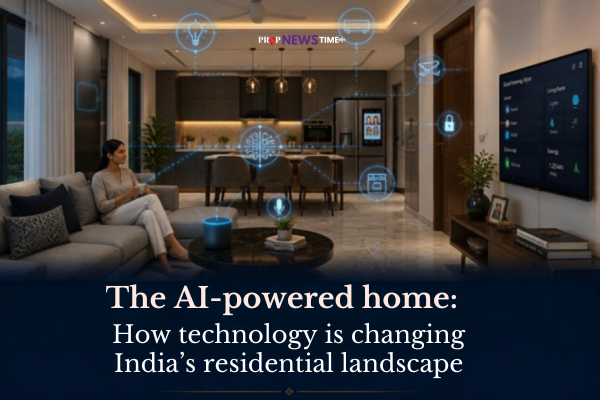
Smart homes are moving towards intelligent buildings
The definition of a smart home is beginning to change. Conventional systems allow residents to control lights, air-conditioning, security cameras and appliances through mobile applications or voice commands. AI-powered buildings take this a step further by allowing systems to analyse information from multiple sensors and respond automatically to changing conditions. In India, the adoption of IoT, AI and building management systems is increasingly being explored to improve building operations, energy efficiency, security and maintenance.
AI can make buildings responsive to real-time conditions
The next stage of residential automation involves systems that do not simply follow pre-set commands but respond to patterns. AI-enabled building systems can combine occupancy data, ambient conditions, equipment performance and other operational information to adjust systems such as lighting, HVAC and elevators. This could allow buildings to reduce unnecessary energy consumption while maintaining occupant comfort. Industry research indicates that IoT-enabled energy management systems can potentially reduce energy costs by around 20%, although actual savings would depend on building design, equipment, occupancy and the quality of implementation.
Predictive maintenance could change building operations
Maintenance is another area where AI could have a significant impact. Instead of waiting for an elevator, HVAC system or other equipment to fail, sensors can continuously monitor operating conditions and identify unusual patterns. Machine-learning models can then flag potential problems for building operators before they develop into larger failures. In India, predictive maintenance remains at an early adoption stage across real estate, but the technology is increasingly being evaluated as part of broader smart-building systems.
Security could become more automated
AI is also changing the way access and security systems are being designed. Connected cameras, sensors and automated access-control systems can analyse activity around a building and support real-time monitoring. In residential developments, these systems could eventually combine visitor management, digital access, delivery authentication and perimeter monitoring into a single platform. However, technologies such as facial recognition also raise privacy and data-management considerations, making responsible deployment and appropriate consent frameworks important as adoption expands.
The Indian residential market is becoming more technology-led
The shift towards intelligent buildings comes as Indian developers increasingly compete on the quality of the overall residential experience rather than only on apartment size and amenities. Technology is becoming part of this proposition, particularly in premium and large-scale developments. Cushman & Wakefield's India Outlook 2026 expects residential launches to remain elevated, supported by urbanisation, lifestyle upgrades and rising disposable incomes, while premium and luxury housing continues to attract demand.
Mumbai could see AI adoption tied to high-density living
Mumbai and the wider MMR could provide a particularly relevant environment for intelligent residential buildings because of high-density development, premium housing and the importance of efficient building operations. Mumbai recorded more than 41,000 residential launches in H1 2026, with Navi Mumbai, Thane and the Eastern Suburbs accounting for significant portions of new supply. In such markets, automated energy management, elevator optimisation, security and predictive maintenance could become increasingly relevant as developers seek to manage large residential communities efficiently.
Bengaluru can connect AI homes with a technology workforce
Bengaluru's technology ecosystem could make it an important market for the adoption of AI-enabled residential infrastructure. The city remains one of India's largest technology and GCC markets, with GCC occupiers accounting for a significant share of office demand. This creates a large population of technology-oriented residents who may be more familiar with connected devices and digital services. The opportunity for developers could therefore extend beyond individual smart-home products towards integrated building platforms that connect residential units with common-area systems and facility management.
Hyderabad and NCR could benefit from scale
Hyderabad and Delhi-NCR could also provide opportunities for technology-enabled residential developments as new housing and employment corridors expand. Hyderabad is simultaneously seeing strong office and digital-infrastructure growth, while Delhi-NCR continues to experience substantial residential and commercial development. Larger developments can provide greater scope for centralised building-management platforms because the cost of deploying sensors, connectivity and automated systems can be distributed across a sizeable project.
AI could influence how buildings are designed
The larger change may eventually occur before a resident even enters a home. If developers begin designing buildings around continuous data collection and automated operations, factors such as equipment placement, sensor networks, connectivity infrastructure, energy systems and mechanical layouts could be planned differently from the outset. This could move AI from being an additional technology layer added after construction to becoming part of the building's underlying infrastructure.
From smart devices to self-learning buildings
The transition from traditional buildings to autonomous buildings can therefore be viewed as a progression. Traditional buildings rely heavily on manual intervention, smart buildings use sensors and programmed rules, while AI-enabled buildings can analyse multiple data streams and make operational decisions based on changing conditions. India's real estate industry is still some distance from fully autonomous residential buildings, and many PropTech solutions remain concentrated in pilot or limited-use applications. The direction, however, is becoming clearer as developers, occupiers and technology providers look at AI as a way to improve building performance rather than simply adding more consumer-facing gadgets.
For India's residential market, the eventual value of AI may therefore lie less in novelty and more in operational efficiency. Buildings that consume less energy, identify equipment problems earlier, manage common areas more efficiently and provide more responsive security could offer measurable benefits to both developers and residents. As India's housing stock becomes increasingly premium, connected and technology-enabled, AI could gradually shift from being a feature marketed to homebuyers to becoming part of the infrastructure that determines how a building operates.
Sources IEEE, WorldGBC, Guidehouse Insights

17th Nov, 2026

17th Nov, 2026


17th Nov, 2026




17th Nov, 2026


17th Nov, 2026
Advertisement








 Facebook
 Whatsapp

