Advertisement






The Gulf conflict has disrupted global supply chains, pushed...
REITs have changed the way commercial real estate is owned a...
What really powers the cloud? Behind every Google search, A...
What really powers the cloud? Behind every Google search, A...
Luxury real estate is one of the most talked-about segments ...
Cities across the world are moving beyond temporary car-free experiments towards permanent street redesigns that prioritise pedestrians, cycling and public spaces. London is advancing the pedestrianisation of Oxford Street, Paris has transformed hundreds of streets and expanded its cycling network, while Barcelona continues to develop its Superblock model. Several US cities are also making pedestrian zones and bike networks permanent. The shift is increasingly relevant to urban planning and real estate as streets are treated not only as traffic corridors but as public spaces that can influence footfall, accessibility, local commerce and the way neighbourhoods develop.
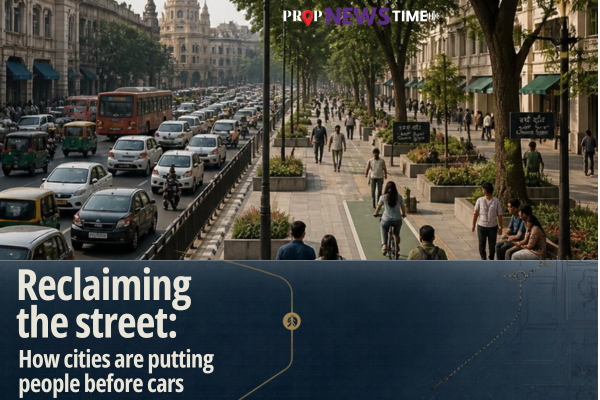
The way cities use their streets is undergoing a significant change, with major urban centres increasingly moving away from roads designed primarily around private vehicles. In 2026, several cities have shifted from temporary street closures and pilot programmes towards permanent, funded interventions focused on walking, cycling, public transport and public spaces. The trend is altering how planners approach some of the most visible and commercially important parts of cities.
London puts pedestrianisation at the centre of Oxford Street
London is among the cities where this transition is now moving into implementation. The city has approved the permanent pedestrianisation of a section of Oxford Street between Great Portland Street and Orchard Street. Traffic is expected to be excluded from nearly a kilometre of the street from October 2026, initially through a live-testing phase before further review. A one-day closure in September 2025 had already resulted in a 45% increase in footfall on the road, highlighting the potential effect of pedestrian-focused design on one of London's major commercial streets.
Paris shifts public space towards walking and cycling
Paris represents a much larger and longer-running transformation. Around 300 streets near elementary schools have been closed to cars, while voters have approved the closure of another 500 streets. Thousands of parking spaces have been replaced by trees and the city now has more than 900 miles of cycling lanes. On Rue de Rivoli, a road that previously devoted seven lanes to traffic and parking, most of the space has been reassigned to bicycles, with only one lane remaining for cars.
Barcelona takes the neighbourhood approach
Barcelona's Superblock model offers another approach. Through-traffic is restricted to every fourth block, allowing internal streets to become spaces for walking, cycling and social activity. The long-term redesign of La Rambla is also nearing completion, with the pedestrian area being expanded and vehicle access restricted. The model has become a reference point for planners considering how neighbourhood-level traffic management can change the use of urban streets.
US cities move from trials to permanent street changes
The US is also moving towards more permanent pedestrian infrastructure. Houston is converting seven blocks of Main Street into a pedestrian promenade, while New York has seen calls for a connected citywide network of car-free streets. Philadelphia's Indego bike-share network has expanded to 250 stations and more than 2,000 bicycles, alongside measures to prevent parking and
Amsterdam curbs cars, block by block
Amsterdam is pursuing its own long-term shift under the Agenda Amsterdam Autoluw ("car-light") policy, which has been steadily converting high-density shopping and residential streets so that cars play a secondary role. A bike street is under construction to form an inner-city ring road where cycling is the primary mode and cars are treated as guests. The city's 2023–2026 clean air roadmap coordinates low-emission zones, permits and enforcement into a predictable sequence, and the approach now extends even to its waterways, where an emission-free sailing zone ties canal access to propulsion type rather than informal norms.
Bogota builds people-first streets into a weekly ritual
Bogota offers one of the longest-running examples of car-free public space anywhere in the world. Its Ciclovía programme, now more than 50 years old, closes 120 kilometres of roads to traffic every Sunday, drawing residents out to walk, cycle and socialise. Since 2016, the city's Plazoleta Programme, developed with Bloomberg Associates and the Global Designing Cities Initiative, has reclaimed underused road space for public plazas designed to improve safety and inclusion. Together, the two programmes have turned street reclamation into an established part of the city's civic culture rather than a one-off pilot.
Milan expands its car-free footprint square by square
Milan is pushing pedestrianisation and greening block by block as part of what planners describe as a "sponge city" strategy. The CityLife district, one of the largest car-free zones in Europe, has become a flagship example, and 2026 has brought a wave of smaller interventions: Piazza Arnoldo Mondadori is being redeveloped so that roughly 600 square metres of asphalt gives way to benches, bike racks, trees and shrubs, while similar projects are under way at Piazza Imperatore Tito and Piazza Santo Stefano to expand green and pedestrian space. The city is also testing lower speed limits as part of the same push, though early data suggests compliance remains a work in progress even where limits have dropped from 50 km/h to 30 km/h.
The next urban model puts people at the centre
For rapidly urbanising cities, the broader lesson is that streets are increasingly being viewed as part of the urban environment rather than simply infrastructure for moving vehicles. The global shift towards permanent pedestrian zones, cycling networks and redesigned public spaces suggests that future urban development will increasingly consider how roads connect people with homes, workplaces, retail and community spaces. The challenge will be to balance these objectives with mobility, accessibility, commercial requirements and equitable access to improved public infrastructure.
Source Fast Company, National Geographic, Londonist, WSP, Domus

17th Nov, 2026

17th Nov, 2026


17th Nov, 2026




17th Nov, 2026


17th Nov, 2026
Advertisement








 Facebook
 Whatsapp

