Advertisement






The Gulf conflict has disrupted global supply chains, pushed...
REITs have changed the way commercial real estate is owned a...
What really powers the cloud? Behind every Google search, A...
What really powers the cloud? Behind every Google search, A...
Luxury real estate is one of the most talked-about segments ...
India’s urban growth is becoming increasingly uneven, with employment, technology, infrastructure and migration concentrating population and real estate activity in a limited number of cities. Bengaluru and Hyderabad are among the strongest growth centres, supported by IT, Global Capability Centres, manufacturing, pharmaceuticals and infrastructure investment. At the same time, research has found that roughly one in nine Indian urban centres is experiencing population decline, driven by factors including low population density, lower fertility and ageing populations. As migration remains concentrated towards major employment hubs, the divergence could increasingly influence housing demand, land values and development patterns across India.
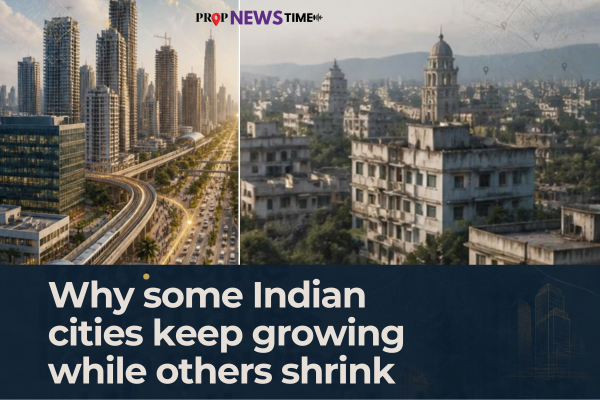
India's urban growth is becoming increasingly concentrated, creating a growing divide between cities attracting people, investment and businesses and urban centres experiencing population decline. While the country continues to urbanise, the growth is not being distributed evenly across its urban network. The attached 2026 report estimates India's urban population at around 37.6% of the total, while highlighting a concentration of internal migration towards a relatively small group of economic centres.
Technology and jobs create new growth engines
Bengaluru and Hyderabad illustrate how employment and investment can reinforce urban expansion. Bengaluru's population is estimated to have increased from around 8.5 million in 2011 to 14.4 million in 2025, with the city attracting IT companies, startups, unicorns and Global Capability Centres. Savills has also identified Bengaluru as the leading city in its 2026 Growth Hubs Index, reflecting its economic and demographic potential.
Hyderabad has followed a similar trajectory, with investments from global technology companies, a large pharmaceutical industry and infrastructure developments such as the Outer Ring Road and Financial District supporting employment and real estate activity. Its population rose from around 7.67 million in 2011 to a projected 11.34 million in 2025.
Infrastructure broadens the growth map
The growth story extends beyond the two major technology centres. Pune, Chennai, Ahmedabad, Surat, Nagpur, Agra and Coimbatore are identified in the report among cities benefiting from combinations of technology, manufacturing, logistics and education-driven employment. Metro rail expansion, industrial and IT corridors, airport connectivity and GCC investments are contributing to the expansion of these urban markets. Cities with multiple economic drivers can also have greater resilience across real estate cycles than those dependent on a single sector.
The housing market already reflects this concentration. In Q1 2026, India's top seven cities recorded 70,631 residential sales, with Bengaluru, Mumbai, Pune and Delhi-NCR together accounting for about 77% of sales. Bengaluru also recorded the highest number of residential launches during the quarter, at 27,055 units.
The other side of India's urbanisation
Population growth, however, is not universal. A peer-reviewed study published in the International Journal of Population Studies found that roughly one in nine Indian urban centres was declining, with about one in five of those centres experiencing population shrinkage. The study identified small population size, low population density, lower fertility, ageing populations and slower urban growth relative to existing urbanisation levels as important factors.
Migration is widening the divide
Migration is an important part of the divergence. Smaller and peripheral regions can lose population when employment opportunities and local economic activity do not keep pace with larger cities. Research cited in the report has documented out-migration from parts of the North-East towards major cities, with unemployment and limited employability among the factors behind these movements.
For real estate, sustained population outflows can eventually affect housing demand, rental markets, land utilisation and the viability of new development. A shrinking population does not necessarily mean an immediate fall in property values, but it can alter the underlying demand base that supports residential, retail and commercial development.
Tier-2 cities could change the equation
The divergence is not necessarily permanent. Recent housing-market trends suggest that some buyers are increasingly looking beyond expensive metropolitan markets towards Tier-2 cities. A CII-Knight Frank India report released in September 2026 found that residential prices across 11 emerging Tier-2 markets had grown significantly faster than those in India's top eight cities over the preceding decade, with infrastructure and commercial activity among the factors supporting the growth.
India's urban growth story is therefore becoming less about whether cities will grow and more about where growth will concentrate. Employment clusters, infrastructure, connectivity and investment are likely to continue supporting major growth centres, while smaller cities will need stronger economic and infrastructure foundations to retain and attract residents. At the same time, the emerging movement towards Tier-2 housing markets could create new growth corridors. For India's real estate sector, this means future demand may increasingly be shaped by the ability of cities to create jobs and infrastructure alongside housing, rather than housing supply alone.
Source World Bank, censusindia, ORF, NITI Aayog

17th Nov, 2026

17th Nov, 2026


17th Nov, 2026




17th Nov, 2026


17th Nov, 2026
Advertisement








 Facebook
 Whatsapp

