Advertisement






The Gulf conflict has disrupted global supply chains, pushed...
REITs have changed the way commercial real estate is owned a...
What really powers the cloud? Behind every Google search, A...
What really powers the cloud? Behind every Google search, A...
Luxury real estate is one of the most talked-about segments ...
Why do some neighbourhoods feel inviting while others feel difficult to navigate, even when both offer similar amenities? The answer often lies in walkability. Research on urban design shows that connected streets, mixed land uses, pedestrian comfort, greenery, safety and access to public transport can influence how people experience a place. Walkability also carries real estate implications, with studies linking pedestrian-friendly neighbourhoods to stronger residential, retail and office performance. As Indian cities expand, designing places that encourage walking is becoming an increasingly important urban and property-market consideration.
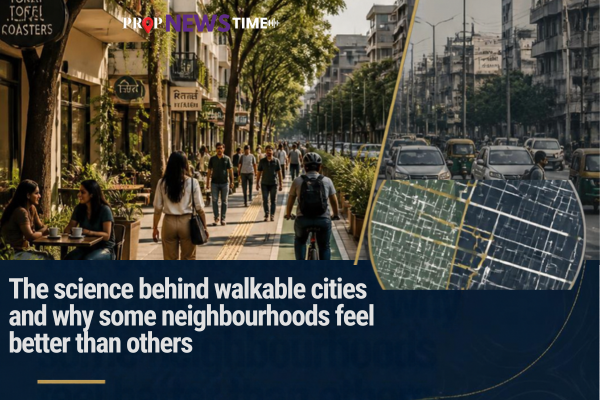
A neighbourhood can look impressive on a map and still feel unpleasant to walk through. A wide road may make driving easy but create a barrier for pedestrians. An area may have cafés, shops and parks but feel disconnected if they are separated by blank walls, parking lots or unsafe crossings. Another neighbourhood may have older buildings and narrower streets yet feel lively, convenient and surprisingly attractive.
The difference is often walkability. Walkability is far more than the presence of a footpath. Urban planning research considers street connectivity, pedestrian infrastructure, land-use patterns, safety, comfort, convenience and attractiveness when evaluating how people experience a neighbourhood. The World Bank's work on pedestrian planning similarly emphasises continuous footpaths, shade, accessibility and people-first street design as essential components of walkable cities.
The economic implications are equally significant. Brookings Institution research has found positive relationships between walkability and residential, office and retail performance in metropolitan markets, suggesting that the places people enjoy walking through can also become stronger-performing real estate markets.
Here are ten reasons why some neighbourhoods feel more enjoyable- and why the science behind walkability is becoming increasingly relevant for India's cities.
1. Our brains naturally prefer human-scale environments
People experience a neighbourhood through constant sensory processing rather than simply observing buildings.
As we walk, our brains continuously interpret movement, street activity, sounds, colours, lighting and the presence of other people. Streets lined with cafés, shopfronts, trees and visible entrances provide frequent visual stimulation, while long compound walls, empty parking lots and oversized roads offer comparatively little engagement.
Urban design researchers have long argued that human-scale environments encourage exploration because they create a continuous sequence of visual interest. Instead of overwhelming pedestrians with oversized infrastructure, these streets make people feel comfortable moving at walking speed.
This helps explain why many older neighbourhoods continue attracting visitors despite having simpler architecture than newer developments. The experience itself often becomes the attraction.
2. Short distances change how people use a city
One of the most important ingredients of walkability is proximity. When grocery stores, pharmacies, cafés, schools, parks and public transport are located within walking distance, daily life becomes more efficient. Instead of treating every activity as a separate trip requiring a vehicle, people can combine errands into a single journey.
The World Bank notes that better land-use planning and pedestrian infrastructure can significantly improve urban accessibility, particularly as South Asian cities become denser.
The real estate implication is equally important. Buyers increasingly value neighbourhoods where convenience comes from everyday accessibility rather than simply owning a larger home farther away. In other words, a neighbourhood's usefulness is often measured not only by how much space it offers, but by how easily residents can reach what they need.
3. Connected streets make walking feel easier
A walkable neighbourhood rarely depends on one perfect road. Instead, it offers multiple connected routes that make movement feel intuitive.
Grid-like street networks allow pedestrians to choose shorter paths, discover local businesses and avoid unnecessary detours. By contrast, cul-de-sacs, oversized blocks and disconnected layouts can make even nearby destinations feel surprisingly far away.
This principle influences how people perceive distance. Two neighbourhoods may have similar geographic sizes, but the one with better street connectivity often feels significantly more accessible. For developers and planners, creating smaller blocks, pedestrian links and multiple access points can transform isolated projects into integrated neighbourhoods that encourage everyday walking.
4. The ground floor determines the street experience
What happens at eye level often matters more than what happens on the skyline. Active ground floors- with shops, cafés, restaurants, community spaces and visible entrances- give pedestrians reasons to slow down and interact with the street. Blank walls, closed façades and parking ramps tend to discourage walking because they reduce visual engagement.
Urban designer Jan Gehl's work on public life has consistently demonstrated that active street edges encourage longer pedestrian activity by making streets feel socially interesting rather than purely functional.
This principle has become increasingly relevant for mixed-use developments, where successful ground-floor planning can strengthen both retail performance and neighbourhood identity. The street, in many cases, becomes an extension of the building itself.
5. Safety changes how people perceive distance
Walking is influenced as much by psychology as by geography. A ten-minute walk through a well-lit, active street with visible shops and other pedestrians often feels shorter than a five-minute walk through an isolated underpass or poorly maintained road.
The World Bank identifies safety, security, comfort and attractiveness as essential components of pedestrian-friendly environments, while Indian urban studies have found that personal security can significantly influence whether people choose to walk.
This has practical implications for real estate. Safe crossings, adequate lighting, clear sightlines and active streets can become valuable neighbourhood features because they encourage consistent pedestrian activity throughout the day. A neighbourhood where people feel comfortable walking after sunset often develops a stronger sense of community and local commerce.
6. Trees and shade can completely change the walking experience
Climate plays an enormous role in walkability, particularly in Indian cities. A short walk can become uncomfortable when pedestrians are exposed to intense sunlight, heat or heavy rainfall. Trees, shaded sidewalks, arcades and well-designed public spaces can dramatically improve thermal comfort, making walking more practical throughout the year.
Research on urban forestry has shown that street trees provide multiple benefits, including shade, cooling and improved pedestrian comfort. These environmental improvements can encourage greater outdoor activity while making neighbourhoods feel more inviting.
For developers, greenery is therefore more than a landscaping feature. It becomes part of the neighbourhood's mobility infrastructure. The most successful pedestrian environments often combine comfortable shade with attractive public spaces that encourage people to pause rather than simply pass through.
7. Public transport extends the meaning of walkability
Walkability does not end where public transport begins. Instead, the two systems reinforce one another. A resident may walk from home to a metro station, use public transport for a longer journey and then walk to work. The quality of those walking connections determines whether the transport system feels convenient.
This explains why transit-oriented development focuses heavily on the areas surrounding stations rather than the stations alone.
Brookings has linked walkable urban places with stronger transit accessibility and broader economic performance, reinforcing the idea that transportation and pedestrian infrastructure work best together. For real estate, this creates opportunities around metro stations, suburban rail corridors and bus hubs- but only when pedestrians can safely and comfortably complete the last few hundred metres.
8. Mixed-use neighbourhoods keep streets alive throughout the day
A purely residential neighbourhood may become quiet during working hours. A business district may become empty after offices close. Mixed-use neighbourhoods behave differently.
By combining homes, offices, cafés, restaurants, schools, parks and entertainment within the same area, they create activity at different times of the day. Morning commuters, lunchtime diners, evening shoppers and weekend visitors all contribute to a more continuous street life.
This diversity creates what urban planners often describe as active public realms- places where people encounter others naturally rather than only through planned destinations. For developers, mixed-use planning can therefore strengthen not only property values but also the overall identity of an urban district.
9. Walkability creates measurable real estate value
The popularity of walkable neighbourhoods is not merely anecdotal. Brookings research examining metropolitan Washington found that more walkable locations were associated with higher office rents, retail rents, residential rents and housing values compared with less walkable areas in the same region.
While walkability is not the only factor affecting property prices, it increasingly interacts with accessibility, employment concentration, retail demand and quality of life.
For investors, this makes pedestrian infrastructure an important part of micro-market analysis rather than simply an urban-design issue. A neighbourhood that encourages walking can become more attractive to residents, retailers and employers simultaneously.
10. The best neighbourhoods succeed because many small details work together
There is rarely a single feature that makes a neighbourhood exceptionally walkable. Instead, successful places combine connected streets, short distances, active frontages, comfortable footpaths, greenery, safety, public transport access and attractive public spaces into one integrated experience.
The World Bank argues that pedestrian improvements work best when they form part of broader urban planning and transport strategies rather than isolated infrastructure projects. For India's rapidly expanding cities, this integrated approach could become increasingly important. Simply building wider roads or adding isolated sidewalks may not create genuinely walkable neighbourhoods if other parts of the pedestrian experience remain fragmented.
Ultimately, walkability works because it reduces friction. When moving through a neighbourhood feels natural rather than difficult, people are more likely to walk, explore and build stronger connections with the place itself.
The neighbourhoods people remember are often not those with the tallest buildings or widest roads- they are the places where everyday movement feels effortless, destinations are close and streets encourage people to stay rather than simply pass through.
Walkability sits at the intersection of psychology, urban design, transport and real estate. Connected streets reduce friction, active ground floors create interest, greenery improves comfort, transit expands accessibility and mixed-use planning keeps neighbourhoods active throughout the day.
For India's developers and city planners, the opportunity extends beyond building better sidewalks. As cities become denser and residents increasingly value convenience, accessibility and quality public spaces, designing genuinely walkable neighbourhoods could become one of the most important drivers of future urban real estate success.
Sources- World Bank, Brookings Institution, Jan Gehl's urban design research, World Bank Sustainable Urban Transport resources and urban planning research on pedestrian environments and walkability.

17th Nov, 2026

17th Nov, 2026


17th Nov, 2026




17th Nov, 2026


17th Nov, 2026
Advertisement








 Facebook
 Whatsapp

