Advertisement






The Gulf conflict has disrupted global supply chains, pushed...
REITs have changed the way commercial real estate is owned a...
What really powers the cloud? Behind every Google search, A...
What really powers the cloud? Behind every Google search, A...
Luxury real estate is one of the most talked-about segments ...
The CII–Indian Green Building Council (CII–IGBC) organised the Green Saurashtra Summit 2026 in Rajkot on 19 September, bringing together government representatives, developers, industry participants and built-environment stakeholders to discuss sustainable regional development. Held under the theme “Advancing Sustainable Development through Practical Green Solutions”, the summit highlighted Saurashtra’s existing green building footprint of 102 IGBC-rated projects covering approximately 0.35 billion sq ft. Discussions focused on expanding resource efficiency, energy-conscious design, low-carbon construction, sustainable materials and climate-responsive planning across residential, commercial, industrial and public infrastructure. Participants called for stronger implementation of green building practices, supported by collaboration between government, industry and other stakeholders. The programme included discussions on Rajkot’s future development, sustainable construction technologies, building performance, Net Zero pathways, water and energy efficiency, and occupant wellbeing.
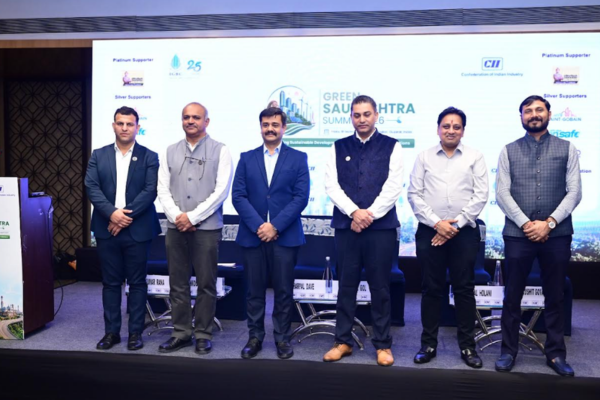
The CII–Indian Green Building Council (CII–IGBC) has called for wider implementation of sustainable construction and resource-efficient development across Saurashtra, as the region’s green building footprint reached 102 IGBC-rated projects covering approximately 0.35 billion sq ft. The Green Saurashtra Summit 2026, held in Rajkot on 19 September, brought together government, real estate, industry and built-environment stakeholders to discuss practical measures for advancing sustainable growth.
Held under the theme “Advancing Sustainable Development through Practical Green Solutions”, the summit examined how green building practices could be integrated into the region’s expanding built environment. Residential and commercial developments account for the principal categories among the 102 rated projects, reflecting the adoption of sustainability measures in these segments.
The discussions covered sustainable planning, energy-conscious design, water conservation, low-carbon construction, resource efficiency and green technologies. Participants from Rajkot, Morbi, Jamnagar, Bhavnagar, Junagadh, Porbandar and other parts of Saurashtra considered ways to extend these practices across the region.
IGBC’s rating frameworks address areas including water efficiency, energy conservation, sustainable materials, waste management and occupant wellbeing. The summit highlighted the need to move beyond awareness towards broader implementation, making these considerations part of mainstream development.
Rushit Govani, president of the Youth Rajkot Builders Association, said the real estate sector had an important role in shaping Saurashtra’s future. He noted that the growing adoption of IGBC frameworks indicated that sustainability was becoming a consideration for developers and homebuyers. He called for energy efficiency, water conservation, sustainable materials and healthier spaces to be incorporated more widely into projects.
Vishal Holani, past chairman of CII Gujarat Western Zone, said sustainable growth and industrial competitiveness were increasingly connected. He said Saurashtra could combine its entrepreneurial and industrial base with resource-efficient technologies and green infrastructure, while encouraging investment in energy efficiency, renewable energy, sustainable materials and other solutions offering environmental and economic benefits.
Kunal Gol, chairman of the IGBC Rajkot Chapter and director of Elixir Realty, said the region needed to build on its existing green building activity by integrating resource efficiency and climate-responsive design into mainstream development. He said the chapter would continue bringing stakeholders together to share practical solutions and support sustainable development.
The inaugural session, titled “Advancing Sustainable Development in Saurashtra”, covered green growth opportunities, sustainable real estate development and industry leadership. Chetan Nandani, deputy municipal commissioner of Rajkot Municipal Corporation, delivered a special address.
A fireside chat on “Shaping a Sustainable Rajkot – Development, Infrastructure & the Built Environment” examined the role of sustainable planning, climate-responsive development, resource efficiency and green building practices in the city’s future growth.
The programme also included a panel discussion, “Sustainable Development in Saurashtra – From Vision to Action”, covering low-carbon construction, emerging construction technologies, resource-efficient materials and energy-conscious design across real estate, hospitality and public development.
The final technical session focused on practical solutions for water, energy, resources and wellbeing, including building performance, Net Zero pathways, next-generation glass technology and low-carbon construction.
The summit concluded with a call for continued cooperation among government, developers, architects, industry and citizens to expand sustainable development across residential, commercial, industrial and public infrastructure in Saurashtra.

17th Nov, 2026

17th Nov, 2026


17th Nov, 2026




17th Nov, 2026


17th Nov, 2026
Advertisement








 Facebook
 Whatsapp

