Advertisement






The Gulf conflict has disrupted global supply chains, pushed...
REITs have changed the way commercial real estate is owned a...
What really powers the cloud? Behind every Google search, A...
What really powers the cloud? Behind every Google search, A...
Luxury real estate is one of the most talked-about segments ...
Adani Green Energy Ltd (AGEL) has expanded its operational battery energy storage system (BESS) capacity at Khavda, Gujarat, to 6.63 GWh from 3.55 GWh in June 2026. The company now accounts for more than half of India’s operational BESS capacity of around 12.6 GWh. The storage system can hold enough clean energy to power around two million homes for a day and support peak demand in cities such as Nagpur, Patna and Visakhapatnam for several hours. AGEL plans to add more than 10 GWh of BESS capacity in FY27 and reach 50 GWh over the next five years.
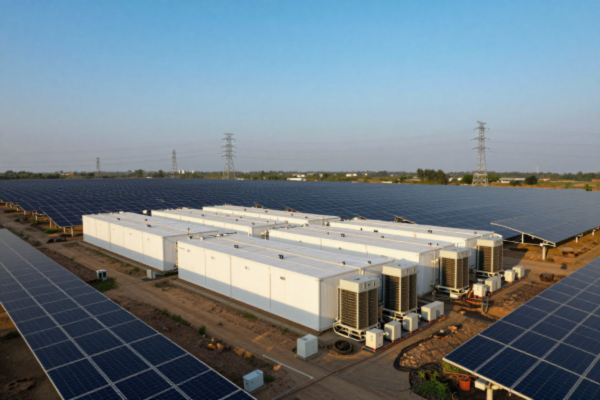
Adani Green Energy Ltd (AGEL) has increased its operational battery energy storage system (BESS) capacity at Khavda in Gujarat to 6.63 GWh, up from 3.55 GWh in June 2026. The company now accounts for more than 50 per cent of India’s operational BESS capacity, which stood at about 12.6 GWh as of the end of August, based on Central Electricity Authority data and industry disclosures.
The 6.63 GWh storage system can store enough clean energy to power around two million homes for a day. According to AGEL, it can also support peak electricity demand in cities such as Nagpur, Patna and Visakhapatnam for several hours. The company said the capacity is also equivalent to the battery storage of more than 150,000 mid-sized electric vehicles, based on a 40 kWh battery pack for each vehicle.
AGEL reached the 6.63 GWh milestone within 14 months of starting on-site BESS construction at Khavda. The latest capacity addition was commissioned within 10 months of construction beginning. The project has made Khavda the site of the world’s largest operational battery energy storage installation at a single location, according to the company.
The BESS is integrated with AGEL’s renewable energy development at Khavda, where the company is developing a 30 GW renewable energy plant across 538 square kilometres of barren land. The Khavda project is planned as a large-scale combination of renewable generation and storage, allowing electricity generated from renewable sources to be stored and supplied when required. The storage system uses lithium-ion battery technology along with an Energy Management System (EMS) and automated telemetry. These systems manage the charging and discharging of the batteries, help optimise performance and support grid services. Battery storage can also help manage peak demand, improve grid stability, reduce energy curtailment and make renewable electricity available when generation from sources such as solar is lower.
AGEL’s BESS capacity has increased rapidly this year. In May 2026, the company had commissioned a cumulative 3.37 GWh at Khavda, including 1.37 GWh added in March. By June, its operational BESS capacity had reached 3.55 GWh. The company had earlier set a target of adding more than 10 GWh of battery storage capacity during FY27.
AGEL is now on track to add more than 10 GWh of BESS capacity during FY27 and has set a longer-term target of 50 GWh of storage capacity over the next five years. It is also pursuing pumped storage projects as part of its broader plan to build renewable power capacity that can be supplied more consistently according to grid requirements.
Sagar Adani, Executive Director of Adani Green Energy, said the company had reached the 6.63 GWh level within 14 months and that storage at this scale could make renewable electricity more reliable and dispatchable when required by the grid. He added that the company would continue to expand both battery and pumped storage solutions as electricity demand increases.
The latest expansion comes as India continues to build storage capacity alongside its renewable energy generation. The Central Electricity Authority’s National Electricity Plan has projected a growing requirement for energy storage as the share of renewable power increases, particularly because solar and wind generation varies by time and location. This makes storage an important part of using renewable electricity beyond the periods when it is generated.
The Khavda project is increasingly linking renewable generation with large-scale electricity storage at the same location. For AGEL, the immediate focus is on adding more storage capacity during FY27 while working towards its 50 GWh target over the next five years. The expansion also reflects a broader shift in India’s power infrastructure, where renewable generation is being developed alongside systems that can hold electricity and release it during periods of higher demand. The pace of further storage deployment will depend on project execution as well as the country’s wider grid and transmission requirements.
Source PTI


14th Nov, 2026

14th Nov, 2026

14th Nov, 2026

13th Nov, 2026


13th Nov, 2026


13th Nov, 2026
Advertisement








 Facebook
 Whatsapp

