Advertisement






The Gulf conflict has disrupted global supply chains, pushed...
REITs have changed the way commercial real estate is owned a...
What really powers the cloud? Behind every Google search, A...
What really powers the cloud? Behind every Google search, A...
Luxury real estate is one of the most talked-about segments ...
High-speed rail is often measured by the hours it saves passengers, but its impact can extend far beyond faster journeys. By improving accessibility between cities, HSR can influence where businesses locate, how land is developed, how property markets evolve and how smaller urban centres connect with major economic hubs. India's Mumbai–Ahmedabad High-Speed Rail corridor illustrates this broader potential, with 12 planned stations linking major commercial and industrial centres across Maharashtra, Gujarat and Dadra & Nagar Haveli. Its effects could extend to employment, tourism, logistics, real estate and regional development.
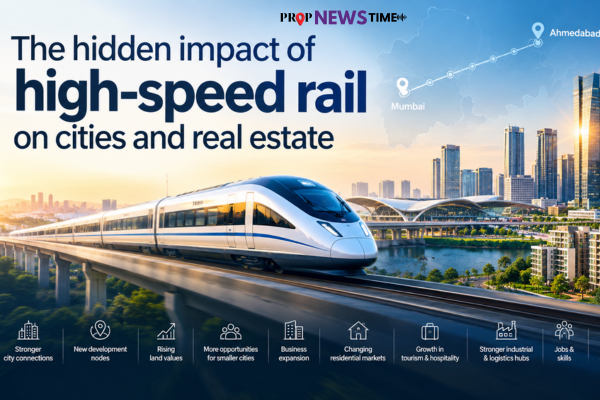
The most obvious benefit of high-speed rail is speed. A journey that once required several hours can potentially be completed in a fraction of the time, making distant cities feel considerably closer. But the real significance of high-speed rail begins when that saved time changes how people, businesses and capital behave.
A company may find it easier to operate across two cities. A professional may consider working in one city while maintaining a home in another. A tourist may add a previously inconvenient destination to an itinerary. A developer may begin examining land around a station that previously had limited connectivity.
This is why high-speed rail is increasingly viewed as more than a transportation project. India's Mumbai–Ahmedabad High-Speed Rail (MAHSR) corridor, for instance, spans approximately 508 km and has 12 planned stations connecting Mumbai, Thane, Virar, Boisar, Vapi, Bilimora, Surat, Bharuch, Vadodara, Anand, Ahmedabad and Sabarmati. The corridor is designed for speeds of up to 320 kmph and is expected to reduce end-to-end travel time to around two hours.
The National High Speed Rail Corporation Limited (NHSRCL) is also planning the stations as multimodal transport hubs, integrating high-speed rail with conventional rail, metro systems, buses and other modes. The bigger story, therefore, is what happens around the railway line. Here are ten ways high-speed rail can reshape cities and real estate beyond simply reducing travel time.
1. High-speed rail effectively brings cities closer together
The first transformation is geographical. A city does not physically move closer to another city when an HSR line opens. But the reduction in travel time can make the two places function as though they are closer.
The Mumbai–Ahmedabad corridor is expected to connect major economic centres across Maharashtra and Gujarat in a much shorter timeframe. Government assessments describe the corridor as having the potential to strengthen economic integration between cities and industrial centres along the route.
This can change how businesses think about their operating geography. Instead of treating Mumbai, Surat, Vadodara and Ahmedabad as completely separate markets, companies may increasingly view them as connected nodes within a larger economic corridor.
For real estate, that can expand the effective catchment area of commercial and residential markets. A location that previously seemed too far from a major business centre could become more relevant once travel becomes faster and more predictable.
2. Station areas can become new development nodes
High-speed rail stations are not simply places where trains stop. They can become anchors for commercial development, hospitality, retail, offices, residential projects and public infrastructure- particularly when they are integrated with other forms of transport.
NHSRCL's station planning specifically includes integration with railways, metro systems, buses, taxis and other modes to improve accessibility. This creates the possibility of transit-oriented development, where real estate growth is concentrated around transport hubs.
The effect can be particularly important in cities where a station is located in an area with development potential. Improved accessibility can encourage developers to consider land uses that may previously have been difficult to justify.
However, the presence of a station alone does not guarantee a successful development district. Last-mile connectivity, land-use planning, pedestrian infrastructure and supporting amenities all influence whether a station becomes a genuine urban node.
3. Land values can respond to improved accessibility
Better transport connectivity can alter the economic value of land. Research on China's high-speed rail expansion found that HSR stations were associated with increases in nearby land values, with the effect generally stronger closer to stations. The World Bank also notes that land-value changes around HSR can reflect improved accessibility and changing development patterns.
This does not mean every property near an HSR station will automatically appreciate. Land values are influenced by zoning, development potential, existing infrastructure, demand, station accessibility and the broader economic performance of the location. The OECD also cautions that some land-value gains may represent redistribution of activity rather than the creation of entirely new economic value.
For investors and developers, the important consideration is therefore not simply "How close is the property to the station?" It is "What development and economic activity can this connectivity realistically support?"
4. Smaller cities can gain access to larger economic markets
One of the most significant effects of HSR can be on cities that sit between major metropolitan centres. Without fast connectivity, smaller cities may struggle to attract businesses that require access to larger talent pools, markets and corporate ecosystems. High-speed rail can potentially change that equation.
The Mumbai–Ahmedabad corridor includes intermediate cities such as Surat, Vadodara, Vapi, Bharuch, Anand and Bilimora. Government assessments describe the project as a means of bringing industrial centres and markets closer together and strengthening regional economic integration.
This could create opportunities for cities that previously operated largely within their own regional markets. For real estate, that can translate into new demand for offices, industrial facilities, hotels, housing, retail and supporting infrastructure- provided local economies have the underlying capacity to absorb that growth.
5. Businesses can reorganise their location strategies
Faster intercity travel can change the geography of business. A company does not necessarily need every function concentrated in a single metropolitan area if executives, employees, suppliers and clients can move more efficiently between connected cities.
The Mumbai–Ahmedabad project is expected to improve connections between major commercial and industrial centres and support business expansion along the corridor. This could encourage businesses to distribute certain operations across different locations.
For example, a company may maintain corporate functions in a major city while locating manufacturing, back-office operations or specialised facilities in another market with lower land or operating costs. That creates a wider real estate effect.
Instead of concentrating all commercial demand in the largest city, high-speed connectivity can potentially distribute parts of that demand across a network of connected locations.
6. Residential markets can expand beyond traditional city boundaries
High-speed rail can also influence where people choose to live. If commuting between cities becomes substantially faster and more predictable, some households may become more willing to consider locations outside the traditional metropolitan core.
This does not automatically mean large-scale long-distance commuting will become the norm. Housing costs, station access, employment patterns, service quality and travel frequency all remain important. But improved accessibility can broaden the range of locations considered by homebuyers.
The result could be greater interest in residential development around selected HSR stations and connected satellite cities. For developers, this creates a potential opportunity to study station catchments, rather than evaluating residential demand purely according to existing municipal boundaries.
The most important question becomes how effectively the station connects residents to employment, education, retail and social infrastructure.
7. Tourism can expand along the entire corridor
High-speed rail can change tourism geography by making destinations that were previously inconvenient to reach more accessible. The Mumbai–Ahmedabad corridor passes through cities and regions with cultural, historical and commercial attractions. Government assessments have identified tourism and hospitality as potential beneficiaries of improved connectivity.
Faster journeys can make short trips more practical, particularly when stations are connected to local transport. That can create additional demand for hotels, serviced accommodation, restaurants, retail, entertainment and tourism infrastructure.
The effect can also work in reverse. A city that previously attracted mainly local visitors could potentially become part of a wider multi-city tourism circuit. For real estate investors, this makes hospitality and mixed-use development around strategically located stations another segment worth monitoring.
8. HSR can strengthen industrial and logistics corridors
High-speed rail is primarily designed for passengers, but its economic effects can extend to industrial and logistics activity. When executives, skilled workers, clients and suppliers can move more easily between industrial centres and metropolitan markets, businesses may find it easier to operate across a larger geography.
The government has specifically highlighted improved connectivity between manufacturing hubs such as Vapi and Mumbai as a potential benefit of the MAHSR corridor. This can reinforce existing industrial clusters and potentially support new commercial activity around connected cities.
At the same time, passenger HSR should not be confused with freight rail. Goods movement depends on dedicated freight and logistics infrastructure. The real estate opportunity therefore comes largely through the economic activity enabled by connectivity, rather than HSR trains directly carrying freight. This distinction is important when assessing industrial and logistics property markets.
9. New jobs and skills can emerge around the corridor
The economic impact of a high-speed rail project begins well before passenger services start. Construction itself generates demand for engineering, manufacturing, contracting, construction materials, equipment and specialised skills.
The Mumbai–Ahmedabad project has also supported technology transfer and domestic capability development in high-speed rail construction. A 2026 government backgrounder estimated that the project could create around 4,000 direct jobs and 35,000–40,000 indirect jobs during operations, while construction has involved a much larger workforce.
The longer-term effect can extend beyond the railway industry. New commercial activity around stations can create jobs in hospitality, retail, services, offices, transport and facility management. Over time, this can influence housing demand and the need for supporting social infrastructure in areas experiencing employment growth.
10. The biggest change could be the creation of a regional economic corridor
Perhaps the most important transformation is that HSR can turn a collection of individual cities into a more closely connected economic system. The Mumbai–Ahmedabad corridor has been described by the government as a link between major commercial centres, with the potential to support economic integration, knowledge transfer and industrial growth along the route.
This is where the real estate implications become much broader than individual station areas. Developers may begin looking at the corridor as a network rather than a series of isolated markets. Investors can compare different nodes based on land availability, employment, infrastructure, affordability and connectivity. Some locations may become commercial centres. Others could emerge as residential markets, industrial hubs, tourism destinations or supporting service centres.
But the outcome will not be uniform. OECD research stresses that HSR can redistribute economic activity between locations, meaning some places may benefit more than others depending on their existing economic base and ability to capture the accessibility advantage. The long-term opportunity therefore lies not simply in building stations, but in planning the urban and economic ecosystem around them.
High-speed rail changes more than the amount of time displayed on a journey planner. By improving accessibility, it can alter how businesses organise themselves, how people evaluate residential locations, where developers acquire land and how smaller cities connect to larger economic markets.
India's Mumbai–Ahmedabad High-Speed Rail corridor demonstrates the scale of this potential. With 12 planned stations and multimodal integration, the project is being designed not only as a fast passenger service but as part of a wider transportation and regional-development network.
The real estate impact will ultimately depend on what happens around the infrastructure. Station planning, last-mile connectivity, zoning, employment creation, social infrastructure and private investment will determine whether faster travel translates into sustained urban growth.
The biggest change brought by high-speed rail may therefore not be that cities become faster to reach. It may be that the economic map between them begins to look very different.
Sources- Press Information Bureau, National High Speed Rail Corporation Limited, OECD, World Bank and other infrastructure and urban-development research.

17th Nov, 2026

17th Nov, 2026


17th Nov, 2026




17th Nov, 2026


17th Nov, 2026
Advertisement








 Facebook
 Whatsapp

