Advertisement






The Gulf conflict has disrupted global supply chains, pushed...
REITs have changed the way commercial real estate is owned a...
What really powers the cloud? Behind every Google search, A...
What really powers the cloud? Behind every Google search, A...
Luxury real estate is one of the most talked-about segments ...
Buildings are no longer viewed only as consumers of energy and materials; they are increasingly becoming part of the climate solution. From low-carbon concrete and engineered timber to passive cooling, building-integrated solar systems and circular construction, new approaches are changing how structures are designed, built and operated. With buildings and construction accounting for a significant share of global energy use and carbon emissions, the industry faces growing pressure to reduce both operational and embodied emissions. These innovations could help create buildings that consume less, waste less and withstand a changing climate.
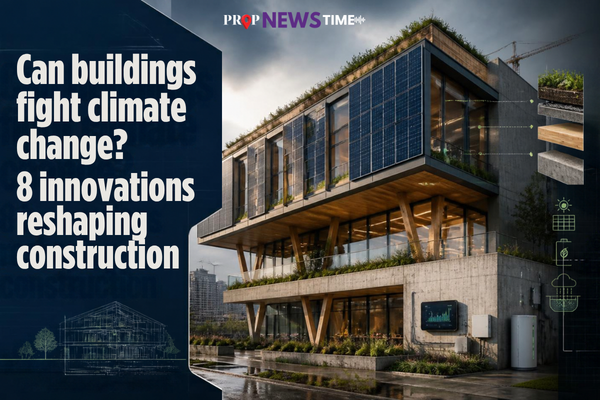
The construction industry sits at the centre of the climate challenge. Buildings require large quantities of cement, steel, glass and other materials, while completed structures consume energy throughout their operating lives. UNEP's latest buildings and construction assessment says the sector accounts for around 34% of global CO emissions, while buildings consume about 32% of global energy.
At the same time, buildings are increasingly expected to cope with extreme heat, flooding, water stress and other climate-related risks. This is pushing architects, engineers, developers and material manufacturers to rethink construction from the ground up. The next phase of sustainable construction is therefore not simply about adding solar panels or planting trees around buildings. It involves changing the materials, technologies, design principles and entire lifecycle of buildings. Here are eight innovations reshaping that transition.
1. Low-carbon concrete is challenging the industry's biggest material habit
Concrete remains fundamental to modern construction, but cement production is highly emissions-intensive. The focus is therefore shifting towards lower-carbon cement and concrete through supplementary cementitious materials, alternative production methods, improved material efficiency and, in some cases, carbon capture and storage.
The International Energy Agency says the cement and concrete transition will require a combination of material efficiency, alternative fuels, supplementary cementitious materials and carbon capture technologies. However, near-zero-emission cement remains more expensive and its deployment is still far below the scale required for a net-zero pathway.
For developers, this means embodied carbon could increasingly become another consideration alongside cost, structural performance and construction timelines. As standards and procurement practices evolve, lower-emission concrete could gradually move from a niche specification to a mainstream construction requirement.
2. Engineered timber is bringing renewable materials into taller buildings
Timber is being reconsidered as a structural material through engineered products such as cross-laminated timber and glue-laminated timber. These systems allow wood to be manufactured into large structural components with greater dimensional stability and predictable performance.
The climate argument is partly linked to replacing emissions-intensive materials and partly to the carbon stored in responsibly sourced timber. UNEP has identified sustainably sourced bio-based materials, including timber and bamboo, as one potential pathway for reducing construction-sector emissions.
However, timber is not automatically sustainable. Its benefits depend on responsible forestry, sourcing, building design, fire and moisture performance, and end-of-life management. The innovation is therefore less about replacing every concrete building with wood and more about expanding the material choices available to designers.
3. Passive design can reduce the need for energy-intensive cooling
One of the simplest ways to make a building more climate-friendly is to reduce the amount of energy it needs in the first place. Passive design uses building orientation, shading, insulation, natural ventilation, window design and appropriate materials to control heat and improve indoor comfort. These measures can reduce dependence on mechanical cooling, particularly in hot climates.
The World Bank identifies measures such as cool roofs, solar shading, insulation, natural ventilation, building orientation and green roofs as tools for improving resilience to extreme heat.
This approach is particularly important as cooling demand rises. The IEA notes that cooling needs are expected to grow, while efficient building envelopes and improved cooling systems remain important components of energy-efficiency strategies.
4. Building-integrated solar can turn facades into power generators
Solar power is moving beyond rooftop panels. Building-integrated photovoltaics, or BIPV, incorporate solar technology directly into roofs, facades, windows, skylights and other parts of the building envelope.
This creates a different relationship between the building and its energy system. Instead of treating solar panels as an additional piece of equipment, the building surface itself can become part of the electricity-generation system.
NREL describes BIPV systems as multifunctional building components that can generate electricity while also serving as elements of the building envelope.
For dense urban areas where available land is limited, integrating generation into existing building surfaces could become increasingly relevant. The effectiveness of such systems, however, depends on orientation, shading, building energy demand, local solar conditions and project economics.
5. Circular construction can turn old buildings into material banks
The greenest construction project is not always a new construction project. Reusing an existing building can avoid the emissions associated with demolition, manufacturing new materials and transporting replacement components.
Circular construction takes this principle further by designing buildings and components for reuse, repair, disassembly and recycling. Materials from one project can potentially become inputs for another rather than ending up as waste.
UNEP has highlighted building reuse, material efficiency, recycling and circular design as important strategies for reducing construction-related emissions. Its 2024–2025 report also estimates that construction and demolition waste amounts to around two billion tonnes globally each year. This could eventually change how buildings are valued: not simply as finished structures, but also as collections of materials that retain value throughout their lifecycles.
6. Smart buildings can continuously optimise energy use
Digital technology is giving buildings the ability to respond to changing conditions rather than operating at fixed settings. Sensors, building-management systems, smart meters, automated shading, connected HVAC equipment and data analytics can monitor factors such as occupancy, temperature, lighting and energy consumption. Systems can then adjust building operations to avoid unnecessary energy use.
The opportunity becomes particularly important in large commercial buildings, where heating, cooling, lighting and equipment can represent substantial operating loads. Digital systems can also provide building managers with data that helps identify inefficiencies that may otherwise remain hidden.
The climate benefit therefore comes not from technology alone, but from using data to operate buildings more efficiently throughout their lifespan.
7. Climate-resilient design is moving beyond carbon reduction
A building can have lower operational emissions and still be poorly prepared for climate risks. As extreme heat, flooding and storms become more important considerations, construction is increasingly having to address both mitigation and adaptation.
Resilient design can include elevated critical equipment in flood-prone locations, heat-resistant materials, flood-resistant construction, passive cooling, water-management systems, backup power and landscape interventions.
The World Bank has emphasised that green and resilient building strategies can simultaneously reduce emissions and improve protection against climate hazards.
This changes the definition of a sustainable building. The objective is no longer simply to consume less energy under normal conditions, but also to remain functional when environmental conditions become more challenging.
8. Modular and prefabricated construction can reduce material and construction waste
Construction is gradually becoming more industrialised, with components increasingly manufactured in controlled factory environments before being assembled on site.
Prefabrication and modular construction can improve material planning, reduce on-site waste and increase the consistency of manufacturing. Components can potentially be designed for disassembly and reuse, strengthening the connection between modular construction and circularity.
The climate benefit depends heavily on project design, transportation distances, factory energy sources and how efficiently materials are used. Nevertheless, the approach offers a pathway towards more predictable construction processes while reducing some of the inefficiencies associated with conventional site-based construction.
The future of climate-conscious construction will not depend on one breakthrough material or technology. It will come from combining lower-carbon materials, efficient building envelopes, renewable energy, digital systems, circular design and climate-resilient planning.
That shift is becoming increasingly important as the world's building stock continues to expand. UNEP estimates that the sector already accounts for a substantial share of global energy use and emissions, while the World Bank expects total global building space to more than double by 2060.
The real transformation, therefore, is not simply about constructing greener buildings. It is about designing buildings that use fewer resources, generate less carbon, adapt to changing conditions and retain value for longer. In that sense, the buildings of the future could become active participants in climate action rather than passive contributors to the problem.
Sources- UNEP, GlobalABC, International Energy Agency, World Bank, World Green Building Council and NREL.

17th Nov, 2026

17th Nov, 2026


17th Nov, 2026




17th Nov, 2026


17th Nov, 2026
Advertisement








 Facebook
 Whatsapp

