Advertisement






The Gulf conflict has disrupted global supply chains, pushed...
REITs have changed the way commercial real estate is owned a...
What really powers the cloud? Behind every Google search, A...
What really powers the cloud? Behind every Google search, A...
Luxury real estate is one of the most talked-about segments ...
Buildings are increasingly being designed not only around energy efficiency but also around the carbon impact of materials, construction methods and building operations. The buildings and construction sector consumes about 32% of global energy and contributes 34% of global CO2 emissions, according to the United Nations Environment Programme. Cement and steel, widely used across the built environment, account for a significant share of these emissions. This has increased interest in technologies that can reduce material-related emissions, improve energy performance, store carbon or reduce construction waste. From concrete that incorporates captured carbon to timber structures, smart glazing, thermal storage and modular construction, several technologies are being developed and adopted across different parts of the built environment.
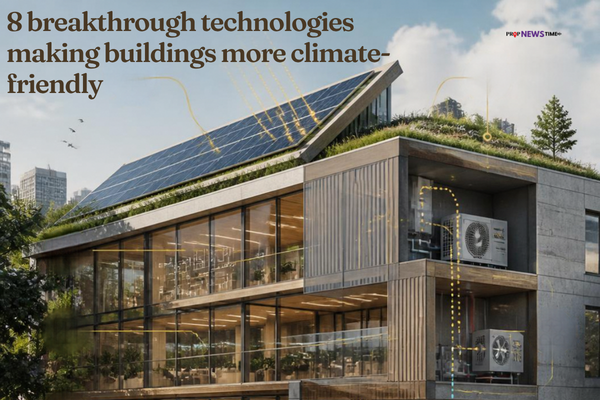
Buildings are moving beyond conventional energy-efficiency measures as developers, architects and engineers look at the carbon footprint of the materials, construction processes and systems used throughout a building’s lifecycle. With the buildings and construction sector accounting for about 32% of global energy consumption and 34% of global CO2 emissions, the focus is shifting towards solutions that can reduce embodied carbon, improve operational performance and minimise construction waste. From carbon-storing concrete and mass timber to smart glass, thermal energy storage and modular building systems, these technologies are changing how the built environment can respond to climate pressures.
1. Carbon-storing concrete
Carbon mineralisation is being explored as a way of incorporating captured CO2 into construction materials. In this process, carbon dioxide reacts with alkaline materials to form stable carbonate compounds that can be incorporated into products such as concrete and aggregates. The US Department of Energy identifies building materials as a significant potential market for mineralised CO2 because carbonate materials can provide a form of long-term carbon storage. Some concrete technologies use captured CO2 during production or curing, where it can form calcium carbonate within the material. The approach can also support reductions in the amount of conventional cement required in certain formulations, although performance, cost and availability vary between technologies and projects.
2. Mass timber and cross-laminated timber
Mass timber uses engineered wood products such as cross-laminated timber (CLT) and glulam for structural applications that have traditionally relied heavily on concrete and steel. CLT panels are manufactured by bonding layers of timber in alternating directions, creating large structural elements that can be used for floors, walls and other parts of a building. Wood also stores biogenic carbon while trees are growing, although the overall climate impact depends on factors including forest management, product lifespan, transportation and what materials the timber replaces. Building assessments are increasingly examining mass timber through whole-building life-cycle analysis to compare embodied carbon with alternative structural systems.
3. Electrochromic smart glass
Electrochromic glass can change its optical properties when an electrical signal is applied, allowing the amount of light and solar heat entering a building to be controlled. The technology can automatically or manually adjust glazing depending on external conditions and building requirements. This can help manage solar heat gain and glare while maintaining daylight, potentially reducing cooling and lighting loads in suitable buildings. The US Department of Energy is supporting projects aimed at improving the cost and installation of electrochromic glazing for both new buildings and retrofits. Adoption remains dependent on factors such as installation costs, climate, building orientation and the performance of conventional high-performance glazing.
4. Phase-change materials
Phase-change materials are designed to absorb and release heat as they move between different physical states. In buildings, they can be incorporated into walls, ceilings, floors or other components to increase thermal storage capacity. When indoor temperatures rise, the material absorbs heat during its phase change and releases it later when temperatures fall. This can help moderate indoor temperature fluctuations and shift part of a building's thermal load away from peak periods. The technology is particularly relevant to buildings where passive thermal management can complement mechanical heating and cooling systems. Its effectiveness depends on the material selected, its placement, the building envelope and local climate conditions.
5. Thermal energy storage and sand-based systems
Thermal energy storage allows electricity or other energy inputs to be converted into heat and stored for later use. Some emerging systems use solid materials, including sand or other granular media, as the storage medium. Instead of storing electricity directly in a battery, excess renewable electricity can be converted into heat and retained for periods when energy is required. Such systems can be relevant to district heating, industrial processes and buildings with substantial heating demand. Their role is different from conventional electrical batteries, as the stored energy is primarily intended for thermal applications. The wider development of thermal storage is linked to the need to integrate variable renewable power with energy demand.
6. Bio-receptive building facades
Bio-receptive facades are designed to provide surfaces where organisms such as mosses, algae and lichens can grow. Rather than treating a building facade as an entirely inert surface, these systems use specific materials, textures and environmental conditions to support biological growth. Vegetated or bio-receptive surfaces can provide shading, retain moisture and influence the immediate microclimate around a building. They can also contribute to urban biodiversity where appropriate conditions exist. However, these systems should not automatically be treated as standalone carbon-removal technologies. Their environmental value depends on factors including the species supported, maintenance requirements, water availability, facade design and local climate.
7. Circular modular construction
Modular construction moves a greater proportion of building production into controlled factory environments before components are transported to the site for assembly. This can improve material management, reduce certain forms of construction waste and allow repeated components to be manufactured more efficiently. The next step is combining modular construction with circular design, where building components can be dismantled, repaired, reused or recycled rather than permanently fixed together. Mechanical connections and standardised components can make future disassembly easier. The US Department of Energy identifies modular and industrialised construction as areas of ongoing development, with potential benefits including reduced material waste and shorter site construction periods.
8. Building-integrated wind energy
Small-scale wind systems can be integrated into or placed around buildings to generate electricity from local wind resources. Designs can include compact or vertical-axis turbines that are adapted to the constraints of the built environment. Unlike large wind farms, building-integrated systems operate in areas where wind conditions are strongly influenced by surrounding structures, making site assessment particularly important. They are therefore more likely to complement other renewable technologies, such as rooftop solar, rather than replace them. Factors including turbulence, noise, structural requirements, maintenance access and actual wind speeds determine whether a particular building is suitable for such systems.
What these technologies mean for the built environment
The emerging building technologies cover different parts of the construction and operating cycle. Carbon mineralisation and mass timber primarily address material and embodied carbon, while smart glass and phase-change materials focus on building energy performance. Thermal storage can help manage energy demand, modular construction can reduce waste and improve resource efficiency, and bio-receptive facades and building-integrated renewables introduce additional environmental functions into building design.The wider shift is towards treating buildings as systems in which material selection, energy use, construction processes, waste and future reuse are considered together. Not every technology will be suitable for every project, but their development reflects a broader move towards reducing both operational and embodied impacts across the building life cycle.
Sources Renewable Energy Magazine, GlobalABC / UNEP, Green Design Consulting

17th Nov, 2026

17th Nov, 2026


17th Nov, 2026




17th Nov, 2026


17th Nov, 2026
Advertisement








 Facebook
 Whatsapp

