Advertisement






The Gulf conflict has disrupted global supply chains, pushed...
REITs have changed the way commercial real estate is owned a...
What really powers the cloud? Behind every Google search, A...
What really powers the cloud? Behind every Google search, A...
Luxury real estate is one of the most talked-about segments ...
Artificial Intelligence is pushing residential real estate beyond conventional smart-home features towards buildings that can continuously monitor, learn and respond to changing conditions. AI-powered systems can combine Internet of Things sensors, predictive analytics and edge computing to optimise energy use, anticipate equipment failures, strengthen security and automate building operations. Instead of relying primarily on residents or facility teams to operate individual systems, autonomous buildings can analyse occupancy, weather, equipment performance and other real-time inputs to determine appropriate responses. This shift could influence how developers design projects, how societies manage assets and how residents experience everyday living.
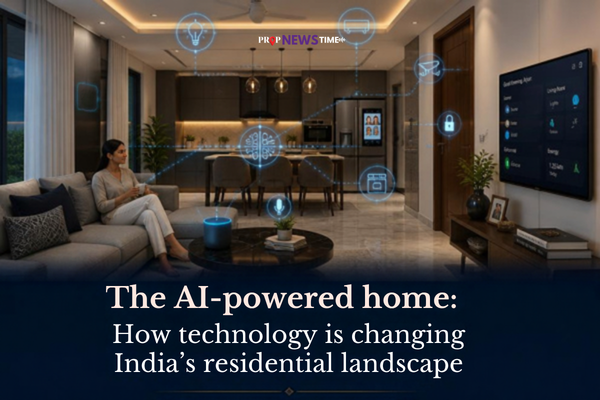
AI is taking residential real estate beyond connected devices and app-based smart-home controls towards buildings that can interpret data and respond to changing conditions with less human intervention. By combining IoT sensors, artificial intelligence, edge computing and predictive analytics, residential systems can monitor occupancy, indoor conditions, energy demand and equipment performance in real time, enabling more adaptive control of lighting, cooling, security and other building functions. The shift is also bringing greater attention to interoperability, privacy and cybersecurity, as intelligent systems increasingly become part of everyday residential operations.
AI is redefining the smart building
The integration of Artificial Intelligence into residential real estate is beginning to change the definition of a smart building. While earlier generations of smart homes focused on connected appliances, mobile applications, automated lighting and voice assistants, newer systems are moving towards buildings that can interpret data, predict requirements and respond with limited human intervention. Research into AI-driven smart buildings increasingly points towards applications spanning energy management, predictive maintenance and broader building operations.
From connected homes to intelligent buildings
The fundamental difference lies in the control mechanism. A conventional building largely depends on people to operate systems manually. A connected or smart building introduces sensors and programmed rules, allowing certain functions to respond automatically. An AI-powered building goes a step further by analysing multiple sources of information simultaneously and using those insights to determine what action should be taken. This creates a shift from simple automation towards systems capable of continuous monitoring, prediction and increasingly autonomous decision-making.
AI-driven energy management
Energy management is one of the most immediate applications. Instead of operating air-conditioning systems according to fixed schedules, AI-based systems can analyse occupancy, outdoor temperatures, weather forecasts, electricity demand and individual comfort preferences. This allows cooling and ventilation to be adjusted according to actual requirements rather than predetermined settings. Such systems can also help buildings respond to periods of high electricity demand by shifting or reducing consumption where possible. AI research in building operations has identified energy optimisation and control as important areas for practical deployment, although large-scale adoption still faces implementation challenges.
Predictive maintenance moves beyond scheduled servicing
Predictive maintenance represents another major change. Sensors installed across elevators, pumps, HVAC equipment, electrical systems and plumbing infrastructure can continuously collect information on temperature, vibration, pressure, energy consumption and operating conditions. Machine-learning models can identify unusual patterns that may indicate developing faults. Rather than waiting for equipment to fail or relying exclusively on calendar-based maintenance, facility teams can intervene when the data indicates a higher probability of failure. This can potentially reduce unplanned downtime while allowing maintenance resources to be directed towards assets showing signs of deterioration.
Managing complex residential developments
This approach could become particularly valuable in large residential developments where multiple towers, lifts, pumps, cooling systems and common facilities generate significant operational data. AI can bring these individual data streams together, enabling facility managers to prioritise repairs and potentially reduce unnecessary maintenance interventions. As residential projects become larger and more technologically integrated, the ability to manage multiple building systems through a common intelligence layer could become increasingly relevant to operational efficiency.
AI brings new capabilities to residential security
Security is also moving from conventional access control towards increasingly automated systems. AI-enabled video analytics can identify movement patterns, recognise authorised individuals and flag unusual activity around entrances or restricted areas. In a residential development, access systems could potentially distinguish between residents, visitors and delivery personnel while maintaining digital records of movement. However, wider deployment will also require careful attention to privacy, consent, cybersecurity and the handling of biometric information. The use of AI in security therefore creates a parallel requirement for stronger governance around data collection and access.
Smarter management of water and other resources
Resource management could eventually become another area of autonomous operation. Buildings equipped with connected water meters, leak-detection sensors, lighting controls and weather-monitoring systems can coordinate different infrastructure systems rather than operating them independently. AI could use weather forecasts and consumption patterns to improve water management, adjust lighting according to daylight availability and identify abnormal consumption before it becomes a larger problem. The broader objective is to move from monitoring individual systems towards coordinated management of the building as a whole.
Building-management systems move towards autonomy
This transition is also changing the role of building-management systems. Research into AIoT-enabled building energy management is increasingly focused on moving from fragmented device-level control towards integrated, closed-loop and autonomous operations. The challenge is no longer simply connecting more devices but creating an infrastructure capable of interpreting data and taking appropriate action. The emerging concept of autonomous buildings similarly centres on systems that can optimise operations and identify or respond to problems with limited human intervention.
Digital infrastructure becomes a developer priority
For developers, this could eventually make digital infrastructure as important as conventional building services. Reliable connectivity, sensor networks, edge-computing capabilities and interoperable building-management platforms may increasingly need to be considered during the design stage rather than added after construction. Designing these systems from the outset could make it easier to integrate different technologies and upgrade them as AI capabilities evolve. This may also influence how developers evaluate the long-term operational requirements of residential assets.
Cybersecurity, privacy and interoperability remain challenges
The transition will not be without challenges. AI-driven buildings require significant sensor infrastructure, reliable connectivity, cybersecurity safeguards and well-integrated building systems. Poor-quality data or incompatible systems can undermine automation, while excessive dependence on algorithms can create operational and privacy risks. Research also identifies data dependency, standardisation, interpretability, safety and implementation costs as barriers to wider real-world deployment of AI in building systems.
From responsive buildings to autonomous environments
The larger shift, therefore, is not simply from manual buildings to smart buildings. It is from buildings that respond to instructions to buildings that increasingly anticipate requirements. As AI, IoT and building-management technologies mature, residential real estate could move towards environments where energy, maintenance, security and resources are continuously monitored and optimised in the background. For developers and property managers, this could make intelligence, interoperability and operational autonomy increasingly important dimensions of future property design, while residents may gradually experience buildings that require less direct intervention in everyday operations.
Sources BEMS, IEEE, WorldGBC

17th Nov, 2026

17th Nov, 2026


17th Nov, 2026




17th Nov, 2026


17th Nov, 2026
Advertisement








 Facebook
 Whatsapp

