Advertisement






The Gulf conflict has disrupted global supply chains, pushed...
REITs have changed the way commercial real estate is owned a...
What really powers the cloud? Behind every Google search, A...
What really powers the cloud? Behind every Google search, A...
Luxury real estate is one of the most talked-about segments ...
The 25th CII Energy Efficiency Summit 2026 began in Hyderabad on September 16, bringing together more than 1,600 policymakers, industry leaders, technology providers, researchers, academics and energy professionals to discuss India’s transition towards a Net Zero economy. Organised by the CII Green Business Centre, the summit is being held alongside the 22nd Power Plant Summit and 20th PaperTech 2026. Discussions on the opening day focused on energy efficiency, clean technologies, industrial decarbonisation, digitalisation, resource conservation and sustainable manufacturing. The event featured more than 60 national and international speakers and an exposition showcasing over 75 technologies and solutions. The inaugural session also saw the release of three publications covering energy-efficiency priorities, thermal power plant benchmarking and best practices in the paper sector. The 27th CII National Award for Excellence in Energy Management also began with participation from 263 industries across more than 15 sectors.
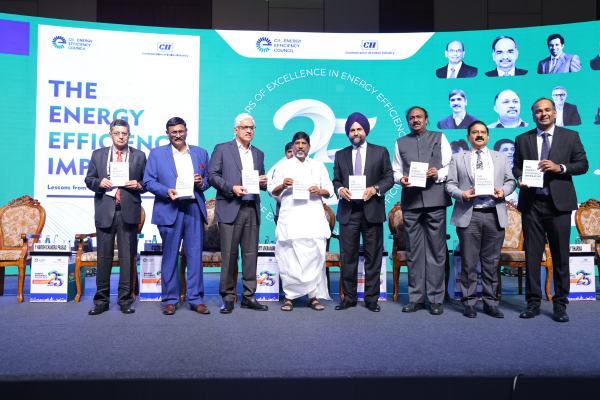
The Confederation of Indian Industry (CII) began the 25th Energy Efficiency Summit 2026 in Hyderabad on September 16, bringing policymakers, industry representatives, technology providers and sustainability professionals together to discuss measures to accelerate India’s transition towards a Net Zero economy.
Organised by the CII Green Business Centre at the Hyderabad International Convention Centre (HICC), the summit is being held under the theme ‘Accelerating the transition to a Net Zero economy through energy efficiency, clean technologies, and sustainable practices’.
The opening day also featured the 22nd Power Plant Summit 2026 and the 20th PaperTech 2026. The three programmes addressed energy efficiency, clean technologies, industrial decarbonisation, resource conservation, digitalisation and sustainable manufacturing.
The Power Plant Summit examined the future of thermal power through efficiency, flexibility, sustainability and artificial intelligence, while PaperTech focused on technology, innovation, sustainability and operational performance in the Indian pulp and paper industry.
Energy efficiency and industrial competitiveness
Addressing the inaugural session, Telangana Deputy Chief Minister Mallu Bhatti Vikramarka said energy efficiency should be treated as an economic competitiveness strategy alongside its environmental role.
He said improving efficiency across motors, cooling systems, buildings, industrial processes and digital energy management could reduce electricity demand, operating costs and emissions. He also emphasised the importance of measuring outcomes, sharing proven solutions and scaling technologies across industries as Telangana and India pursue economic growth with lower resource consumption.
Tejpreet Singh Chopra, Chairman, Energy Efficiency Summit 2026, and Founder and CEO, BLP-Industry.AI, highlighted the role of artificial intelligence and digital tools in identifying and implementing energy-efficiency opportunities. He described energy efficiency as a ‘first fuel’ that can reduce demand and create greater capacity for cleaner power sources, while noting that digital technologies could enable continuous monitoring of a larger number of industrial assets.
Ajay Sharma, Chairman, Power Plant Summit 2026 and Executive Director (Operation Services), National Thermal Power Corporation Ltd, said India’s energy transition would need to consider not only additional generation capacity but also the efficiency of existing assets and their integration with renewable energy and storage.
He said thermal power would continue to have a role during the transition and would need to become more efficient, flexible and responsive while renewable energy, storage and digital technologies expand.
Ganesh Bhadti, Chairman, PaperTech 2026 and Executive Director (Operations and Projects), Seshasayee Paper & Boards Ltd, highlighted energy efficiency and decarbonisation as key areas for the long-term sustainability of industry. He also pointed to the paper sector’s use of renewable, recyclable and biodegradable resources as a foundation for further decarbonisation.
Publications and industry recognition
The inaugural session saw the release of three publications. The Energy Efficiency Imperative: Lessons from the Past, Leadership for the Future examines lessons from India’s energy-efficiency journey and identifies future priorities.
The CII Thermal Power Plant Benchmarking Report 2026 establishes performance benchmarks for thermal power plants and identifies opportunities to improve efficiency and resource utilisation.
The Best Practice Manual in Paper Sector – Volume 14 presents 11 practices for energy and resource efficiency drawn from Indian and international paper-sector operations.
The discussions also highlighted the role of technology-led efficiency, operational improvements, modernisation, AI-enabled decision-making, resource conservation, renewable energy and circularity in supporting the transition towards Net Zero.
The first day also marked the beginning of the 27th edition of the CII National Award for Excellence in Energy Management. A total of 263 industries across more than 15 sectors are participating by presenting energy-efficiency practices, technologies and approaches.
Participation and technology showcase
The summit has brought together more than 1,600 policymakers, senior industry leaders, technology providers, researchers, academics, startups and other stakeholders. More than 60 national and international speakers are contributing to the discussions.
An exhibition running alongside the summit features more than 75 technologies and solutions related to energy efficiency, clean technology and sustainable industrial practices.
The discussions across the three programmes are focused on translating energy and sustainability objectives into practical measures that can be implemented at industrial scale, while addressing energy security, operating efficiency and environmental performance.

17th Nov, 2026

17th Nov, 2026


17th Nov, 2026




17th Nov, 2026


17th Nov, 2026
Advertisement








 Facebook
 Whatsapp

