Advertisement






The Gulf conflict has disrupted global supply chains, pushed...
REITs have changed the way commercial real estate is owned a...
What really powers the cloud? Behind every Google search, A...
What really powers the cloud? Behind every Google search, A...
Luxury real estate is one of the most talked-about segments ...
India's cities are no longer building only for growth they are building for survival. Record-breaking heatwaves, urban floods and stronger cyclones have forced governments to redesign infrastructure in ways that would have seemed unusual a decade ago. From Ahmedabad's pioneering Heat Action Plan and Chennai's massive stormwater drain network to Odisha's cyclone shelters and Mumbai's underground flood-control projects, climate resilience is increasingly shaping urban investment. These eight real-world initiatives show how Indian cities are adapting to extreme weather while protecting people, property and long-term economic growth.
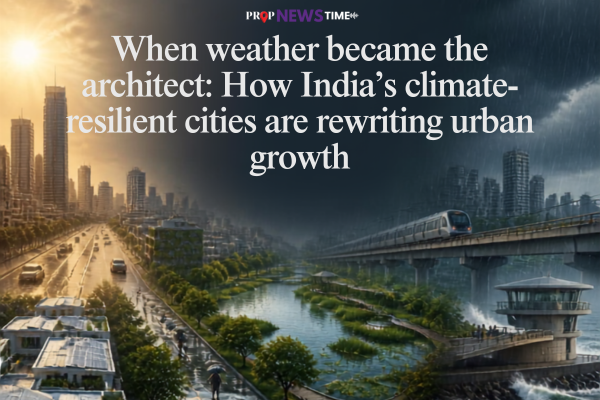
A bridge, a road or a building is no longer judged only by how well it serves people on a normal day. Increasingly, the real test comes during a flood, a heatwave or a cyclone.
Over the past decade, Indian cities have experienced repeated reminders that climate risks can disrupt transport, construction, businesses and entire neighbourhoods. In response, several cities have moved beyond emergency relief and begun redesigning infrastructure itself. Some are cooling their streets before summer arrives. Others are rebuilding drainage systems, restoring wetlands or constructing permanent evacuation networks. Together, these projects show that climate resilience is becoming one of India's biggest infrastructure stories.
1. Ahmedabad built India's first Heat Action Plan
After a deadly heatwave in 2010, Ahmedabad became the first Indian city to launch a Heat Action Plan in 2013. Developed by the Ahmedabad Municipal Corporation with the Indian Institute of Public Health and international partners, the programme introduced colour-coded heat alerts, hospital preparedness, public awareness campaigns and emergency coordination before temperatures peaked. Instead of treating heat as an unavoidable summer event, the city created a system that helps schools, hospitals and civic agencies prepare in advance. The model has since inspired heat action plans across dozens of Indian cities
2. Chennai rebuilt its drainage system after the 2015 floods
The devastating 2015 Chennai floods exposed major weaknesses in the city's stormwater infrastructure and triggered one of India's largest urban drainage upgrades. The Greater Chennai Corporation has since constructed hundreds of kilometres of new stormwater drains, upgraded older networks and restored canals and water bodies to improve water flow. Alongside engineered infrastructure, the city has adopted sponge-city principles that help absorb rainwater naturally instead of relying only on concrete drains. Rather than rebuilding exactly what existed before, Chennai fundamentally changed how it manages urban flooding.
3. Odisha turned cyclone preparedness into permanent infrastructure
Odisha's response to the 1999 Super Cyclone transformed the state into one of India's strongest examples of disaster resilience. Through the Odisha State Disaster Management Authority (OSDMA), hundreds of cyclone shelters were built across vulnerable coastal districts, supported by evacuation routes, trained community volunteers and one of India's most advanced early-warning systems. These shelters serve local communities throughout the year while becoming emergency centres during cyclones. The result has been a dramatic improvement in evacuation capacity, proving that permanent preparedness can save lives long before a storm makes landfall.
4. Mumbai invested in underground flood-control infrastructure
Mumbai's monsoon flooding pushed the city to rethink drainage on a much larger scale. The BRIMSTOWAD programme modernised stormwater systems, while newer flood-control projects introduced underground holding tunnels, pumping stations and improved drainage infrastructure to reduce waterlogging in vulnerable areas. The Mumbai Coastal Road project also incorporates pumping stations designed to improve flood resilience along parts of the coastline. Instead of relying only on surface drains, the city is increasingly using hidden underground infrastructure to help manage extreme rainfall in one of India's most densely populated metropolitan regions.
5. Surat made flood forecasting part of city infrastructure
After experiencing repeated floods, Surat strengthened its resilience by investing in real-time flood forecasting rather than depending only on post-disaster response. The Surat Municipal Corporation introduced river monitoring systems, emergency coordination mechanisms and improved drainage management that allow authorities to respond faster as water levels rise. Better forecasting also helps businesses prepare earlier, reducing disruption to one of India's largest textile and diamond industries. In Surat's case, data has become as important as concrete—turning information into a form of protective infrastructure.
6. Bengaluru began restoring lakes as flood infrastructure
Bengaluru's recurring floods revealed how years of urban expansion had weakened its natural drainage network. The Bruhat Bengaluru Mahanagara Palike (BBMP) and state agencies have increasingly focused on restoring interconnected lakes, rejuvenating rajakaluves (stormwater channels) and removing blockages that prevent rainwater from flowing naturally. These lakes are no longer being viewed only as recreational spaces—they are increasingly treated as working pieces of urban infrastructure that help reduce flooding during heavy rainfall. The city's experience has highlighted that protecting natural systems can be just as important as building new ones.
7. Kochi began using wetlands as climate infrastructure
Kochi's low-lying geography has made flood management increasingly dependent on preserving its natural water systems. Instead of relying solely on engineered solutions, projects under the Kerala Urban Development Programme have focused on improving drainage while protecting wetlands, canals and backwater networks that naturally store and move water. These ecosystems help slow floodwaters and reduce pressure on urban drainage systems during heavy rainfall. Kochi's approach demonstrates that environmental restoration can become a practical part of infrastructure planning rather than simply a conservation exercise.
8. Telangana made cool roofs part of heat resilience
As heatwaves intensified across Hyderabad and other cities, Telangana's Cool Roof Policy introduced practical measures to reduce indoor temperatures. The programme encourages reflective roof coatings, cooler construction materials and heat-reducing designs for government buildings and affordable housing. Cooler roofs help lower indoor temperatures, reduce dependence on air conditioning and improve comfort during extreme heat, particularly for lower-income households. Rather than waiting for temperatures to rise each summer, the policy addresses heat at the building-design stage itself.
India's climate-resilience story is increasingly being written through infrastructure rather than emergency response alone. Ahmedabad prepared for heat before summer arrived. Chennai rebuilt its drainage network after devastating floods. Odisha invested in permanent cyclone shelters, while Mumbai, Surat, Bengaluru, Kochi and Telangana redesigned systems that help cities function even during extreme weather. Together, these projects show that the strongest cities of the future may not be the ones that grow the fastest, but the ones that continue working when the climate becomes increasingly unpredictable.
Sources: Ahmedabad Municipal Corporation, National Disaster Management Authority (NDMA), Greater Chennai Corporation ,Brihanmumbai Municipal Corporation (BMC) Odisha State Disaster Management Authority (OSDMA)

17th Nov, 2026

17th Nov, 2026


17th Nov, 2026




17th Nov, 2026


17th Nov, 2026
Advertisement








 Facebook
 Whatsapp

