Advertisement






The Gulf conflict has disrupted global supply chains, pushed...
REITs have changed the way commercial real estate is owned a...
What really powers the cloud? Behind every Google search, A...
What really powers the cloud? Behind every Google search, A...
Luxury real estate is one of the most talked-about segments ...
Data centres have rapidly evolved from back-end digital infrastructure into one of real estate's fastest-growing asset classes. India's operational data centre capacity crossed 1.5 GW in 2025, while JLL projects it will reach about 2.07 GW by the end of 2027, supported by cloud adoption, artificial intelligence and digital services. Unlike conventional commercial properties, these facilities depend on power, fibre connectivity and specialised infrastructure as much as location. The sector is increasingly reshaping investment strategies, land acquisition, urban development and infrastructure planning across India's property market.
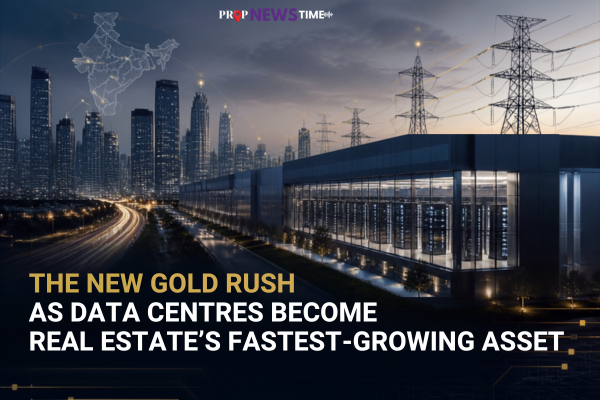
For decades, India's property market revolved around residential towers, office campuses, shopping malls and warehouses. Data centres rarely entered mainstream real estate conversations because they were viewed primarily as technology infrastructure.
That perception has changed dramatically. Every online payment, AI application, cloud service, streaming platform and enterprise workload ultimately relies on physical computing infrastructure. As digital activity expands, so does the need for buildings capable of housing servers, cooling systems, power infrastructure and network connectivity.
The scale of growth illustrates why investors are paying attention. CBRE reported that India's operational data centre capacity crossed 1.5 GW, equivalent to around 23 million sq ft, during 2025. JLL expects capacity to reach 2,073 MW by the end of 2027, requiring approximately 10.7 million sq ft of additional real estate and nearly USD 6.3 billion in investment.
The result is a new race for land, power and connectivity- one that is turning data centres into one of the most closely watched segments of India's alternative real estate market. Here are ten reasons why this sector has become real estate's newest gold rush.
1. AI has transformed computing into a real estate opportunity
Artificial intelligence is creating an entirely new layer of demand for physical infrastructure.
Unlike conventional digital applications, AI workloads require significantly greater computing power, higher-density servers and advanced cooling systems. That translates into larger and more specialised data centre developments.
JLL expects AI to become one of the strongest drivers of future data centre expansion, with cloud providers already preparing infrastructure for increasingly demanding workloads.
The implication for real estate is significant. Every increase in computing demand ultimately creates demand for buildings capable of supporting that infrastructure. Unlike earlier generations of data centres, AI-ready facilities require more electricity, advanced liquid or hybrid cooling technologies and larger equipment rooms, making them fundamentally different from traditional commercial buildings.
2. Cloud adoption has turned digital growth into physical demand
Cloud computing has changed how businesses store and process information, but it has not eliminated the need for physical infrastructure. Instead, computing capacity has become concentrated inside large-scale facilities operated by cloud companies and specialised data centre providers. JLL's research shows cloud service providers remain one of the largest sources of user demand within India's data centre market.
As businesses continue migrating applications, financial services, e-commerce and enterprise systems to cloud platforms, the underlying real estate supporting those services continues expanding.
The more digital the economy becomes, the greater the need for physical buildings capable of keeping it running. This shift also means that real estate developers are increasingly dealing with technology companies as long-term occupiers rather than conventional office tenants.
3. Power has become the new location advantage
Traditional commercial real estate often competes on visibility, accessibility and rental potential. Data centres compete on something else entirely: power availability. Reliable electricity is no longer just an operating requirement- it is the foundation of the asset itself. As computing density rises, operators increasingly evaluate whether locations can deliver long-term power capacity rather than simply whether land is available.
CBRE's Asia Pacific outlook notes that power availability is increasingly influencing where new data centre capacity can be delivered across the region. This shift is changing how investors evaluate land. A location with scalable power infrastructure may become more valuable than one offering conventional commercial advantages alone. Some developers now assess substations, transmission infrastructure and future electricity expansion plans before finalising land acquisitions, making utility infrastructure as important as road access.
4. Mumbai's dominance shows why connectivity matters
Infrastructure- not just geography- determines where data centres cluster. CBRE reported that Mumbai accounted for roughly 53% of India's operational data centre capacity during 2025, reflecting the city's advantages in submarine cable connectivity, internet exchanges and established digital infrastructure.
Chennai, Delhi-NCR and Bengaluru have also emerged as major markets because they combine enterprise demand with strong network connectivity.
The lesson is clear: digital connectivity can increasingly influence real estate value in the same way highways and airports have historically shaped commercial development. Access to international cable landing stations, low-latency networks and enterprise ecosystems creates competitive advantages that are difficult to replicate elsewhere.
5. Investors are treating data centres as an alternative asset class
Data centres are increasingly attracting institutional capital because they combine infrastructure-like characteristics with long-term real estate demand. JLL estimates that India's expected expansion to around 2.07 GW by 2027 could require approximately USD 6.3 billion in investment.
The opportunity extends beyond constructing buildings. Capital is flowing into land acquisition, development partnerships, operating platforms, power infrastructure and supporting digital ecosystems.
For many investors, data centres now sit alongside logistics parks, life sciences facilities and student housing as part of a broader alternative real estate strategy. Unlike speculative commercial developments, many data centre projects benefit from long-term contracts with enterprise clients and cloud providers, making them attractive to pension funds, infrastructure investors and private equity firms seeking stable cash flows.
6. New markets are entering the data centre race
Mumbai remains the largest market, but the next phase of growth is becoming more geographically diverse. Chennai, Delhi-NCR and Bengaluru continue expanding, while other locations are attracting attention as operators search for suitable land, scalable power and future infrastructure capacity.
CBRE's outlook suggests that distributed digital infrastructure and expansion into emerging locations could gradually reshape India's data centre geography. The next major cluster may therefore emerge where infrastructure readiness meets future demand, rather than simply where office markets are already strongest.
This geographical diversification is becoming increasingly important because land constraints, rising electricity demand and development costs are encouraging operators to explore alternative locations. States are also competing to attract investment through dedicated data centre policies, incentives and faster approvals, creating new opportunities beyond India's traditional technology hubs.
7. Sustainability has become a competitive advantage
The enormous energy requirements of data centres have pushed sustainability from a branding exercise to a business necessity. Operators are increasingly investing in renewable energy, advanced cooling systems, energy-efficient designs and better water management strategies.
CBRE identifies renewable energy integration as one of the important themes shaping India's future data centre expansion. This means resilience and sustainability are becoming part of the asset's long-term financial performance rather than simply environmental considerations.
Modern facilities are increasingly being designed with solar procurement agreements, energy-efficient cooling technologies and water conservation systems to reduce operating costs while meeting environmental targets. As enterprise customers strengthen their own sustainability commitments, greener data centres could enjoy a competitive advantage in attracting global clients.
8. Land is being valued differently
The rise of data centres is changing how certain land parcels are evaluated. Instead of focusing solely on commercial visibility or residential catchments, developers increasingly consider proximity to substations, fibre corridors, network redundancy and industrial infrastructure.
A site capable of supporting high-capacity digital infrastructure may command stronger long-term interest than land suited only for conventional commercial development. The result is a new layer of competition for strategically located industrial and infrastructure-oriented land.
This trend is also influencing planning decisions around industrial corridors and logistics zones. Locations that were once considered secondary commercial markets can suddenly become highly desirable if they combine power availability, connectivity and expansion potential, demonstrating how digital infrastructure is redefining traditional land valuation models.
9. Governments increasingly see data centres as economic infrastructure
Data centres are becoming important not only for technology companies but also for governments pursuing digital-economy ambitions. Several Indian states have introduced dedicated data centre policies, investment incentives and infrastructure support to attract operators, recognising that these facilities can generate investment, employment and supporting economic activity.
Policy support is helping create an ecosystem where power utilities, infrastructure agencies, developers and technology companies increasingly work together. This broader institutional backing is accelerating the sector's emergence as a long-term real estate opportunity rather than a niche technology investment.
Beyond direct investment, governments increasingly view data centres as critical infrastructure supporting financial services, e-governance, telecommunications, healthcare and artificial intelligence. Their presence can also encourage supporting industries such as equipment manufacturing, engineering services, facility management and specialised construction, creating broader economic benefits around major data centre clusters.
10. The next real estate cycle could be powered by digital infrastructure
Perhaps the biggest shift is that data centres are expanding the definition of what qualifies as prime real estate. Traditional property cycles were often driven by housing demand, office expansion or retail consumption. The next cycle may increasingly be influenced by cloud computing, AI, digital payments, streaming, enterprise technology and connected devices.
JLL's estimate of approximately 10.7 million sq ft of additional real estate demand by 2027 illustrates the physical scale of this transformation. As digital infrastructure becomes more essential to economic activity, the buildings supporting that infrastructure could become some of the most strategically valuable assets in India's property market.
This evolution also changes how cities compete for investment. Instead of focusing exclusively on attracting corporate headquarters, urban regions increasingly need reliable electricity, resilient infrastructure, high-capacity telecommunications networks and supportive policies to participate in the digital economy. The real estate market of the next decade may therefore be shaped not only by where people live and work, but also by where data is stored, processed and transmitted.
Data centres have moved far beyond their role as hidden technology infrastructure. They are becoming a distinct real estate asset class whose value depends on power, connectivity, resilience and long-term digital demand as much as the buildings themselves. AI, cloud adoption and enterprise digitalisation are accelerating demand, while investors and governments increasingly view the sector as critical economic infrastructure. At the same time, the search for suitable land, scalable power and future-ready locations is reshaping development patterns across multiple Indian cities. The new gold rush is therefore not about mining physical resources- it is about building the infrastructure that powers the digital economy. As India's online ecosystem continues expanding, data centres could become one of the defining real estate stories of the next decade.
Sources- JLL India, CBRE India, Cushman & Wakefield, Knight Frank India, Reuters, Economic Times, Times of India and other real estate and data centre industry reports.

17th Nov, 2026

17th Nov, 2026


17th Nov, 2026




17th Nov, 2026


17th Nov, 2026
Advertisement








 Facebook
 Whatsapp

