Advertisement






The Gulf conflict has disrupted global supply chains, pushed...
REITs have changed the way commercial real estate is owned a...
What really powers the cloud? Behind every Google search, A...
What really powers the cloud? Behind every Google search, A...
Luxury real estate is one of the most talked-about segments ...
India's real estate growth is increasingly spreading beyond established metropolitan cores as population movement, employment decentralisation and infrastructure investment reshape urban boundaries. Satellite cities and peripheral urban centres are emerging as important residential and commercial markets, supported by better roads, metro networks, expressways, airports and social infrastructure. JLL notes that leading Tier-II cities are benefiting from decentralised work models, infrastructure development and competitive costs, while CBRE identifies proximity to infrastructure projects as an important determinant of residential demand. Analysing these markets at the micro-market level can help identify where migration and infrastructure are likely to create the next phase of real estate growth.
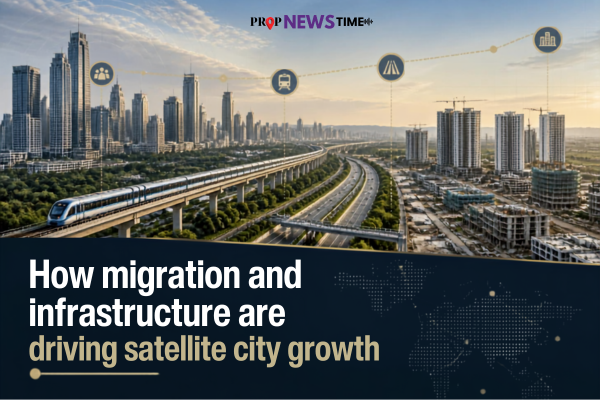
India's real estate market is no longer defined only by what happens inside the boundaries of its largest cities. As metropolitan areas become more expensive and congested, population and economic activity are increasingly spreading into surrounding satellite cities, peripheral corridors and emerging urban centres.
This expansion is being supported by a combination of demographic migration, employment opportunities and infrastructure development. New expressways, metro extensions, airports, railway networks and social infrastructure can improve connectivity between established employment hubs and previously peripheral locations.
The scale of this urban expansion is visible across India's major metropolitan regions. Research on the Mumbai Metropolitan Region, for instance, found that built-up area increased substantially between 1999 and 2019, with peripheral areas recording significant growth and transportation infrastructure influencing the pattern of development.
At the same time, JLL's analysis of India's emerging Tier-II cities highlights decentralised work models, infrastructure development, competitive costs and talent availability as factors creating new opportunities outside traditional metropolitan hubs. For developers and investors, however, identifying a promising satellite city is only the first step. The bigger opportunity lies in understanding which micro-markets within that city are positioned to benefit first. Here are 10 factors that can help decode that opportunity.
1. Track where population movement is actually happening
Demographic migration is one of the clearest indicators of future housing demand. People tend to move towards areas offering employment, better connectivity, relatively affordable housing and improved quality of life. A satellite city experiencing sustained population inflows can therefore create demand not only for homes but also for schools, healthcare, retail, offices and everyday services.
However, population growth at the city level does not automatically translate into equal growth across every locality. Micro-market analysis needs to identify where new residents are settling, what types of households they represent and whether the migration is temporary or permanent. This distinction can help developers avoid investing simply because a city has a strong headline population-growth story.
2. Follow employment nodes before residential demand
Housing demand often follows employment. When companies establish offices, industrial facilities, logistics parks or business districts in peripheral areas, surrounding residential markets can gradually develop. JLL's research on emerging Indian cities points to decentralised work models and expanding economic activity as important drivers of their real estate potential.
For investors, this means tracking upcoming employment clusters can be more useful than looking only at current housing sales. A micro-market located close to a future employment hub could experience stronger demand as the development progresses.
The key is to distinguish between announced projects and operational economic activity. Employment that actually materialises tends to create more durable housing demand than speculative infrastructure announcements.
3. Infrastructure can create new real estate corridors
Roads, metro systems, railways and airports can fundamentally change the accessibility of a location. CBRE's research identifies proximity to infrastructure projects as one of the factors influencing residential market performance.
The impact can be particularly strong when a new infrastructure link connects a satellite city directly with a major employment centre. Reduced travel times can expand the practical residential catchment of the larger city.
CBRE has also identified substantial development potential around transit nodes. Its 2025 research estimated more than 106 million sq ft of potential real estate development within major transit nodes across India's top eight cities, demonstrating how transportation infrastructure can create new development opportunities. For micro-market analysis, the question is therefore not simply whether infrastructure exists, but how much it improves actual accessibility.
4. Look beyond headline connectivity to last-mile access
A location may sit close to a major highway or metro station and still remain inconvenient for residents if the final connection is poor. Last-mile connectivity can influence commuting patterns, retail footfall and the attractiveness of residential projects. Roads connecting housing clusters to transit stations, employment districts and schools can therefore be as important as the headline infrastructure project itself.
This is where micro-market analysis becomes particularly useful. Two neighbourhoods located within the same satellite city can have dramatically different accessibility depending on road quality, public transport availability and congestion.
The strongest locations are often those where multiple transportation options overlap, rather than those dependent on a single road or transit link.
5. Compare affordability with the parent city
One of the fundamental attractions of satellite cities is the potential to offer more space at a lower cost than the metropolitan core. When home prices in the parent city rise, buyers may increasingly consider peripheral locations if commuting remains manageable. Reuters' 2025 housing market reporting highlighted affordability pressures in India's major cities, with migration and the concentration of well-paying jobs contributing to housing challenges.
But affordability should not be measured simply by comparing the headline price per square foot. A better analysis considers the total cost of living, including commuting expenses, travel time, maintenance, school fees and access to services. A slightly more expensive micro-market with superior connectivity can ultimately provide greater value than a cheaper but isolated location.
6. Social infrastructure can separate winners from laggards
Housing markets do not mature on residential supply alone. Schools, hospitals, retail centres, recreational facilities and community infrastructure can determine whether a new locality becomes a complete neighbourhood or remains primarily a housing cluster. This is particularly important in satellite cities, where new residential development can sometimes outpace supporting infrastructure.
Investors should therefore track both existing and planned social infrastructure. A locality with multiple schools, healthcare facilities, retail centres and public amenities can have stronger long-term attractiveness than an area where these facilities remain speculative. Over time, the emergence of social infrastructure can also reinforce property demand by making residents less dependent on the parent city.
7. Study land availability and development intensity
Land availability is another important component of micro-market analysis. A satellite city may have significant developable land, but not every parcel will be equally attractive. CBRE reported that land and development sites accounted for more than 46% of India's real estate investment inflows in 2025, with residential and office development among the major uses attracting capital.
Large-scale land availability can support new townships, commercial districts and mixed-use developments. But excessive supply can also create competition between projects. The more important question is therefore whether a micro-market has controlled supply combined with genuine demand drivers.
8. Watch where institutional capital is moving
Institutional investment can provide another signal of market confidence. When established developers, private equity investors and institutional funds begin acquiring land or backing projects in a particular corridor, it can indicate that the location has passed a more rigorous assessment of demand, infrastructure and future development potential.
CBRE reported that India's real estate investment inflows reached a record USD 14.3 billion in 2025, with land and development sites attracting a significant share of capital. However, institutional activity should be treated as one indicator rather than definitive proof of future appreciation. Investors still need to examine the underlying fundamentals of the specific micro-market.
9. Identify the point where a satellite city becomes self-sustaining
The most successful satellite cities eventually stop functioning merely as residential extensions of a larger metropolitan area. As employment, retail, education, healthcare and entertainment develop locally, residents become less dependent on the parent city. This creates a more diversified real estate market and can support residential and commercial demand simultaneously.
The evolution of satellite cities can therefore be viewed in stages: housing-led expansion, infrastructure-led connectivity, employment creation and finally self-sustaining urban activity. Micro-markets approaching the later stages can become particularly interesting because their demand is no longer dependent on a single infrastructure project or commuting relationship.
10. Build a forward-looking micro-market scorecard
The final step is to bring the different indicators together rather than evaluating each one independently. A practical micro-market scorecard can include population growth, employment potential, infrastructure accessibility, last-mile connectivity, housing affordability, social infrastructure, land availability, new supply, rental demand and institutional investment.
Knight Frank's infrastructure research demonstrates the value of examining real estate markets through the interaction of employment, physical infrastructure and social infrastructure rather than treating property demand as an isolated variable.
The advantage of such a framework is that it can help distinguish between a locality benefiting from temporary speculation and one supported by multiple structural growth drivers. For developers and investors, that distinction could become increasingly important as India's urban expansion creates more competing satellite markets.
Satellite cities are becoming an increasingly important part of India's urban growth story, but their real estate potential cannot be assessed simply by looking at city-level property prices or announced infrastructure projects. The stronger opportunities are likely to emerge where demographic migration, employment, connectivity, social infrastructure and land availability reinforce one another. Infrastructure can open a location, but sustained employment and community development are what can ultimately turn it into a mature real estate market.
As India's metropolitan regions continue to expand, micro-market analysis could therefore become more important than broad city-level assessments. The next generation of real estate opportunities may not necessarily be found in the most prominent cities, but in specific corridors and neighbourhoods where migration and municipal infrastructure are converging to create the conditions for long-term urban growth.
Sources- JLL India, CBRE India, Knight Frank India, Anarock, Reuters, Hindustan Times, Economic Times and other real estate and infrastructure research reports

17th Nov, 2026

17th Nov, 2026


17th Nov, 2026




17th Nov, 2026


17th Nov, 2026
Advertisement








 Facebook
 Whatsapp

