Advertisement






The Gulf conflict has disrupted global supply chains, pushed...
REITs have changed the way commercial real estate is owned a...
What really powers the cloud? Behind every Google search, A...
What really powers the cloud? Behind every Google search, A...
Luxury real estate is one of the most talked-about segments ...
Global real estate investors rarely choose a city based on property prices alone. They look at the wider ecosystem: economic growth, infrastructure, population, talent, transparency, regulation, liquidity and the ability to generate reliable returns over time. A city with strong fundamentals can attract capital even when entry costs are high, while weak governance or limited liquidity can deter investors despite cheaper assets. Here are 10 factors that can determine whether a city makes it onto the global real estate investment map.
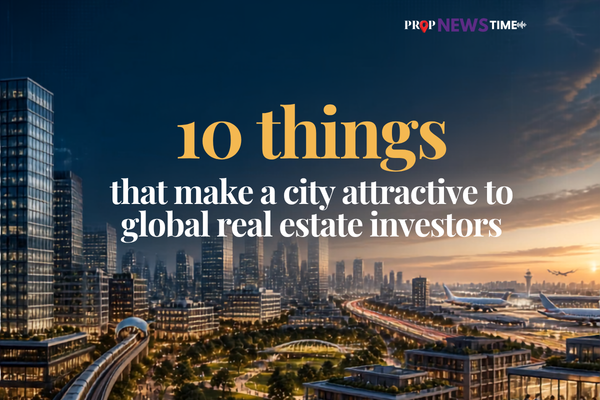
A global real estate investor looking at a city is not simply asking, “How much does property cost here?”
The bigger questions are: Is the economy growing? Are businesses moving in? Can people and goods move efficiently? Is there enough demand for property? Can an investor enter and exit the market without difficulty? And perhaps most importantly, can the rules be understood and trusted?
This is why two cities with similar populations can attract very different levels of international capital. Real estate is ultimately a physical asset, but the investment case depends heavily on everything surrounding it.
1. A strong and growing economy
Property demand follows economic activity
A city's economic base is one of the first things investors examine. Diverse industries, business expansion, job creation and rising incomes can support demand for offices, homes, retail and other property types. Cities dependent on a single industry can carry greater concentration risk, while diversified economies can offer investors a broader demand base.
2. Deep real estate demand
Investors want evidence that people and businesses actually need space. Population growth, household formation, migration, office employment, consumption and business expansion can all translate into real estate demand. The most attractive cities tend to have several demand drivers working at the same time rather than relying on one property segment.
3. Infrastructure that keeps the city connected
Airports, metro systems, highways, public transport and digital infrastructure influence how easily people, businesses and goods move. New infrastructure can also open up previously peripheral locations for development. For investors, however, the key is not simply announcing a project but whether it is funded, delivered and connected to genuine economic activity.
4. Liquidity and an active investment market
A city can have attractive properties but still struggle to attract global capital if transactions are infrequent. A deeper market with active buyers, sellers, lenders, funds, REITs and institutional participants gives investors greater confidence about entering and eventually exiting an investment. PwC and ULI identify market size and liquidity among the most important factors influencing city selection.
5. Transparent rules and reliable regulation
Foreign investors need to understand how property transactions, ownership, development approvals, taxation and dispute resolution work. Transparent markets reduce uncertainty and make it easier to assess risk. JLL's global transparency framework includes regulatory and legal factors, transaction processes, market fundamentals and sustainability when evaluating real estate markets.
6. A strong talent pool
A city with skilled workers can attract businesses, and businesses create demand for offices, housing and supporting infrastructure. Technology, finance, professional services, manufacturing and other knowledge-intensive sectors can therefore have an indirect but significant impact on real estate. For investors, talent availability can be an indicator of whether economic growth is likely to remain sustainable.
7. Quality of life that attracts and retains people
Housing is not the only consideration for a growing workforce. Healthcare, education, public spaces, culture, safety, mobility and recreational infrastructure can influence where people choose to live and companies choose to locate. Cities that can combine economic opportunity with liveability can create a stronger long-term foundation for residential and commercial property demand.
8. Climate resilience and sustainability
Climate risk can affect property values, operating costs, insurance and the long-term viability of assets. Investors are therefore paying greater attention to energy efficiency, emissions, water availability, flood risk, heat exposure and resilience. Sustainability is increasingly becoming part of investment risk assessment rather than simply a building-level feature. JLL has incorporated climate and building-performance measures into its global transparency assessment.
9. A diverse real estate ecosystem
Global investors increasingly look across offices, residential, logistics, data centres, retail, hospitality, healthcare and other specialised assets. A city with several investable sectors gives capital more opportunities to diversify and reposition as demand changes. The growth of alternative sectors such as data centres and logistics is already influencing global investment priorities.
10. A credible long-term growth story
Ultimately, global capital wants to understand where a city is heading. Population trends, infrastructure pipelines, business investment, government policy, employment growth and urban expansion all contribute to that outlook. A city does not need to be the biggest or most expensive market to attract international capital, it needs a convincing combination of growth, stability, investability and long-term demand.
A globally attractive real estate city is rarely built around one spectacular project. It is created through a combination of economic strength, demand, infrastructure, liquidity, transparency, talent and liveability.
That is also why investment rankings can change. As capital becomes more selective, investors are looking beyond established global centres for cities where fundamentals are improving and new opportunities are emerging.
For cities competing for global real estate capital, the message is simple: building more property is only part of the equation. Building a stronger city is what makes the investment case.
Sources: PwC and Urban Land Institute, JLL,PwC and Urban Land Institute, ULI Asia Pacific

17th Nov, 2026

17th Nov, 2026


17th Nov, 2026




17th Nov, 2026


17th Nov, 2026
Advertisement








 Facebook
 Whatsapp

