Advertisement






The Gulf conflict has disrupted global supply chains, pushed...
REITs have changed the way commercial real estate is owned a...
What really powers the cloud? Behind every Google search, A...
What really powers the cloud? Behind every Google search, A...
Luxury real estate is one of the most talked-about segments ...
India's next real estate cycle is being shaped by multiple structural demand drivers, with Global Capability Centres (GCCs), data centres, logistics and warehousing, and retail emerging as key growth engines. GCCs are strengthening office demand, data centres are creating specialised infrastructure requirements, logistics is expanding alongside manufacturing and consumption, while retail is moving towards experience-led formats. With investment, infrastructure and occupier strategies evolving across cities, the next phase of India's property market could be defined less by one dominant sector and more by the convergence of these demand drivers across emerging commercial and urban corridors.
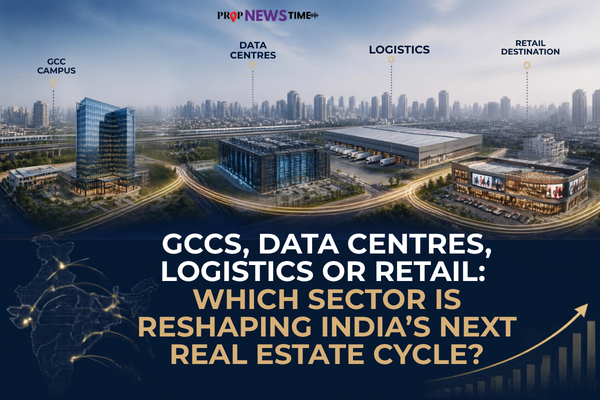
India's commercial real estate market is entering a phase where demand is no longer being driven by a single occupier category. Global Capability Centres (GCCs), data centres, logistics and warehousing, and modern retail are each influencing a different part of the property ecosystem. While GCCs are strengthening office demand, data centres are creating a new category of infrastructure-led real estate, logistics is benefiting from manufacturing and consumption, and retail is becoming increasingly experience-driven. The numbers indicate that all four sectors have meaningful momentum. Yet their impact differs in scale, geography, capital intensity and the kind of real estate they require. Here are nine factors that could determine which segment has the strongest influence on India's next real estate cycle.
1. GCCs: The strongest force in office real estate
GCCs have moved well beyond their earlier role as cost-efficient back offices. They are increasingly handling technology, engineering, analytics, finance, research and other high-value functions for multinational companies, making premium office space a strategic requirement. JLL's India GCC data shows that GCC leasing reached a record 31.3 million sq ft in 2025, with more than 2,000 GCCs now operating in India and total occupied space exceeding 263 million sq ft. Bengaluru remains the country's leading GCC market, while Hyderabad, Chennai, Mumbai, Pune and Delhi-NCR continue to attract specialised operations.
The significance of GCCs extends beyond office absorption. New centres create demand for housing, hotels, transportation, retail and social infrastructure around employment hubs. The sector is therefore influencing not just commercial property but the wider urban development ecosystem.
2. Data centres: Real estate meets digital infrastructure
Data centres operate differently from conventional commercial properties. Their demand is linked to cloud computing, digital services, financial technology, artificial intelligence and the growing volume of data generated by India's economy. CBRE reported that India's operational data-centre stock had reached approximately 1,530 MW, equivalent to around 23 million sq ft, by September 2025, with 260 MW of new capacity added during the first nine months of the year. The expansion is being supported by digitisation, cloud adoption and AI-driven workloads.
The sector's influence is therefore larger than its physical footprint suggests. Data centres require land, power, cooling systems, connectivity and specialised infrastructure, making access to electricity and fibre as important as location itself. CBRE also noted that Mumbai accounted for 53% of India's data-centre capacity as of September 2025.
3. Logistics and warehousing: India's consumption story takes physical form
The growth of e-commerce, quick commerce, organised retail, manufacturing and third-party logistics is creating sustained demand for strategically located warehouses and distribution facilities. Knight Frank's Q1 2026 data, reported by the Economic Times, showed warehousing leasing across India's top eight cities rising 15% year-on-year to 19.3 million sq ft. Manufacturing and third-party logistics companies were among the major demand drivers as businesses strengthened their supply-chain networks.
The momentum is also visible in more recent data. Vestian reported that warehousing absorption reached 23.9 million sq ft in Q2 2026, representing a 27% year-on-year increase. Logistics real estate is consequently becoming more sophisticated. Developers are increasingly looking at larger, better-connected facilities near highways, ports, airports and consumption centres. As infrastructure improves and supply chains become more organised, the sector could reshape the location strategy of industrial and peripheral urban development.
4. Retail: From expansion of stores to expansion of experiences
Retail is taking a different route into the next real estate cycle. Instead of simply adding more stores, retailers are increasingly seeking high-quality malls, prominent high streets and formats that encourage customers to spend more time physically engaging with brands.
CBRE recorded approximately 8.9 million sq ft of retail leasing across India's top cities in 2025, the highest level recorded to date. Around 4.3 million sq ft of new supply was added during the year, with Hyderabad, Mumbai and Delhi-NCR among the leading markets for new additions.
The changing nature of retail demand is particularly important for developers. Flagship stores, food and beverage formats, entertainment, experiential concepts and youth-focused brands are influencing the design of shopping destinations.
In other words, retail real estate is increasingly competing on experience rather than simply location and floor space. This can support higher-quality malls and mixed-use developments in India's growing consumption centres.
5. Geography is becoming as important as the sector
One of the biggest changes underway is the diversification of India's real estate geography. GCC demand is expanding beyond traditional Bengaluru, Hyderabad and Delhi-NCR clusters, while Tier-II cities are increasingly being considered for new capability centres because of talent availability and cost advantages. JLL has identified cities such as Ahmedabad, Kolkata, Jaipur, Coimbatore, Mysuru and Kochi as emerging locations for GCC expansion.
The logistics sector is following infrastructure and consumption corridors, while data centres are increasingly being influenced by power availability and connectivity. Retail, meanwhile, is following rising household incomes, urbanisation and changing consumption patterns. This means the next real estate cycle may not be defined by one city or one asset class. Instead, different sectors could create multiple new growth corridors across India.
6. So, which sector could lead the next cycle?
If the question is about immediate influence on commercial real estate, GCCs currently have the strongest claim. Their large office requirements and ability to generate demand for surrounding urban infrastructure give them a significant multiplier effect. If the focus is on long-term structural transformation, however, data centres could be equally consequential. AI, cloud adoption and digitalisation are creating infrastructure requirements that extend beyond conventional real estate.
Logistics is likely to remain a powerful beneficiary of India's manufacturing and consumption expansion, while retail will continue transforming the quality and experience of urban commercial destinations. The more accurate conclusion, therefore, may not be that one sector will replace the others. India's next real estate cycle is likely to be multi-engine: GCCs driving offices, data centres powering digital infrastructure, logistics supporting physical consumption and manufacturing, and retail capturing the resulting increase in consumer spending.
7. Infrastructure is becoming the common denominator
Whether it is a GCC campus, hyperscale data centre, logistics park or retail destination, infrastructure is increasingly determining where real estate growth happens. Expressways, metro networks, airports, ports, power infrastructure and digital connectivity are influencing development decisions. For data centres, reliable power and fibre connectivity are fundamental requirements; for logistics, highway and multimodal connectivity can determine the efficiency of a facility; and for offices and retail, accessibility and public transport remain critical to occupier and consumer demand.
This is creating new real estate corridors around infrastructure rather than restricting growth to established business districts. The result could be a broader geographical distribution of commercial and industrial development.
8. The rise of mixed-use and interconnected developments
The boundaries between different real estate sectors are becoming less distinct. A large employment hub can generate demand for housing, hotels, restaurants, retail and entertainment, while logistics and manufacturing clusters can stimulate industrial and residential development around them.
GCC expansion provides a clear example of this interconnected demand. As companies establish large employment centres, the surrounding ecosystem often requires supporting amenities, hospitality and residential infrastructure. Similarly, retail growth can benefit from the employment and population growth created by new commercial corridors. This interconnected demand is encouraging developers to think beyond individual buildings and towards larger, integrated urban ecosystems where several asset classes support one another.
9. The next cycle could belong to convergence
The strongest real estate markets of the coming years may not necessarily be those driven by a single sector. Cities where GCC offices, data centres, logistics infrastructure, retail consumption and transport connectivity overlap could emerge as particularly attractive investment destinations. The four sectors also operate on different demand cycles, which could provide greater resilience to the overall market. GCCs can support office absorption, data centres can respond to digitalisation, logistics can benefit from manufacturing and consumption, while retail can capture the spending generated by expanding employment and urbanisation.
The next phase of India's property market could therefore be less about choosing GCCs versus data centres versus logistics versus retail, and more about identifying where these demand drivers converge. For developers and investors, the opportunity may lie in the cities and corridors where employment, infrastructure, consumption, manufacturing and digital demand reinforce one another. That convergence could ultimately define the character of India's next real estate cycle.
India's next real estate cycle is unlikely to be driven by a single asset class. GCCs currently have the strongest direct influence on office demand, while data centres represent one of the country's most infrastructure-intensive emerging opportunities. Logistics is being supported by manufacturing, consumption and supply-chain formalisation, and retail is evolving alongside changing consumer behaviour.
The bigger story, however, is the interaction between these sectors. As employment centres, digital infrastructure, logistics networks, transport corridors and consumption hubs increasingly overlap, they can create entirely new real estate ecosystems. The winners of the next cycle may therefore be the cities, developers and investors capable of identifying and capitalising on this convergence.
Sources- JLL India, CBRE India, Knight Frank India, Vestian, Cushman & Wakefield, Times of India, Economic Times and other industry reports

17th Nov, 2026

17th Nov, 2026


17th Nov, 2026




17th Nov, 2026


17th Nov, 2026
Advertisement








 Facebook
 Whatsapp

