Advertisement






The Gulf conflict has disrupted global supply chains, pushed...
REITs have changed the way commercial real estate is owned a...
What really powers the cloud? Behind every Google search, A...
What really powers the cloud? Behind every Google search, A...
Luxury real estate is one of the most talked-about segments ...
India's office market remains dominated by major metropolitan centres, but Tier-2 cities are increasingly emerging as the next frontier for occupiers seeking talent, cost efficiency and scalable expansion. Cities such as Ahmedabad, Jaipur, Kochi, Coimbatore, Chandigarh, Indore and Bhubaneswar are attracting interest from GCCs, flexible workspace operators, technology companies and other businesses. Improving infrastructure, growing talent pools and lower occupancy costs are strengthening their appeal. As companies adopt distributed and hub-and-spoke workplace strategies, smaller cities could account for a growing share of India's future office demand.
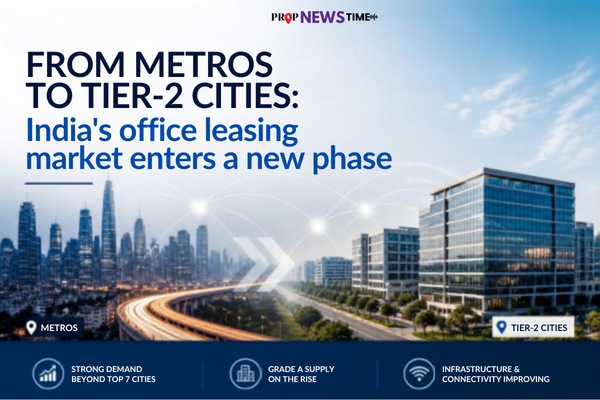
India's office market has traditionally revolved around Bengaluru, Mumbai, Delhi-NCR, Hyderabad, Chennai and Pune. These cities continue to dominate leasing volumes, supported by established business ecosystems, large talent pools and deep Grade A office stock. However, the next phase of office expansion is beginning to look different.
Tier-2 cities are moving from being secondary locations to becoming strategic extensions of corporate portfolios. JLL has identified Ahmedabad, Kolkata, Jaipur, Coimbatore, Mysuru and Kochi among the emerging locations gaining traction for GCC activity, while CBRE has pointed to improving connectivity, talent availability, cost advantages and retention as factors supporting the rise of Tier-2 markets.
The shift does not mean that smaller cities have overtaken metros in total leasing. Instead, their growing importance lies in the pace of expansion and the changing reasons behind corporate location decisions. Here are nine factors explaining why Tier-2 cities are becoming increasingly important to India's office market.
Lower operating costs are creating a strong advantage
Cost remains one of the most straightforward reasons for companies to look beyond the largest office markets. Office rentals, employee costs and other operating expenses can be comparatively lower in Tier-2 cities, allowing companies to establish operations without taking on the cost structure associated with major metropolitan locations.
JLL estimates that Tier-2 cities can offer 10-35% cost savings, alongside access to relatively untapped talent pools. This combination is particularly relevant for companies looking to scale operations while maintaining cost discipline.For occupiers, the calculation is therefore shifting from simply asking where the largest talent pool exists to asking where the right talent can be accessed at a sustainable cost.
GCCs are opening a new chapter for smaller cities
Global Capability Centres are among the strongest forces behind India's office demand, and their expansion is gradually moving beyond the traditional metropolitan hubs.
According to JLL's India GCC Guide 2026, Tier-2 cities are emerging as the next frontier for GCC set-ups. Cities such as Ahmedabad, Jaipur, Coimbatore, Mysuru and Kochi are developing more sophisticated business ecosystems and offering companies alternatives to the established GCC markets.The trend is also reflected in broader market research. CBRE notes that Tier-II locations are increasingly being used as extensions of enterprise footprints, supported by connectivity, talent availability, cost advantages and higher retention rates.
This matters because GCCs typically require quality office infrastructure and long-term operating ecosystems. Their arrival can therefore accelerate the development of Grade A commercial real estate in smaller cities.
Talent is becoming more distributed
The availability of skilled workers is no longer restricted to India's biggest cities. Universities, engineering institutions, management schools and established industries have created talent pools across several smaller urban centres.The employment trend is reinforcing this shift. An August 2026 analysis by Apna found that job postings in Tier-2 cities increased 16.1% in Q1 FY27, compared with 7.3% growth in Tier-1 cities. Tier-3 cities recorded even faster growth of 30.6%.
For companies, this creates an opportunity to build operations closer to emerging talent markets rather than concentrating every function in a handful of metros. It also gives employees access to corporate opportunities without necessarily relocating to the country's most expensive urban centres.
Infrastructure is reducing the gap with metros
One of the biggest barriers to corporate expansion into smaller cities was historically infrastructure. That gap is gradually narrowing.Improved highways, airports, metro and regional transport networks, digital connectivity and better urban infrastructure are making several Tier-2 markets more accessible. For office occupiers, connectivity is particularly important because it influences employee commuting, client access and the ability to attract talent from surrounding regions.
Colliers expects decentralised work models to support real estate requirements in Tier-II and Tier-III cities, with ongoing infrastructure development strengthening the trend. Infrastructure is therefore doing more than improving mobility. It is expanding the geographical boundaries within which companies can realistically operate.
Flexible workspaces are becoming the entry point
Flexible workspace operators are playing an important role in introducing corporate occupiers to smaller markets. Instead of committing immediately to large, long-term leases, companies can enter a Tier-2 city through managed or flexible offices and scale their footprint according to demand.
Colliers expects several operators to expand into cities including Ahmedabad, Bhubaneswar, Coimbatore, Chandigarh, Indore, Jaipur, Kochi, Lucknow and Thiruvananthapuram. Average seat rentals in these markets can be 30-35% lower than in Tier-I cities, while Tier-II locations could account for 10-15% of India's flex stock by 2027. This hub-and-spoke model gives businesses greater flexibility. A company can maintain a large headquarters in a metro while creating smaller teams or satellite offices in emerging cities.
Companies are moving from one-city concentration to distributed portfolios
The traditional model of putting most corporate functions in one major city is gradually being complemented by a distributed approach. A business may retain its headquarters in Bengaluru, Mumbai or Delhi-NCR while placing technology, support, research, customer operations or other functions in lower-cost markets. Such a strategy can help companies access different talent pools and reduce concentration risk.
CBRE's latest office outlook notes that occupiers are expected to selectively pursue expansion into Tier-II cities as they look for new business opportunities and long-term scalability. The result is a more interconnected office market in which Tier-2 cities are not necessarily competing directly with metros. Instead, they can complement the established hubs as part of a wider corporate real estate strategy.
The office ecosystem is becoming more sophisticated
For Tier-2 cities to attract large occupiers, lower costs alone are not enough. Companies increasingly require Grade A buildings, reliable infrastructure, sustainability credentials, amenities, flexible workspace options and professional property management. This is where the supply side is beginning to change. Developers and workspace operators are increasingly identifying smaller cities as viable commercial markets rather than treating them purely as speculative opportunities.
The broader Indian office market is also seeing a strong flight to quality. CBRE reported that green-certified assets accounted for 76% of office completions in Q2 2026, while 73% of leasing activity was concentrated in green-certified buildings. As these standards become more common nationally, Tier-2 cities will need to offer comparable quality to capture larger corporate requirements.
Smaller cities can create new office-led growth corridors
Office expansion rarely affects only office buildings. New employment centres can stimulate demand for housing, hotels, restaurants, retail, transport and other urban services. This creates the possibility of office-led growth corridors emerging around Tier-2 cities. A new business park can become an anchor for surrounding commercial and residential development, particularly where road, airport or other infrastructure improvements are taking place simultaneously.
The pattern is already visible in other real estate sectors. CBRE has highlighted how improved connectivity, e-commerce growth and consumption demand are making Tier-II cities increasingly attractive for industrial and logistics development. Office demand could create a similar multiplier effect, allowing smaller cities to develop broader commercial ecosystems over time.
The next advantage could be strategic, not just financial
The strongest case for Tier-2 cities may ultimately go beyond cheaper real estate. For global companies and domestic enterprises, diversification of talent, operating locations and business functions can provide greater resilience. A distributed office network can help companies reach new employee pools, improve retention and create alternative locations for expansion.
The trend is therefore becoming less about metros versus Tier-2 cities and more about how the two can work together. The largest cities will continue to house major corporate headquarters, GCC clusters and large-scale office campuses, while emerging cities could absorb incremental functions and new business operations. As Colliers has noted, the combination of cost arbitrage, skilled talent and infrastructure development is expected to support further office requirements in Tier-II and Tier-III markets.
State policies are making smaller cities more business-friendly
State governments are increasingly using incentives, industrial policies, IT and GCC policies, infrastructure investments and ease-of-doing-business measures to attract companies beyond the established metropolitan markets. These interventions can reduce the initial barriers for businesses considering a new location and, in turn, encourage developers to bring more Grade A office supply to emerging markets.
For companies, policy support can influence everything from land and infrastructure availability to investment incentives and talent development. As more states compete to attract technology, services and GCC operations, Tier-2 cities could benefit from a stronger pipeline of corporate occupiers. This could create a reinforcing cycle: policy support attracts businesses, businesses create office demand, and office demand encourages further infrastructure and real estate investment.
Tier-2 cities are not yet replacing India's metros as the country's largest office markets, but they are becoming an increasingly important part of the next growth story. Their appeal is being built on a combination of lower operating costs, expanding talent pools, improving infrastructure, flexible workspace availability and growing GCC interest.
The bigger shift is in the way companies are thinking about office portfolios. Instead of concentrating every operation in a few major cities, businesses can increasingly build distributed networks that combine metropolitan headquarters with specialised teams and satellite operations in emerging markets.
If this trend continues, India's office market could become more geographically diversified over the next few years. The metros are likely to remain the anchors, but Tier-2 cities could increasingly become the next layer of India's corporate real estate growth.
Sources- JLL India, CBRE India, Colliers India, Knight Frank India, Apna, Moneycontrol, Times of India and other industry reports

17th Nov, 2026

17th Nov, 2026


17th Nov, 2026




17th Nov, 2026


17th Nov, 2026
Advertisement








 Facebook
 Whatsapp

