Advertisement






The Gulf conflict has disrupted global supply chains, pushed...
REITs have changed the way commercial real estate is owned a...
What really powers the cloud? Behind every Google search, A...
What really powers the cloud? Behind every Google search, A...
Luxury real estate is one of the most talked-about segments ...
India's retail real estate market is moving beyond the conventional shopping mall, with developers and retailers experimenting with high streets, mixed-use developments, transit-linked destinations, experiential formats and technology-enabled stores. Retail leasing reached a record 8.9 million sq ft across major Indian cities in 2025, according to CBRE, while demand in H1 2026 remained resilient at about 3.9 million sq ft. The shift is being supported by changing consumer behaviour, D2C brands moving offline, premiumisation and demand for spaces that combine shopping, dining, entertainment and lifestyle.
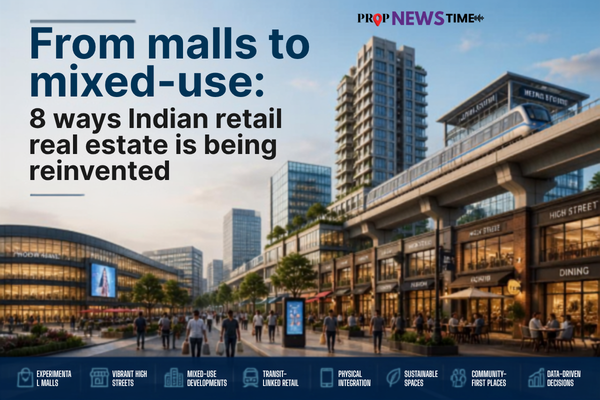
For years, the shopping mall was the clearest symbol of organised retail in India's cities. Large enclosed centres brought together fashion, food, entertainment and services under one roof, creating destinations that could attract consumers from across an urban region. That model is not disappearing, but it is being joined by a much wider range of formats. High streets are becoming more organised, mixed-use projects are bringing retail closer to homes and workplaces, airports and transit hubs are emerging as retail destinations, while retailers are investing in stores designed around experiences rather than transactions.
The scale of demand provides context. India's retail leasing touched a record 8.9 million sq ft in 2025, while H1 2026 absorption reached around 3.9 million sq ft, a 20% increase over H1 2025, according to CBRE. Here are eight ways India's retail real estate landscape is being reinvented.
1. Malls are becoming destinations, not just shopping centres
The modern mall is increasingly being designed as a destination where consumers can spend several hours rather than simply visit a few stores. Food and beverage, entertainment, leisure and lifestyle concepts are becoming more important components of mall planning. CBRE's 2025 data showed F&B accounted for around 12% of retail leasing, while entertainment zones are increasingly incorporating technologies such as virtual reality and gamification.
This is changing the role of the mall within the urban landscape. Instead of competing solely on the number of brands available, newer projects are competing on the overall experience they provide. JLL's 2026 retail outlook similarly points to growing demand for superior shopping malls that combine entertainment, F&B and lifestyle offerings.
2. High streets are becoming more organised and premium
High streets are no longer simply the traditional alternative to malls. They are developing into structured retail destinations, particularly in locations with strong pedestrian movement, affluent catchments and good connectivity. JLL reported that high streets captured 48% of retail leasing transactions in Q1 2026, compared with 40% for shopping malls. The shift was partly driven by limited availability of new institutional-grade mall space, but it also reflects retailers' willingness to use multiple formats to expand their presence.
CBRE's 2026 outlook describes high streets as increasingly sophisticated, 24/7 environments that can function as physical brand showcases while offering retailers comparatively leaner operating models. As a result, established high streets are being upgraded through better public spaces, façade improvements, organised parking, pedestrian infrastructure and curated tenant mixes.
3. Mixed-use developments are bringing retail closer to everyday life
Retail is increasingly being integrated with residential, commercial and hospitality components instead of being developed as a standalone destination. The logic is straightforward: people already living or working within a mixed-use development create a built-in consumer base. Offices can support weekday retail and F&B demand, residences can provide evening and weekend footfall, while hotels and entertainment can bring additional visitors.
CBRE has specifically identified mixed-use developments and support retail in business parks as formats expected to expand as retailers seek greater market penetration. This model also changes the scale of retail. Instead of every consumer travelling to a large regional mall, smaller retail clusters can become part of the neighbourhoods where people live, work and spend their leisure time.
4. Retail is moving towards transit and infrastructure-led locations
Airports, metro stations, transport hubs and major highway corridors are becoming part of India's expanding retail geography. The attraction is the same one that has historically made prime high streets valuable: movement of people. Transit locations can capture consumption from commuters and travellers who may not make a dedicated shopping trip.
CBRE's 2026 retail outlook highlights transit-oriented nodes, highway transit hubs and airports as emerging retail opportunities. Airport retail, in particular, is developing into a specialised premium segment where convenience, brand visibility and captive footfall intersect. This could create new retail corridors around infrastructure projects as India's transport network expands.
5. D2C brands are taking their online businesses offline
The rise of direct-to-consumer brands is changing the tenant mix of Indian retail spaces. Brands that initially built their customer base through websites and social media are increasingly opening physical stores to improve brand visibility, allow consumers to experience products and strengthen customer relationships. CBRE found that D2C brands accounted for approximately 27% of total retail leasing in 2025.
The trend continued into 2026. D2C players accounted for about 28% of retail absorption in H1 2026, according to CBRE, making them one of the notable demand drivers in the market. For real estate developers, this introduces a different kind of occupier. These brands may require smaller, distinctive spaces, experience-led layouts and locations that provide strong visibility rather than simply large floor plates.
6. Stores are being designed around experience and technology
The physical store is increasingly becoming an extension of a brand's digital identity. CBRE noted that retailers are experimenting with experiential flagship stores, kiosks and Gen Z-focused formats to increase customer visits, dwell time and engagement. Technology is also entering the retail experience through virtual try-ons, generative AI-powered styling, social-sharing tools and technology-enabled inventory management.
The implication for real estate is significant. A store is no longer simply a place to display and sell products. It can function as a showroom, community space, service centre, content studio or brand experience. This is pushing developers to think about retail spaces that can accommodate changing layouts, digital installations and more interactive customer experiences.
7. Retail is becoming more specialised by consumer and location
The new retail landscape is also becoming more segmented. Fashion and apparel remain the largest demand driver, but the category itself is becoming more diverse, ranging from streetwear and athleisure to luxury, ethnic wear, sustainable labels and youth-focused brands.
In 2025, fashion and apparel accounted for about 48% of India's retail leasing, while jewellery represented around 8% and F&B about 12%, according to CBRE. In H1 2026, fashion and apparel remained the leading category with roughly 40% of absorption, followed by F&B at 14% and entertainment at 9%. This diversification is influencing where brands choose to locate. A luxury retailer may prioritise premium malls or high streets, while a family entertainment concept may favour a mixed-use development with a large catchment. Retail real estate is therefore becoming increasingly format- and consumer-specific.
8. The next retail wave could be built around convergence
The biggest change may be that there is no longer one dominant format for India's retail future. Malls, high streets, mixed-use developments, business parks, transit hubs and neighbourhood retail can all serve different consumer needs. CBRE expects more than 50-55% of new retail supply through 2028 to comprise destination malls larger than 800,000 sq ft, while also pointing towards the expansion of high streets, mixed-use projects and transit-linked formats.
JLL estimates that around 46.1 million sq ft of new retail supply is expected across India's top seven cities between 2026 and 2030, providing room for both established and emerging formats to expand.
The future of retail real estate may therefore not be about replacing malls with mixed-use developments or high streets. Instead, India's retail ecosystem is becoming more layered, with different formats operating alongside one another and responding to different patterns of consumption.
India's retail real estate story is moving from a simple expansion of shopping space towards a more complex evolution of where, why and how consumers spend time. Malls are becoming experience-led destinations, high streets are becoming more organised, mixed-use projects are integrating retail into everyday urban life, and transit infrastructure is opening new locations for consumption. At the same time, D2C brands are bringing online-first businesses into physical spaces, while technology and experiential formats are changing what a retail store is expected to do.
The result is not the end of the mall. It is the emergence of a broader retail ecosystem in which malls, high streets, mixed-use developments, neighbourhood centres and transit-linked destinations each play a role. As India's consumption base expands, the next generation of retail real estate could be defined less by the size of a shopping centre and more by its ability to create a reason for people to be there.
Sources- CBRE India, JLL India, Knight Frank India, Economic Times, Business Standard, Hindustan Times and other industry reports

17th Nov, 2026

17th Nov, 2026


17th Nov, 2026




17th Nov, 2026


17th Nov, 2026
Advertisement








 Facebook
 Whatsapp

