Advertisement






The Gulf conflict has disrupted global supply chains, pushed...
REITs have changed the way commercial real estate is owned a...
What really powers the cloud? Behind every Google search, A...
What really powers the cloud? Behind every Google search, A...
Luxury real estate is one of the most talked-about segments ...
India's changing lifestyles are influencing not just what people buy, but also the kinds of spaces they want to live, work and spend time in. Rising urbanisation, smaller households, hybrid work, experience-led consumption and growing demand for convenience are pushing developers to rethink conventional residential and commercial formats. From managed living and mixed-use developments to senior housing, co-living and amenity-rich communities, real estate is increasingly being designed around evolving patterns of everyday life. The result is a market where flexibility, convenience, community and access to services are becoming increasingly important alongside location and physical space.
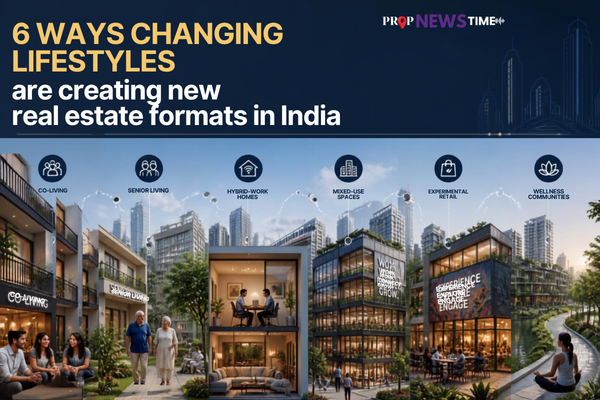
India's real estate market has traditionally been organised around familiar categories: apartments for families, offices for employees, malls for shopping and standalone commercial buildings for businesses. But the way Indians live and work is changing, and those changes are beginning to show up in the built environment.
Urban households are becoming more diverse, work patterns are becoming more flexible and consumers are placing greater value on convenience, experiences and access to services. Younger professionals are increasingly comfortable with shared and managed living, while older households are creating demand for housing formats designed around healthcare, accessibility and community. At the same time, hybrid work is changing the relationship between homes and workplaces.
These shifts are encouraging developers and operators to experiment with formats that combine multiple uses or provide services beyond the traditional property offering. Here are six ways changing lifestyles are creating new real estate formats across India.
1. Co-living is reshaping housing for mobile professionals
The growth of India's young, mobile workforce is creating demand for housing that offers flexibility without requiring residents to manage an entire household independently. Co-living developments typically combine private bedrooms or living spaces with shared kitchens, lounges, work areas, housekeeping and other services. The format is particularly relevant to students, young professionals and people relocating to cities for work.
The demand is linked closely to India's urbanisation and workforce mobility. A 2025 report by Colliers estimated India's co-living market could expand significantly as more young professionals move between cities and seek flexible rental arrangements.
For developers, the format changes the economics of residential real estate. Instead of selling individual homes, operators can manage larger properties as service-led accommodation, creating a recurring-revenue model around rental housing.
2. Senior living is moving from niche housing to a recognised asset class
India's ageing population is creating demand for residential environments designed around the needs of older adults rather than simply adapting conventional housing. Senior living communities can combine residential units with housekeeping, dining, recreation, security, wellness services and access to healthcare. The format is gaining attention as life expectancy rises and families become more geographically dispersed.
A JLL India report noted that India's senior living market remains relatively underpenetrated compared with several developed markets, despite the country's ageing population and increasing demand for organised senior-care solutions.
The emergence of this segment is also changing the definition of residential amenities. Accessibility, medical support, community spaces and on-site services can become as important as conventional features such as gyms and swimming pools.
3. Hybrid work is creating homes that double as workplaces
The rise of hybrid and flexible working has changed the role of the home. For many professionals, a residence is no longer only a place to return to after work; it can also function as a workspace for part of the week. This is influencing both homebuyer preferences and project design. Developers are increasingly incorporating study areas, flexible rooms, work lounges, business centres and high-speed connectivity into residential developments.
The broader office market is evolving alongside this trend. CBRE has observed that companies are increasingly adopting flexible workplace strategies while maintaining quality office environments, creating demand for a combination of traditional offices, flexible workspaces and satellite locations.
Residential projects that acknowledge this shift can therefore become extensions of the workplace, particularly in cities where long commutes make working closer to home attractive.
4. Mixed-use developments are bringing more of daily life into one place
The growing value placed on convenience is strengthening the case for mixed-use developments that combine residential, retail, office, hospitality and leisure uses. Instead of requiring residents to travel across the city for everyday needs, mixed-use developments can place shops, restaurants, workplaces, entertainment and services within the same development or neighbourhood.
The trend is particularly relevant in large Indian cities where commuting times are high and access to quality public infrastructure varies significantly between neighbourhoods. Developers are increasingly looking at integrated communities that can generate activity throughout the day rather than relying on a single use.
This also creates a more diversified real estate model. Residential users can support retail, offices can generate weekday footfall and hospitality can bring additional visitors, allowing different asset classes to reinforce one another.
5. Experience-led spaces are changing retail and commercial real estate
Consumers are increasingly seeking experiences alongside products, and this is changing the design of commercial spaces. Shopping centres are adding restaurants, entertainment, wellness, events and recreational concepts, while retailers are investing in stores that function as brand experiences rather than simple points of sale. CBRE recorded a record 8.9 million sq ft of retail leasing across India's major cities in 2025, with F&B and entertainment among the categories contributing to demand.
This shift is influencing the wider commercial property market. Offices are incorporating hospitality-style amenities and social spaces, while mixed-use developments are increasingly planned around dining, entertainment and community activities. The underlying change is simple: people are spending more value on how a space makes them feel and what they can do there, not just on the transaction taking place inside it.
6. Wellness and community are becoming part of the property proposition
Health, wellness and social connection are increasingly influencing residential and commercial design. Developers are responding with features such as landscaped open spaces, walking tracks, fitness facilities, sports areas, meditation zones, community rooms and outdoor gathering spaces.
The change is particularly visible in premium residential developments, where amenities have evolved from basic recreational facilities into broader lifestyle offerings. Similar ideas are appearing in workplaces, hotels and mixed-use projects.
The demand for such spaces reflects a broader lifestyle shift: urban consumers are increasingly looking for environments that support work, recreation, social interaction and personal wellbeing within or close to their everyday surroundings. For developers, this means amenities are no longer simply add-ons used to differentiate a project. They are increasingly becoming part of the core real estate proposition.
Changing lifestyles are gradually pushing India's real estate market beyond conventional categories. Co-living is responding to mobile professionals, senior living is addressing the needs of an ageing population, and hybrid work is changing how homes and offices are designed. At the same time, mixed-use developments are bringing multiple daily needs closer together, while retail and commercial spaces are becoming more experience- and community-led.
The next generation of real estate formats is therefore likely to be defined less by a single building type and more by the services, experiences and flexibility built around the space. As Indian households, workplaces and consumption patterns continue to evolve, developers that understand these changes could have an advantage in designing properties that fit the way people actually live.
Sources- JLL India, CBRE India, Colliers India, Knight Frank India, Anarock, Economic Times, Times of India and other industry reports

17th Nov, 2026

17th Nov, 2026


17th Nov, 2026




17th Nov, 2026


17th Nov, 2026
Advertisement








 Facebook
 Whatsapp

