Advertisement






The Reserve Bank of India (RBI) maintained the repo rate at 5.5% earlier this week, a decision seen as a stabilising measure for the housing sector at a crucial time when festive-season demand is at its peak. With GDP growth revised upwards to 6.8% for FY26, experts suggested that the status quo on borrowing costs, combined with the rationalisation of GST and recent government measures, would sustain buyer confidence. Despite ongoing global trade tensions and tariff-related uncertainties, industry leaders believed the move would encourage both homebuyers and developers to plan with greater certainty.
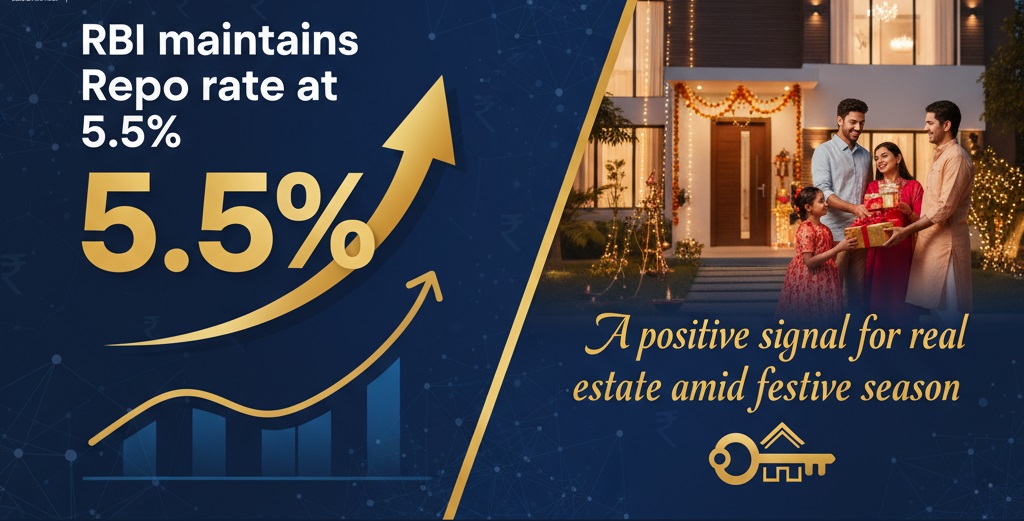
The Reserve Bank of India kept the repo rate unchanged at 5.5% earlier this week, offering stability to the housing market at the onset of the festive season. The central bank also revised its GDP forecast for FY26 to 6.8%, underscoring optimism about India's economic trajectory. Analysts suggested that with borrowing costs held steady, the real estate sector stood to benefit from a stronger homebuying sentiment, particularly as festive periods traditionally generate the highest sales momentum. Advertisement


Industry representatives noted that stability in policy rates, coupled with GST rationalisation, would boost affordability and offset inflationary risks stemming from global trade disruptions. Prashant Sharma, President of NAREDCO Maharashtra, observed that the unchanged repo rate was a welcome step during peak buying season and remarked that the rationalisation of GST would improve consumer confidence, even as additional US tariffs posed inflationary concerns.
Kaushal Agarwal, Chairman of The Guardians Real Estate Advisory, highlighted that the status quo on rates for the second consecutive time created predictability in borrowing costs, which was vital for buyers at this time of year. He pointed out that while global pressures persisted, India's robust domestic fundamentals and upward GDP outlook would keep the housing market active.
Similar sentiments were shared by Vikas Jain, CEO of Labdhi Lifestyle and President of NAREDCO Maharashtra NextGen, who stated that unchanged rates aligned with market expectations and would sustain demand. He emphasised that developers could now focus on extending GST-related benefits to customers, strengthening overall consumption.
Shraddha Kedia-Agarwal, Director of Transcon Developers, noted that the move reassured buyers during a critical sales period, adding that GST rationalisation was helping address cost challenges. She underlined that the upward GDP projection reflected the strength of the economy, which would convert aspirational interest into purchases.
Other industry leaders also echoed the importance of this stability. Dhruman Shah, Promoter of Ariha Group, suggested that stable borrowing costs combined with GST adjustments would accelerate sales conversions and enhance affordability. Similarly, Aniruddha Mehta, Chairman and Managing Director of Umiya Buildcon, described the decision as a balanced approach that created the right conditions for long-term investments, especially with strong traction in mid-income and premium housing.
Several developers stressed that predictable interest rates were vital for project planning. Pradeep Aggarwal, Chairman of Signature Global, and Jash Panchamia, Executive Director of Jaypee Infratech, both suggested that stability would boost consumer confidence and liquidity across sectors. Ashok Kapur of Krishna Group added that while a cut might have provided an additional push, the sector was already benefiting from earlier reductions and supportive lending rates from banks.
Vikas Bhasin, Managing Director of Saya Group, recalled that the government's policy measures throughout the year, including tax incentives in the Union Budget and GST rationalisation, had further strengthened household savings and boosted buyer sentiment. Raoul Kapoor, Co-CEO of Andromeda Sales and Distribution, remarked that global trade tensions limited the scope for rate cuts, yet the RBI's cautious stance ensured domestic stability.
Adding perspective on affordability, industry experts explained that even small shifts in lending rates significantly impacted home loan EMIs. For instance, a 100-bps cut could reduce the monthly instalment on a INR 1 lakh loan with a 20-year tenure by INR 65, which translated into savings of over INR 1,600 and INR 3,200 for loans of INR 25 lakh and INR 50 lakh respectively.
Ankur Jalan, CEO of Golden Growth Fund, stated that in view of the global trade climate, maintaining the status quo while passing on GST benefits would sustain demand. He suggested that such measures could shield India?s growth momentum from external shocks.
However, not all industry voices were fully satisfied with the decision. Vijay Harsh Jha, Founder and CEO of VS Realtors, remarked that with housing sales showing considerable decline until the third quarter, a cut in repo rates along with GST rationalisation would have provided an additional boost to festive-season sales. Similarly, Umesh Gowda H.A, Chairman of Sanjeevini Group, noted that while the RBI's approach was understandable in light of trade tensions, a rate cut would have significantly accelerated demand.
Market data reflected a mixed scenario. According to PropEquity, housing sales across India's top nine cities fell by 4% in the July-September quarter, settling just above 1 lakh units at 1,00,370. New launches stood at 92,229 units, representing a 10% quarter-on-quarter decline, although analysts maintained that festive momentum would still push absorption rates higher in the coming months.
The RBI's decision to maintain the repo rate at 5.5% has largely been welcomed by the real estate sector as a steadying force during the festive season. Developers and analysts alike highlighted that stability in borrowing costs, together with GST rationalisation and an upgraded GDP outlook, would sustain buyer confidence. Yet, some industry voices cautioned that slowing sales and flat launches indicated the need for stronger measures, including a potential rate cut, to fully stimulate demand. Overall, the sector enters the festive quarter with cautious optimism, supported by a predictable policy environment.

5th Jun, 2025

25th May, 2023

11th May, 2023

27th Apr, 2023
Advertisement





 Facebook
 Whatsapp