Advertisement






Navi Mumbai has been honoured with entry into the prestigious 'Super Swachh League' under Swachh Survekshan 2024, recognising cities that ranked in the top three at least twice over the past three years. It is the only city from Maharashtra with a population over 10 lakh to receive this recognition. The city also retained its 'Seven Star' garbage-free rating and top-tier 'Water Plus' certification. Navi Mumbai's smart, decentralised waste management system, inclusive workforce, and eco-friendly initiatives have set national benchmarks. The award was accepted by civic leaders and sanitation workers in New Delhi, marking a proud moment for the city and state.
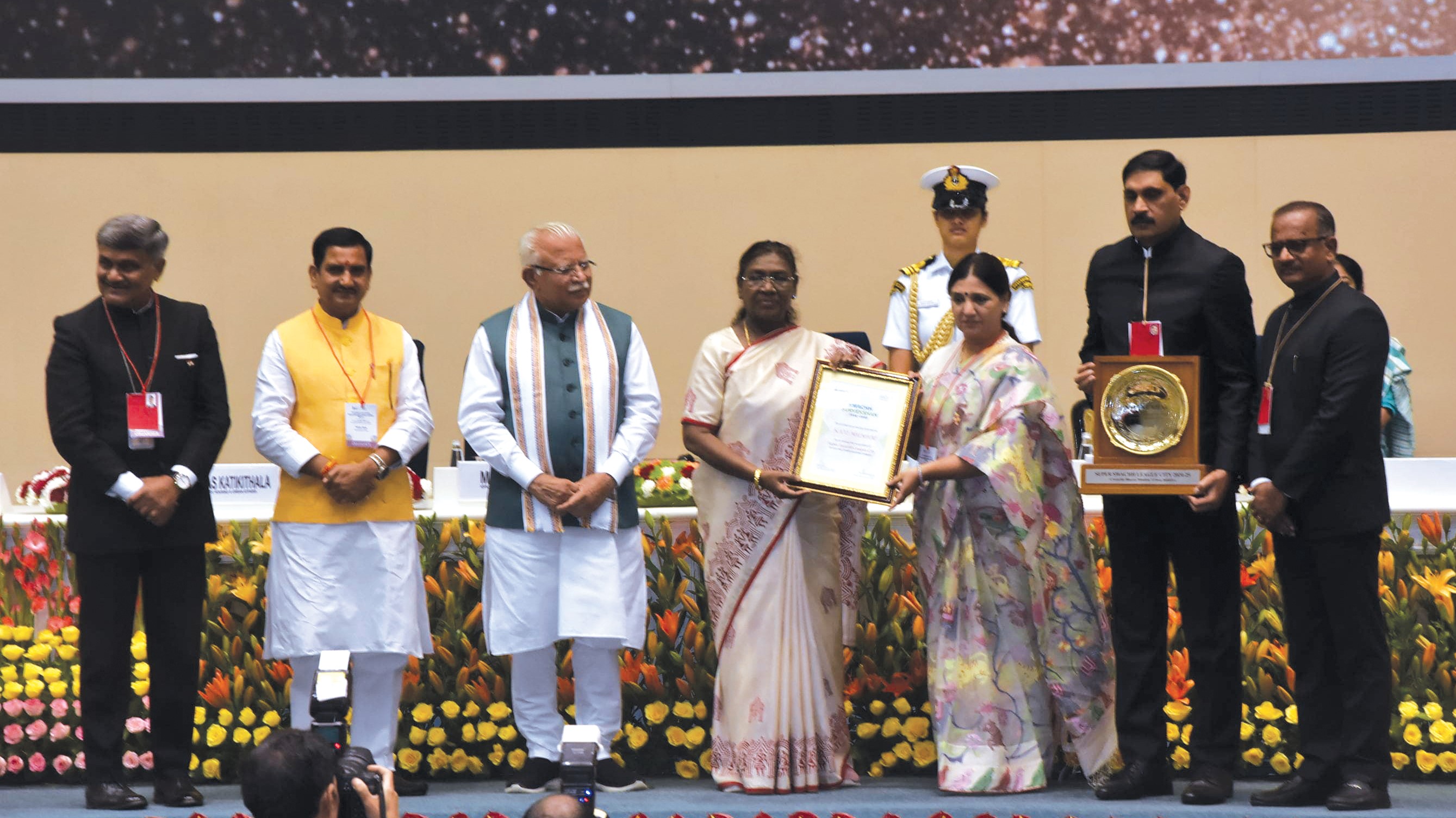
Navi Mumbai has secured a position in the prestigious 'Super Swachh League' under the Swachh Survekshan 2024, a new category introduced by the Ministry of Housing and Urban Affairs to honour consistently high-performing cities. This league comprises cities that have ranked in the top three at least twice over the past three years. Among cities with populations exceeding 10 lakh, Navi Mumbai emerged as the only one from Maharashtra to be recognised in this elite league, elevating its rank above the standard cleanliness index. Advertisement


The city retained its 'Seven Star' rating in the garbage-free city assessment and continued to hold the highest 'Water Plus' certification under the ODF+ (Open Defecation Free) category, reaffirming its stronghold on sustainable sanitation. The accolades were presented at Vigyan Bhavan, New Delhi, by the President of India, in the presence of key dignitaries including the Union Minister for Housing and Urban Affairs, the Minister of State, and senior officials. Representing Maharashtra, Minister of State for Urban Development Madhuri Misal and Municipal Commissioner Dr Kailas Shinde accepted the honour, accompanied by city engineer Shirish Aradwad.
Dr Kailas Shinde, while acknowledging the city's inclusion in the Super Swachh League, noted that it was a moment of immense pride for every Navi Mumbaikar and expressed that this recognition also elevated the standing of Maharashtra at the national level.
The award ceremony also witnessed the participation of four sanitation workers, representing the city's front-line waste management team. Present among them were Deputy Commissioner Dr Ajay Gadade and Smita Kale from the Solid Waste Management Department, Additional City Engineer Arvind Shinde, and Transport Manager Yogesh Kaduskar, along with two 'Swachhata Mitras' and two 'Swachhata Sakhis'-symbolising the city's inclusive approach.
Commissioner Dr Kailas Shinde attributed this achievement to the continuous support of Maharashtra's top political leadership including the Chief Minister, Deputy Chief Ministers, and local MPs and MLAs. He also credited brand ambassadors Padma Shri awardees Shankar Mahadevan and Achyut Palav, as well as civic staff, citizen volunteers, educational institutions, transgender communities, NSS, NCC cadets, and local entrepreneurs and businesses.
Navi Mumbai's waste management system is powered by smart and decentralised practices. The city introduced source-level segregation into wet, dry, and hazardous waste streams, with dedicated collection of sanitary waste commencing this year. An advanced fleet of 206 vehicles, including electric trucks and mini tippers, supports the collection and transportation system, tracked via GPS and RFID technology. Additionally, 7 mechanical sweepers, 5 of which are eco-friendly, and 10 UNDP-backed electric vehicles operated by women 'Parisar Sakhis' enhance street-level cleanliness.
Out of 750 TPD of total waste generated, 350 TPD of wet waste is processed into compost, while 400 TPD of dry waste is sorted and recycled. Plastics are used for RDF in cement kilns or converted into granules for road coating. Additionally, a 10 TPD facility processes coconut waste into fibre for coir products and artefacts.
By leveraging real-time data, decentralised processing, and inclusive employment, Navi Mumbai has successfully institutionalised cleanliness as a civic culture. Its innovations are already setting new benchmarks for other cities aiming to meet both environmental standards and community welfare goals.

5th Jun, 2025

25th May, 2023

11th May, 2023

27th Apr, 2023
Advertisement





 Facebook
 Whatsapp