Advertisement






The Maha Mumbai Metro Operation Corporation Limited (MMMOCL) has implemented a comprehensive monsoon preparedness strategy for Metro Lines 2A and 7 to maintain uninterrupted services and ensure commuter safety throughout the season. Under the leadership of MMRDA Chairman and Deputy CM Shri Eknath Shinde, Chief Minister Shri Devendra Fadnavis, and Metropolitan Commissioner Dr. Sanjay Mukherjee, the initiative includes technical inspections, safety reinforcements, infrastructure upgrades, and real-time monitoring. Field-level execution has also been strengthened with nodal officers, dewatering pumps, traffic management personnel, and a dedicated monsoon control room functioning round-the-clock.
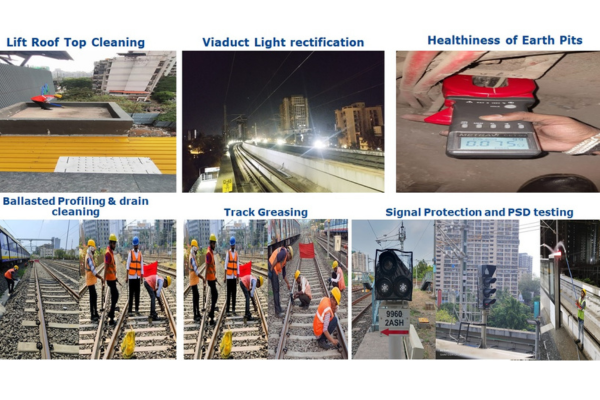
In a proactive move to maintain seamless metro operations during the monsoon, the Maha Mumbai Metro Operation Corporation Limited (MMMOCL) rolled out an extensive preparedness plan for Metro Lines 2A and 7. The initiative, steered under the direction of MMRDA Chairman and Deputy Chief Minister Shri Eknath Shinde, and supported by Maharashtra Chief Minister Shri Devendra Fadnavis, has been implemented under the leadership of Dr. Sanjay Mukherjee, IAS, Metropolitan Commissioner of MMRDA and Chairman of MMMOCL. It reflects the administration's strong focus on commuter convenience and operational resilience during the heavy rains. Advertisement


Among the critical measures taken, wind velocity anemometers have been installed at ten key locations across both lines to enable real-time weather monitoring, allowing swift operational responses. Metro frequency will be increased in flood-prone zones to help manage commuter load effectively and reduce waiting periods.
For enhanced security, each station now features a minimum of 64 high-definition CCTV cameras to ensure continuous surveillance. A specially designated emergency coach remains on standby, available for rapid deployment by the MCGM Disaster Management Team, thus enabling quick mobilisation of essential support if required.
A full technical check of all vital equipment-including diesel generator sets, UPS units, lightning arrestors, earthing systems, and dewatering pumps-has been completed across the 30 stations and Charkop depot. All 34 metro trains have undergone leak-proof waterproofing inspections, ensuring that passengers remain dry and safe inside coaches regardless of rainfall intensity.
Cleaning has been finalised across the 35 km-long viaduct, with attention given to rainwater downtake pipes, roof gutters, saucer drains, sewer lines, and median chambers, helping prevent waterlogging. Additionally, over 759 electrical insulators, along with 25 kV cables connecting three Receiving Substations to their respective feeding points, have been examined. Inspections also included transformer bushings, lightning arrestors, heaters, CTs, PTs, and neutral isolators across 34 switchgear units to uphold electrical integrity.
Reinforcing ground-level readiness, nodal officers have been appointed on a project-wise basis to ensure decentralised efficiency. Dewatering equipment and pothole repair vehicles have been stationed at critical locations, while dedicated traffic wardens are posted around stations to ensure smooth pedestrian and vehicle movement.
Further elevating operational capability, a monsoon control room is actively monitoring the network around the clock, with a direct communication link to the MCGM Disaster Management Cell. Emergency helplines (1800 889 0505 / 0808, and 84529 05434) are functional 24/7, available to address commuter concerns immediately.
The Chief Minister conveyed that the Maharashtra government remained committed to the safety and comfort of metro users, adding that this meticulous monsoon plan ensured reliable service even during heavy downpours. The Deputy Chief Minister remarked that each measure, from inspections to field deployment, underscored the state's promise to maintain uninterrupted services through the season.
Dr. Sanjay Mukherjee stated that the metro was prepared to run at regulated speeds even during incessant rainfall, and that standby trains were ready for immediate deployment in case of emergencies. He emphasised that every possible precaution had been taken to prioritise commuter safety and reliable service.
Ms. Rubal Agarwal, Managing Director of MMMOCL, observed that the team had acted with urgency and precision. She noted that the safety-first approach had driven every aspect of this preparedness from infrastructure checks to on-site execution ensuring that Mumbai's metro remained dependable no matter the weather.
By combining technological readiness, field-level planning, and high-level coordination, the initiative sets a benchmark for urban transport resilience. While the weather may remain unpredictable, the city's metro system now stands better equipped than ever to meet it head-on ensuring that safety, speed, and service never take a backseat, even when the skies open up.

5th Jun, 2025

25th May, 2023

11th May, 2023

27th Apr, 2023
Advertisement





 Facebook
 Whatsapp